FoodPackLab Editorial Team
What Makes Food Packaging Recyclable In Practice In Malaysia?
For Malaysian F&B operators and packaging buyers, what makes packaging recyclable is not the material name or recycling symbol. The complete used package must be accepted, collected, sorted, commercially processed and sold as recovered material through a recovery chain that actually operates where the waste is generated.
For Malaysian F&B operators and packaging buyers, what makes packaging recyclable is not the material name or recycling symbol. The complete used package must be accepted, collected, sorted, commercially processed and sold as recovered material through a recovery chain that actually operates where the waste is generated.
A PET container, paper box or PP cup may have recycling potential. That does not mean it will be recovered after a customer finishes a takeaway meal.
This guide explains how to assess recyclable food packaging in Malaysia by checking material compatibility, package design, contamination, collection and sorting, commercial processing and demand for recovered material.
Key takeaway: Treat recyclability as a route to verify, not a feature printed on a product sheet. If one part of the recovery chain is missing, the practical outcome is likely to be disposal.
At A Glance: Six Factors That Determine Practical Recyclability
For a quick assessment, check whether the complete used package passes all six tests:
- Material compatibility: The main material and every attached component suit the intended recycling process.
- Package design: Size, shape, colour, labels and decoration allow the package to be identified and separated.
- Condition after use: Food, liquid and oil residue remain within the receiving programme’s limits.
- Collection and sorting: A current local route accepts and retains the complete package.
- Commercial processing: An operating facility converts the collected material into usable feedstock.
- End-market demand: Manufacturers regularly buy and use the recovered output.
If any test fails, describe the packaging as technically recyclable only when the evidence supports that narrower claim. Do not present it as recyclable in practice for the location concerned.
Recyclability Depends On A Working Recovery Chain
A package has a realistic recycling route only when every essential step works:
- The customer or outlet empties and separates the package correctly.
- A collection route accepts the used item.
- Workers or sorting equipment identify and retain it.
- A commercial facility processes it into usable feedstock.
- A manufacturer buys and uses the recovered material.
This chain explains what makes packaging recyclable in real operating conditions. A failure at any stage can send an otherwise suitable material to disposal.
Three claims that sound similar have different meanings:
- “Made from a recyclable material” describes the potential of a material.
- “Designed for recycling” describes compatibility with a specified recycling process.
- “Recyclable in practice” requires collection, sorting and recycling to work in practice and at meaningful scale.
A recycling symbol identifies an intention or material category. It does not create a collection route, processing facility or buyer.
A resin code, generic recycling logo or supplier statement is therefore weak evidence on its own. Buyers need to identify the actual route that would receive the finished package after use.
Technical Recyclability Vs Practical Recyclability
The distinction between technical recyclability vs practical recyclability prevents a common procurement mistake.
Technical recyclability means that a material can physically be converted into usable feedstock under suitable conditions. Practical recyclability means that repeatable commercial recovery is available, supported by collection coverage, sorting capability, processing capacity and demand for the output.
For example, a clean, uncoated mono-material container may be technically suitable for recycling. It may still be discarded if local collection excludes it, sorting equipment cannot identify it or no processor buys that stream.
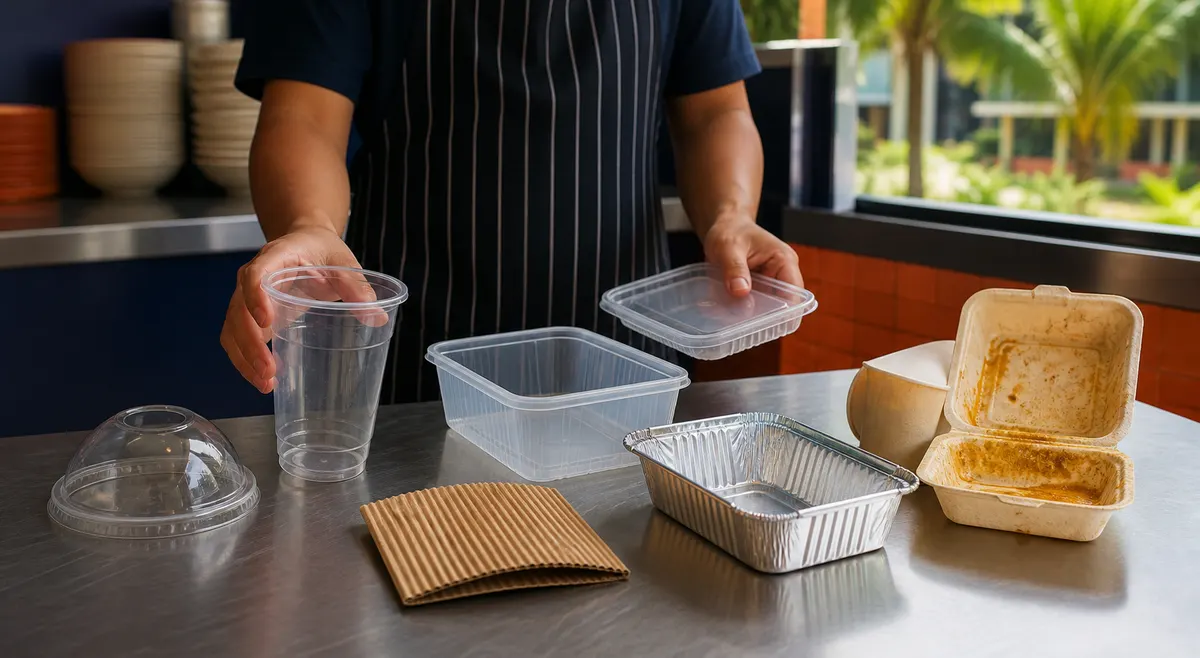
The whole package matters. Lids, liners, labels, sleeves, adhesives, inks and coatings can change how the main container is identified and processed.
One widely used circular-packaging convention counts a whole pack as recyclable when its main recyclable components represent more than 95% of its weight and the remainder does not hinder or contaminate recycling. This is a definition used by one organisation, not Malaysian law, a certification threshold or proof of local acceptance.
Packaging Material Compatibility Covers Every Component
Packaging material compatibility is a whole-system question. Start with the main material, but do not stop there.
Ask the supplier for a component specification or structure declaration that identifies:
- The main container, tray, cup, bottle, box or wrap.
- The lid, cap, closure or seal.
- Any film window, liner or barrier layer.
- Waterproof, oil-resistant or heat-seal coatings.
- Labels, sleeves and adhesives.
- Inks, pigments, metallic decoration and foil.
A paper box with a bonded plastic lining does not behave like plain paper in a pulping process. A PET, HDPE or PP pack can also perform differently when it contains incompatible layers, pigments or labels.
| Component | Material | Function | Separable after use? | Compatible with target stream? | Evidence required |
|---|---|---|---|---|---|
| Main body | Exact resin, fibre, metal or composite | Contains and protects food | Usually the retained component | Confirm with intended processor | Material and weight specification |
| Lid or closure | Exact material and colour | Leak control and resealing | Check likely customer behaviour | Confirm attached or separated route | Component and disposal instructions |
| Coating or liner | Polymer, foil or other barrier | Oil, moisture or oxygen control | Often bonded | Check process-specific effect | Layer weight and finished-pack assessment |
| Label or sleeve | Film, paper, ink and adhesive | Branding and product information | May require removal | Check detection and washing behaviour | Sorting and separation evidence |
Coatings And Barriers In Recyclable Packaging Can Change The Route
Coatings and barriers in recyclable packaging are not automatically disqualifying. They are used for valid functions such as leak resistance, grease resistance, heat sealing, oxygen control and shelf-life protection.
The buying question is whether the target recycling process can separate or tolerate them.
Fibre-based Packaging
Paper and card are generally repulped in water so usable fibres can be recovered. Bonded plastic, foil and other non-fibre layers may reduce fibre yield or leave reject material that must be removed.
External industry guidance has recommended keeping plastic at no more than 5% of card-packaging weight and making it readily separable with minimal water-based adhesive. That is scoped design guidance, not a Malaysian acceptance rule. The intended paper recycler still needs to assess the finished pack.
Plastic Packaging
A barrier layer may soften, melt or separate differently from the main resin during washing, extrusion or filtration. In one PE-film assessment, EVOH above 5% of film weight disrupted extrusion and increased yellowing, haze, gels and bubble breakage.
That finding applies to the tested PE-film system. It should not be treated as a universal threshold for every polymer, pack or recycling process.
Before approving a coated or multilayer pack, ask:
- What is the complete layer structure by weight?
- Does the assessment cover the finished pack or only the base sheet?
- Which recycling process and geography were assessed?
- Do printing, lamination, sealing or added liners change the result?
Recyclable Packaging Design Must Support Identification And Separation
Recyclable packaging design must help sorting equipment and workers recognise the main material. A technically suitable container can be lost if its visible surface suggests the wrong material.
Large labels and full-body sleeves may hide a bottle from optical sorting systems. The label material and its density can also determine whether it separates from the container during washing or flotation.
For PET packaging, an adhesive that releases during the intended wash and remains with the separated label is generally preferable. Residue that remains on PET or redeposits during washing can contaminate or discolour the recovered resin.
Metallic decoration, foil, heavy ink coverage and certain pigments may interfere with detection or lower output quality. Some dark pigments cannot be detected by near-infrared equipment, while detectable dark formulations may still require sorting tests.
An undecorated or lightly decorated mono-material format is often easier to assess. It is a sensible procurement preference when it still meets food protection, branding, tamper evidence and operational needs.
Packaging Collection And Sorting Are Physical Processes
Packaging collection and sorting involve screens, conveyors, optical detectors, air jets, magnets and manual decisions. A bin label alone cannot ensure that an item survives these steps.
Very small components can fall through size-sorting screens. Design guidance for one PET thermoform stream prefers packs larger than 5 cm in at least two directions because smaller items are more likely to be lost.
This is not a universal Malaysian threshold. It illustrates why buyers should ask whether sauce cups, seals, straws, sachets, loose lids and cutlery wrappers are large enough to remain in the intended stream.
Shape matters too. A rigid bottle or tub normally behaves as a three-dimensional object. A flattened or flexible plastic item may behave as a two-dimensional object and be directed towards paper or residual material.
The practical question is simple: is the complete item large and rigid enough to survive the actual sorting process, or does only its material look suitable on paper?
Food Contamination In Packaging Recycling Changes The Outcome
Food contamination in packaging recycling is a quality and operating constraint. Significant food, liquid or oil residue can cause odour, contaminate other materials or make the recovered stream unattractive to a processor.
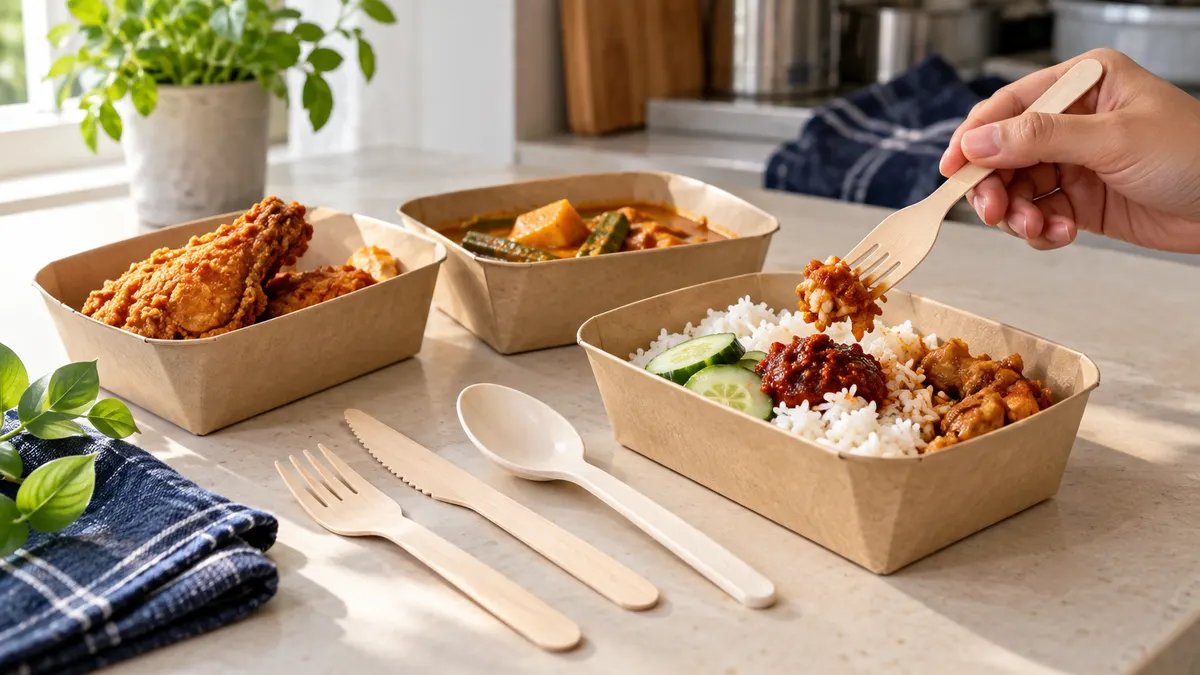
Malaysian F&B formats present different challenges. Curry and soup containers can retain liquid and oily residue. Nasi lemak and fried-food packs may retain grease and food scraps. Drink bottles can be easier to empty, while bakery packs may carry little residue unless they contain cream, icing or grease.
This does not mean every package must be perfectly clean. Preparation requirements vary by collector and processor.
Design packs that are easy to empty, and give simple instructions that match the receiving programme. Removing food and draining liquid may be enough for one route; another may impose different requirements.
Do not recommend washing blindly if it creates an unrealistic burden for customers or outlet staff. Confirm the required condition with the actual recovery partner.
Source separation is equally important. A suitable pack placed in general waste is unlikely to enter a recycling stream at all.
Recycling Packaging In Malaysia Depends On Local Infrastructure
Recycling packaging in Malaysia cannot be assessed through a nationwide yes-or-no material list alone. Acceptance can differ between municipalities, collectors, materials recovery facilities and recyclers.
Packaging recycling infrastructure includes separate collection or take-back routes, sorting facilities, baling capacity, transport, commercial processors and manufacturers willing to use recovered material.
A market study using 2019 data estimated that about 24% of the PET, LDPE, HDPE and PP it assessed was recycled in Malaysia. Approximately 1.07 million tonnes per year of those four plastics was disposed of.
These figures are not a current recycling rate for every plastic package or all Malaysian waste. They are a dated but useful demonstration that resin-level potential does not guarantee recovery.
The same study identified gaps in domestic processing capacity, limited investment, low-quality recovered material, weak local recycled-content demand, reliance on higher-quality imported scrap, limited design-for-recycling standards and insufficient incentives for source separation.
One documented Malaysian facility manually sorted cardboard, paper, HDPE, PET, PP and selected metals before baling the materials for sale. This illustrates how practical acceptance depends on defined streams and buyers. It does not mean every facility accepts the same list.
Recycled Material Market Demand Completes The Chain
Recycled material market demand is not an optional final detail. Collection, sorting, cleaning, processing and transport all cost money.
A recycler needs enough volume of sufficiently consistent material. It also needs a buyer willing to pay for the recovered resin, fibre or metal.
A technically processable stream may not operate commercially when volumes are low, contamination is high or transport costs exceed the material’s value. Stable demand can support investment, while weak demand can limit collection and processing.
Ask three separate questions:
- Can this material be processed?
- Is anyone processing it commercially at useful scale?
- Is the recovered output regularly bought and used in new products?
Export potential is not proof of dependable local recycling. Buyers should look for a current operating route rather than a theoretical destination.
Compare Buying Scenarios, Not Broad Material Labels
| Packaging scenario | Likely advantage | Practical failure point | Evidence to request |
|---|---|---|---|
| Plain mono-material rigid container | Simple material stream and easier identification | Food residue, unsupported colour or no local collection route | Complete resin specification and named recovery route |
| Paper food box with a waterproof lining | Useful resistance to wet or oily food | Liner may reduce repulpability or fibre yield | Finished-pack repulpability assessment and intended processor’s acceptance |
| Clear bottle with a large sleeve | Branding and tamper evidence | Sleeve may hide the bottle or contaminate its stream | Sorting compatibility plus sleeve and adhesive specifications |
| Small sauce sachet or flexible wrapper | Low material weight and strong product protection | Small size, two-dimensional behaviour, multilayer construction or limited collection | Operating collection and commercial processing route for the exact structure |
| Greasy takeaway pack | May retain food and resist leakage during delivery | Post-use residue may make it unsuitable for the intended stream | Receiving-facility requirements and realistic preparation instructions |
Do not sacrifice food safety, leak resistance, heat performance or shelf life merely to simplify a recycling claim. Food-contact and safety conclusions require suitable documentation and qualified human review.
For broader comparisons, buyers can compare packaging materials and formats or examine how a fibre-based option’s recovery route differs in the bagasse food packaging guide.
Buyer Checklist: Verify The Route Before Making A Claim
Use this checklist to test what makes packaging recyclable for a specific outlet, format and recovery route:
- Define the food use: hot, cold, oily, liquid, fried, baked or dry.
- Record the expected hold time and takeaway or delivery conditions.
- Request the complete structure, including coatings, labels, adhesives and inks.
- Identify the intended post-use collection route.
- Confirm which collector, sorter or recovery partner accepts the complete used pack.
- Check its size, shape, colour and label compatibility with that sorting route.
- Identify the commercial processor and the output it produces.
- Ask whether that recovered output has regular market demand.
- Define realistic emptying, separation and cleanliness instructions.
- Trial the instructions at one outlet before a wider rollout.
- Record the geography and effective date of every acceptance statement.
- Have a qualified person review public environmental, certification, compliance and safety wording before publication.
Use An Evidence Hierarchy
- Stronger evidence: Current written acceptance from the actual collector or processor for the finished package.
- Useful but limited evidence: A design-for-recycling test covering the complete structure and a relevant process.
- Weak evidence on its own: Resin codes, generic symbols, supplier brochures or tests of only the base material.
Scope note: A one-outlet trial does not prove national recovery. It is a low-cost operational check before arranging broader, location-specific validation.
Frequently Asked Questions
Does A Recycling Symbol Mean Packaging Will Be Recycled In Malaysia?
No. It may identify a material or indicate technical potential, but local collection, sorting, processing and end-market demand still require verification.
Is Mono-material Packaging Always Recyclable?
No. Size, shape, colour, residue, labels and available infrastructure can still prevent recovery.
Can Coated Paper Food Packaging Be Recycled?
Sometimes. The outcome depends on coating weight, separability, fibre yield and acceptance by the intended paper recycler.
Should Customers Wash Takeaway Packaging Before Recycling It?
Follow the receiving programme’s current instructions. Packaging generally needs to be emptied and free from significant residue, but preparation requirements vary.
Is Compostable Packaging Recyclable With Conventional Plastic Or Paper?
Do not assume so. Compostable packaging needs a verified recovery route and may be incompatible with conventional plastic or paper recycling streams.
The Practical Next Step
Ultimately, what makes packaging recyclable is the complete recovery chain and the condition of the package after use—not only the material from which it was made.
Assess six factors: material compatibility, coatings and components, contamination, size and shape, collection and sorting, and commercial processing plus end-market demand.
Before changing packaging or publishing a recycling claim, compare shortlisted packs against a named local recovery route. Use the checklist, then ask the relevant collector, sorter or recycler to confirm acceptance of the complete package in writing.
Explore more packaging buying guides, or submit a packaging question when a recovery claim needs further scrutiny.