FoodPackLab Editorial Team
How Reusable Packaging Systems Work
A reusable container that never comes back is just expensive single-use packaging. The success of a reuse programme is decided not by the container alone, but by whether the entire return, washing and redistribution loop works reliably.
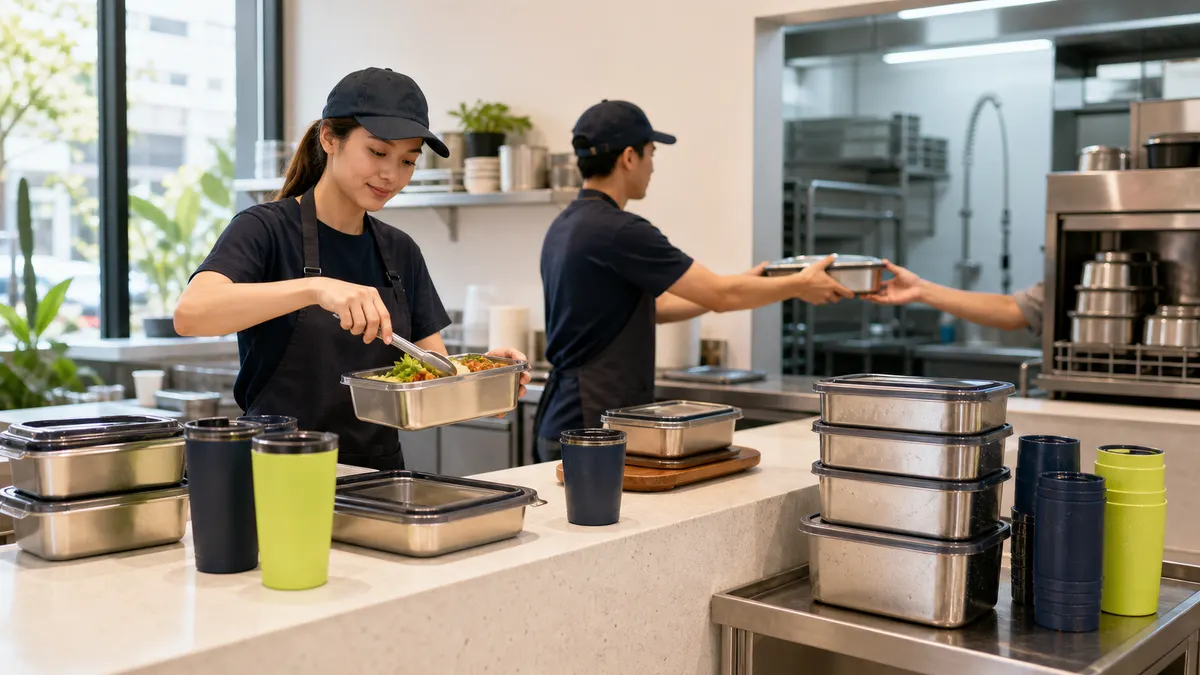
A reusable container that never comes back is just expensive single-use packaging. The success of a reuse programme is decided not by the container alone, but by whether the entire return, washing and redistribution loop works reliably.
If you run a Malaysian cafe, restaurant, cloud kitchen, catering service or food court, the key question is not whether a container can be washed. How reusable packaging systems work depends on whether each container can complete a controlled loop of issue, use, return, washing, inspection and redistribution enough times to justify the added cost and effort.
Key takeaway: A durable container is only one component. Before launching, decide who owns the container pool, how customers return items, who washes them, what causes rejection and how many successful uses the business needs from each package.
A viable reuse programme manages the container through its complete operating loop, including the points where units become lost or unusable.
Reusable Packaging Is A Managed Service, Not Just A Container
Buying a technically reusable cup, bowl or meal box does not create a reuse system. The package must return, remain identifiable, survive washing, pass inspection and arrive back where it is needed.
The seven essential operating parts are:
- Suitable containers and compatible lids
- A customer return incentive
- Convenient collection points
- Reverse movement of used packaging
- Controlled washing and sanitising
- Documented inspection and rejection procedures
- Pool tracking and performance measurement
A reusable container creates value only when it comes back fit for another use.
The simplest way to understand how reusable packaging systems work is to follow one container through the complete loop. Every failed return, rejected wash or logistics error reduces the number of successful uses achieved.
The Complete Reuse Loop, From Filling To Redistribution
- Issue: A clean, inspected container enters stock and is filled.
- Use: The customer receives the food or drink and retains the required parts.
- Return: The customer takes the container to an accepted return point.
- Collect: Used stock is stored separately and moved to a washing location.
- Wash: Units are pre-cleaned, washed, sanitised and dried under a documented process.
- Inspect: Each unit is accepted or rejected against format-specific criteria.
- Redistribute: Accepted stock is packed, stored hygienically and returned to service.
Loss exits: Non-return, mis-sorting, damage, contamination and post-wash rejection remove units from the active pool.
The detailed sequence begins when a clean, inspected package enters outlet stock. The outlet fills it and issues it to a customer. Where the design requires a matched lid and base, the customer must retain both.
After use, the customer returns the package to an accepted collection point. Dirty items are kept away from clean stock, collected on a planned route and moved to the washing location.
Food residue and foreign material are removed before washing. The units are then washed, sanitised, rinsed where required, dried, inspected and protected from recontamination while awaiting redistribution.
A rejected unit leaves the active pool through an appropriate recovery or disposal route. Recording this exit is important because an unrecorded rejection can look like a customer non-return.
Closed Sites Are Simpler Than Public Networks
A caterer serving lunch every weekday in one office has a relatively closed loop. Containers can be collected from a known location, returned in bulk and counted before leaving the building.
A public network is harder. It may involve several merchants, public collection points, different opening hours and customers returning packages far from the original outlet.
For example, a cafe cup returned inside the same office building is easier to manage than a curry container sent through third-party delivery and returned at another merchant. Both are reusable, but their collection cost and loss exposure are very different.
Who Owns And Operates The Container Pool?
There are two common structures. A company-owned pool is purchased and operated by one F&B business. A third-party or shared pool is operated across participating merchants using standard packages and common services.
| Structure | Who manages it | Main advantage | Main burden | Suitable early setting |
|---|---|---|---|---|
| Company-owned pool | One F&B company | Direct control over stock, procedures and customer experience | The business must manage returns, washing, losses and replacement | A cafe group or cloud-kitchen group with repeat customers |
| Shared centralised pool | A pooling or service operator | Common returns, washing and tracking across merchants | Service charges, coordination and reliance on agreed standards | A cluster of nearby cafes or a managed food court |
| Closed-site system | A caterer, venue or site manager | Known users and concentrated collection | Stock must cover service, return and wash turnaround | An office, campus, event venue or recurring catering client |
A company-owned system can measure realised use by comparing successful fills with the number of packages introduced into the pool. The calculation must also account for clean and dirty inventory still in circulation, rejected units and planned retirements.
A third-party operator may own the assets and handle digital tracking, deposits, refunds, collection, washing, inspection, replacement and performance reports. Responsibilities still need to be explicit. Merchants should know who carries the cost when units disappear, arrive damaged or fail the wash inspection.
Shared infrastructure and standard container formats can simplify sorting, washing and redistribution. They also require clear agreements covering service areas, wash turnaround, hygiene responsibilities, data ownership, stock shortages and acceptable loss levels.
For a Malaysia MVP, a single office campus, university area, catering client, managed venue or dense merchant cluster is a more workable starting point than a nationwide consumer-return network. National coverage is a later-stage logistics model, not a sensible launch assumption.
Reusable Packaging Return Systems Depend On Convenient Journeys
Returns are a network-design problem as much as a customer-attitude problem. The central decision question is simple: can the customer return the package during a journey they already make?
Possible return channels include:
- Returning to the original outlet
- Returning to any participating merchant
- Using a collection point at an office, residence or campus
- Handing back containers with the next delivery
- Bulk collection after catering or event service
In one overseas consumer study, 82% of respondents were broadly willing to pay a deposit when a meal container could be returned to any partner restaurant. Willingness fell to 64% when return was limited to the original outlet.
This is useful behavioural evidence, but it does not predict Malaysian return rates. Local performance will depend on the service area, customer group, deposit, transport habits and actual convenience of each return point.
Before launch, test:
- Distance from customer routines to the nearest return point
- Return-point opening hours
- Whether returning requires a queue or staff interaction
- Whether different merchants accept the same package
- Whether lids and bases must be returned together
- How long customers have before losing a deposit or incurring a fee
- Whether returns can use existing catering or delivery routes
Choosing Reusable Packaging Return Incentives
A refundable deposit transfers some of the cost of non-return to the user. Its purpose is to make completing the loop more attractive than keeping or discarding the container.
A deposit is not ordinary sales revenue while the customer remains entitled to a refund. The business needs a clear process for recording the liability, confirming returns and issuing cash or digital refunds without unnecessary friction.
Other incentive structures include:
- A borrowing charge applied after a free return period
- Loyalty credit for each completed return
- A membership or subscription model
- No deposit within a controlled office, campus or catering programme
A deposit that is too low may not outweigh the inconvenience of returning. A deposit that is too high can discourage adoption, increase refund disputes or make the reusable option feel like an expensive purchase.
In the same overseas study, 66% of respondents considered a meal-container deposit below CHF2 too small to make returning worthwhile. This is not a Malaysian price recommendation. It shows why a token amount may fail to change behaviour.
A limited Malaysian pilot called Tapauware launched with four vendors in Subang and Shah Alam. It used purchase or upfront-deposit models, with a reported customer deposit of RM10. One pilot does not establish the correct deposit for another business or prove nationwide viability.
An MVP should test at least two incentive levels where practical. Compare adoption, return rate, return time, refund issues and customer complaints rather than judging the incentive only by initial order volume.
Reusable Packaging Reverse Logistics Creates The Real Operating Burden
Reverse logistics means moving used packaging from customers and collection points back into a controlled washing and redistribution process. This is often where a simple container idea becomes a transport, storage and labour problem.
The operating plan should answer:
- Who empties each collection point?
- How often are used items collected?
- How are leaks, odour and pests controlled?
- Can containers be nested without trapping food residue?
- How are dirty items physically separated from clean stock?
- What happens when rubbish or foreign packaging enters a return bin?
- Who records collected, missing and damaged units?
Decentralised And Centralised Washing Have Different Costs
Decentralised washing can reduce transport distance because each merchant or site washes locally. It also creates more sites that need suitable equipment, training, monitoring, records and clean-storage space.
Centralised washing can improve process consistency, sorting and asset tracking. However, used packaging must be collected and clean stock redistributed, adding handling, route planning and transport emissions.
A 2025 life-cycle and cost model found that both centralised and decentralised takeaway systems reduced greenhouse-gas emissions by 51–63% under the study conditions. They also cost approximately two to 2.5 times as much as single-use packaging, while centralised collection added transport emissions.
Those results are modelled outcomes, not universal performance claims or Malaysian cost estimates. Different container weights, power sources, wash loads, labour rates, vehicle utilisation and return distances can produce different results.
For an early Malaysian pilot, concentrate customers within a dense service area and use existing delivery or catering routes where possible. Dedicated collection trips should be added only after the volume and route economics are understood.
Reusable Packaging Washing And Sanitising Need A Documented Process
Washing is not a single step. A controlled process separates dirty stock, removes food residue, applies suitable cleaning and sanitising stages, dries the package and protects it from recontamination.
- Receive and separate: Keep returned stock away from clean packaging and food-preparation areas as required by the approved site procedure.
- Remove residue: Clear leftover food and foreign material before loading the wash equipment.
- Pre-clean: Soak or pre-clean when required by the documented process and soil type.
- Wash: Use controlled settings suitable for the container material, equipment and food residue.
- Sanitise: Follow the approved process and the relevant equipment and chemical instructions.
- Rinse: Thoroughly remove cleaning compounds from food-contact surfaces where required.
- Dry: Allow complete drying before stacking or packing.
- Protect: Store clean units in a way that prevents recontamination.
Food type changes the washing challenge. Curry and oily fried food may leave grease, staining or aroma. Soup puts more pressure on seals and leak control, while bakery items can leave crumbs and grease in corners or hinges.
Drink containers may retain sugar or dairy residue in lids, valves and threads. A smooth bowl and a multi-part drink lid may therefore require different cleaning, inspection and replacement rules.
A published ANSI/CSA process standard for reusable food packaging treats pre-cleaning, cleaning, sanitising, drying, post-wash inspection, packing, record-keeping and performance monitoring as distinct requirements. This is a useful process reference, but it does not replace a system-specific food-safety assessment.
Malaysia's Food Hygiene Regulations 2009 require relevant containers and appliances to be cleaned and rendered sanitary. They also require cleaning compounds to be thoroughly rinsed from food-contact surfaces.
There is no responsible universal wash temperature, chemical concentration or contact time for every reusable package. These settings depend on the equipment, chemical instructions, container material, soil type and validated operating procedure.
The Reusable Packaging Inspection Process Decides What Returns To Service
Surviving a wash does not automatically make a container suitable for redistribution. Every unit should pass documented acceptance criteria for its specific container and lid format.
A practical post-wash check can cover:
- Residual food, grease, odour or staining beyond the acceptance policy
- Cracks, cuts, warping, melted areas or brittle surfaces
- Deep scratches or damaged food-contact surfaces
- Loose hinges, clips or handles
- Missing, mismatched or poorly fitting lids
- Seal damage that could cause leakage
- Labels, ink, adhesive or other foreign contamination
- Incomplete drying or signs of recontamination
Acceptance and rejection rules should reflect supplier instructions, the validated wash process and applicable food-safety requirements. A scratched base, damaged seal and missing lid are different problems and may need different corrective actions.
Record units under separate categories:
- Returned and accepted
- Returned but rejected
- Not returned
- Lost during collection or logistics
- Retired at the planned end of service life
This distinction matters. Customer non-return is usually a behavioural or network loss. Post-wash rejection is a quality loss that may point to poor handling, an unsuitable menu, damaging wash conditions or inadequate packaging design.
Reusable Packaging Loss Rates Control Realised Lifespan
Loss includes non-return, theft, mis-sorting, damage, inspection rejection and planned retirement. These exits determine the difference between technical design life and the number of successful uses achieved in practice.
Technical design life is how many cycles a package might withstand under defined test conditions. Realised lifespan is how many successful fills it completes inside the actual operating system.
A reuse model shows how quickly small per-cycle losses accumulate. With an 80% customer return rate and a 2% quality-loss rate, a package produces only about four to five uses on average.
In a simplified survival calculation, the chance of a package both returning and passing inspection is 0.80 × 0.98, or 0.784, per cycle. The pool therefore shrinks materially after every issue. This is an illustration, not a forecast for a particular Malaysian business.
A non-food returnable-mailer case shows the same operational distinction. The package was technically capable of 20 cycles, yet the system experienced an average loss rate of about 30%. Returned mailers could still be rejected because of tears, ink or adhesive contamination.
The lesson is not that food containers will experience the same loss. It is that a supplier's durability figure cannot substitute for operational return and inspection data.
Replacement purchases must be included in both cost and environmental accounting. Ignoring them makes the system appear more efficient than it is.
Minimum Weekly Operating Dashboard
- Packages issued
- Packages returned
- Return rate
- Median return time
- Wash acceptance rate
- Quality-loss rate
- Missing units
- Successful fills per package
- Replacement purchases
- Cost per successful use
This dashboard is the practical answer to how reusable packaging systems work in a real business. It connects customer behaviour, wash quality, stock availability and replacement cost instead of treating them as separate projects.
Reusable Packaging Environmental Break-even Is System-specific
Environmental break-even is the point at which the full impacts per successful reusable use compare favourably with the chosen single-use alternative. It is not one universal number of washes.
The required number of successful uses changes with:
- Container material, weight and manufacturing impact
- Actual durability in the intended food service
- Customer return rate
- Inspection rejection rate
- Washing equipment, water, detergent and energy source
- Drying method
- Return and redistribution distance
- Collection vehicle utilisation
- Repairs, replacement parts and replacement containers
- The single-use package selected as the comparison baseline
Life-cycle accounting should include return transport, washing, repair or refilling and replacements. Counting only the single-use packages avoided gives an incomplete comparison.
Reusable packaging reuse cycles should count completed, food-service-ready uses. A wash event, attempted return or rejected container is not another successful use.
Ask for a system-specific model with its assumptions shown. Then replace assumed return, wash-rejection and transport figures with data from the pilot. This provides a more credible buying basis than accepting a fixed break-even claim taken from another system.
A Practical Malaysia MVP
A narrow pilot should answer whether the operating loop works before the business invests in a larger container pool or makes cost and environmental claims.
- Choose one dense service area or controlled customer group.
- Start with one or two standard container formats.
- Select foods that match the tested seal, heat, oil, liquid and hold-time capabilities.
- Set clear return locations and operating hours.
- Test a deposit or another defined incentive.
- Establish procedures for dirty storage, collection, washing, drying and clean storage.
- Document inspection and rejection criteria for each format.
- Track every issue, return, rejection and replacement for a fixed trial period.
Practical first candidates include office catering, campus food service, recurring cafe customers, managed events and clusters of nearby takeaway merchants. These settings concentrate returns and make missing stock easier to investigate.
More difficult early uses include dispersed delivery zones, long-distance delivery, low-frequency visitors and menus that heavily stain packaging, retain odour or damage seals. These are not automatic exclusions, but the container and wash process should be validated for the intended use before expansion.
For a broader view of material suitability, visit the compare food packaging materials hub. More operational purchasing topics are available in the food packaging buying guides.
Go Or No-go Questions
- Can customers return packages during journeys they already make?
- Is the incentive strong enough without discouraging orders?
- Is there enough stock to cover customer return time, washing and redistribution?
- Can dirty and clean stock remain physically separated?
- Can the wash process be performed consistently and documented?
- Are rejected units removed from service reliably?
- What return rate and successful cycle count are required for the model to work?
- Does cost per successful use include labour, logistics, washing, losses and replacement?
- Can the programme expand without sharply increasing collection distance?
Build The Operating Model Before Buying The Pool
For Malaysian F&B operators, the safest starting point is a one-page operating model covering ownership, issue, return, collection, washing, inspection, redistribution, losses and reporting. Then run a contained pilot with a defined customer group and trial period.
The strongest proof of how reusable packaging systems work is not the container's advertised durability. It is the number of successful, food-service-ready uses the complete operation achieves at an acceptable cost and loss rate.
Use pilot evidence before making environmental, cost-saving or nationwide scalability claims. If the food use, return route or package specification remains unclear, the next step is to discuss your packaging requirements before committing to wider deployment.
References
- Ellen MacArthur Foundation — Unlocking a Reuse Revolution: Scaling Returnable Packaging
- European Commission — Product Environmental Footprint Method Recommendation
- Psychological Determinants of Consumption of Reusable Containers for Takeaway Food and Drinks
- Scaling Up Reusable Container Systems Through City-Wide Centralized Collection and Washing
- Integrating Behavioural, Material and Environmental Science to Inform the Design and Evaluation of a Reuse System for Takeaway Food
- PR3 — Container Washing, Inspection, and Packing for Distribution (RES-002:25/CSA R303:25)
- Ministry of Health Malaysia — Food Hygiene Regulations 2009