FoodPackLab Editorial Team
Verifying cold drink cup lid compatibility for cafe takeaway service
A practical guide for Malaysian cafes to verify exact cup and lid pairings through product-code checks, realistic drink trials, seating and removal checks, straw insertion and condensation handling. Includes blank trial and approval records, guidance on separating rim leaks from opening spills, and replacement-batch checks.
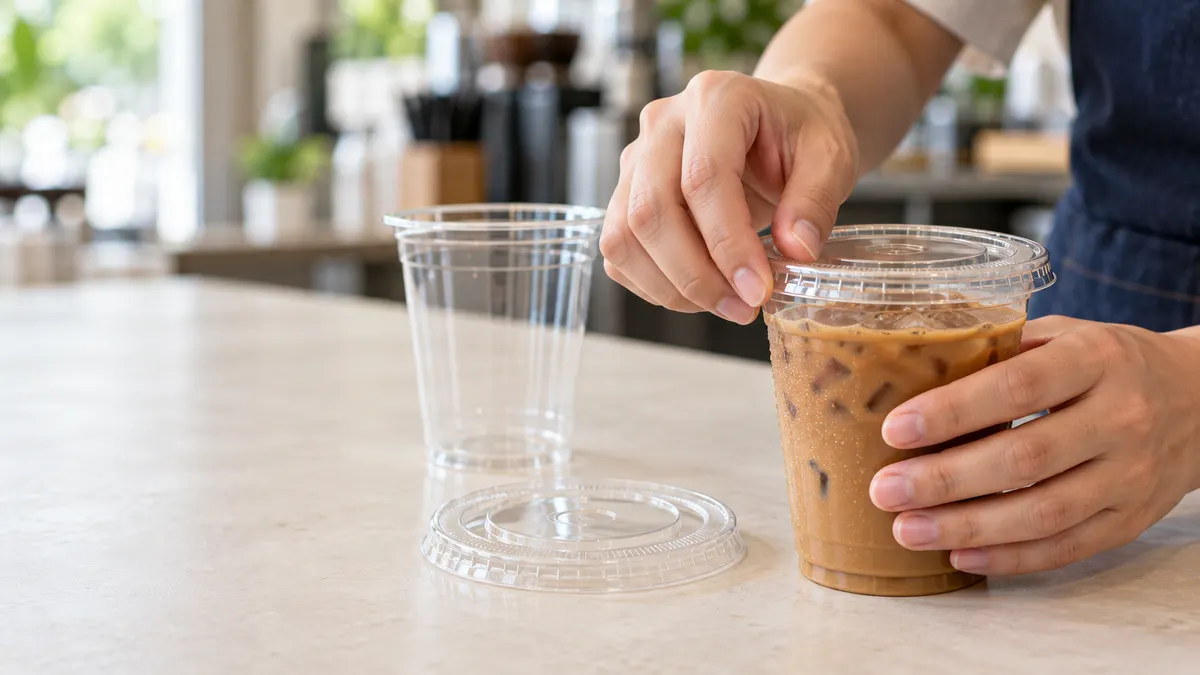
A lid clicks into place, then an edge lifts when the straw goes in. For Malaysian cafe owners, beverage buyers and outlet supervisors, checking cold drink cup lid compatibility means finding out whether an exact pairing stays seated through filling, waiting and handover, rather than simply whether it appears to fit at the counter.
Key takeaway: Approve an identified cup and lid together, using the intended drink, fill level, straw and service sequence. Record the conditions and failures, then check replacement stock against that record. Matching ounce labels, nominal diameters or an audible click cannot establish compatibility.
The cold drink cup lid compatibility procedure below is a proposed cafe check. It contains no completed test results, universal pass standard or statistical guarantee. Supplier listings illustrate particular combinations; they do not independently prove how your stock will perform.
1. Start with cup and lid product code matching
Before ordering samples, ask the supplier to identify the exact components it considers compatible. Detpak directs buyers to product codes on its product pages and in technical data when checking which items work together. A description such as "16 oz cold cup with dome lid" leaves too much unspecified. Detpak’s guidance on compatible items supports checking the codes.
Put these fields on the purchasing request:
- Cup code, lid code, supplier and manufacturer where available.
- Material of each component and intended cold-use conditions.
- Opening configuration: straw hole, sip opening, vent or no hole.
- Pairing evidence: product-page link, technical specification or written supplier confirmation.
- Specification version and confirmation date.
For a Malaysian example, WAKIM lists its 14 oz PC9814 PET cup with dome lid DL98, while its listed 12 oz PET cup uses DL92. These are supplier-listed combinations, not evidence that those lids fit every cup with the same capacity description. WAKIM Malaysia — PET Plastic Cups.
Different capacities can also share a documented lid family. Huhtamaki Henderson — Product Catalogue 2025 lists LFPET-420-510 and LDPET-420-510 for PET420, PET510 and PET630 cups. This New Zealand catalogue example does not establish compatibility with unrelated Malaysian stock. Catalogue year: 2025; accessed 30 October 2026.
A shared lid can simplify purchasing, but each cup code still needs its own documented pairing.
2. Examine cold cup rim profiles and clarify the dimensions
Think of the cup rim and the lid’s retaining groove as two shapes that must engage around the circumference. Packaging supplier Honokage explains that fit depends on their geometry, roundness and stiffness; nominal diameter alone is insufficient. Honokage’s cup and lid fit guidance.
Inspect samples for uneven rims, distorted circles, damaged edges and walls that deform during closure. Assess the actual components rather than assuming that a material name predicts fit.
Dimensions also need a named measurement point. Benxon describes A98-DL as a dome lid for a 98 mm PET cup, yet lists the lid’s own diameter as 102 mm. These figures describe different features, so they should not be treated as conflicting measurements of the same feature. Benxon / Lee Soon Seng Plastic Industries — A98-DL.
Ask whether a quoted diameter refers to the cup opening, outside rim, lid outside edge or another feature. Matching numbers help identify candidates; they do not prove secure engagement.
Use size labels to select candidates, then base approval on a recorded service trial.
3. Define a cup and lid compatibility test around the intended drink
Begin with an actual recipe, such as the outlet’s iced latte or iced tea. Include normal ice and toppings. Assess materially different recipes or filling conditions separately instead of extending one result to the whole menu.
BioPak explains that ounce labels are reference sizes and actual brimful capacity can vary between manufacturers. Brimful capacity means the volume at maximum fill. Record liquid volume, ice, toppings and resulting headspace (the space between the contents and rim), rather than using the advertised cup size as the only fill instruction. BioPak — Products FAQ.
For cold drink cup lid compatibility, the trial conditions must be specific enough for another supervisor to repeat. The product requirements checklist for food packaging can help define the service conditions before samples arrive.
Copy the worksheet below for each trial. Complete the planned conditions first; leave actual conditions and observations blank until the work is done.
| Variable | Planned condition | Actual condition | Observation |
|---|---|---|---|
| Cup, lid and opening configuration | |||
| Drink recipe and liquid volume | |||
| Ice, toppings and fill height or headspace | |||
| Drink temperature and collection wait | |||
| Closure method and handover sequence | |||
| Straw specification and insertion stage | |||
| Sample count, selection method and operators |
Write the acceptance criteria before testing. Proposed criteria include complete seating, no observed rim leakage during the defined handling sequence, no unintended lid disengagement, manageable closure and removal, and no damaging interaction with the intended straw. Define any acceptable spill limit for openings separately.
Choose and record the sample count and selection method. Include units from different packs and more than one operator where practical. One successful cup cannot show repeatability, and a cafe’s chosen sample count is not a statistical guarantee.
Honokage recommends testing with realistic contents and handling. The following sequence turns that supplier guidance into a proposed outlet procedure. Honokage’s service-condition guidance.
- Identify the component codes and lots, then inspect their condition.
- Prepare the intended drink and record the actual fill conditions.
- Close the lid using the specified method and inspect the full circumference.
- Follow the collection wait and insert the straw at its normal service stage.
- Lift, hold and hand over the cup as staff normally would.
- Record each observation against the sample and handling step.
Use separate samples for removal or other checks that could alter later observations. Keep trial drinks out of customer service.
4. Check cold cup lid seating across repeated closures
Follow the supplier’s closure instructions using the intended counter setup. Inspect all the way around after closing. Honokage cautions that an audible click does not confirm complete seating. Honokage’s seating guidance.
For each sample, record raised sections, gaps, buckling, lid distortion or cup deformation. Also record whether the lid seats on the first attempt, needs repeated pressing or requires awkward force or support.
Keep the first attempt visible in the record even if a retry succeeds. For example, "edge raised after first closure; seated after second attempt" tells purchasing more than a final "pass".
Compare observations across operators and packs. Investigate mismatched components, damaged stock, component variation and closure technique before deciding whether the combination is suitable.
5. Assess cold cup lid removal separately
Easy closure does not establish manageable opening. IMADA distinguishes opening force from closing force and explains that excessive tightness can reduce usability. Its example provides no universal acceptable force for disposable cold-drink cups. IMADA — Takeout Container Lid Opening/Closing Force Test.
If intentional removal belongs in your workflow, use separate filled samples over a spill-catching surface. Support the cup normally, remove the lid using the intended method and record sudden release, splashing, tearing, permanent lid damage or cup deformation.
If staff reopen and reclose drinks, assess subsequent seating separately. Initial fit does not establish performance after reopening.
For unresolved problems or more objective comparisons, instrumented measurement is an option. Thwing-Albert describes lid-removal fixtures for rigid or flexible lids, including drink cups, with positioning intended to replicate opening. Agree the test setup and acceptance criteria for your application rather than inventing a universal force limit. Thwing-Albert — Lid Removal Fixture.
6. Test straw insertion and lid security together
Record the intended straw’s diameter, tip design and insertion method, including the normal angle. Honokage identifies slot cracking, lid depression and edge lifting as possible insertion problems. Honokage’s straw-interaction guidance.
During the proposed check, watch for these changes and cup deformation. Inspect the circumference again afterwards, then repeat ordinary lifting and handover. Assess routinely used alternative straws separately when their diameter or tip differs.
The opening configuration belongs in the approved specification. Benxon lists A98-DL with a straw hole and A98-DL-NO-HOLE without one. Similar appearance does not make these variants interchangeable in a straw-service workflow. Benxon’s A98-DL variants.
If a workflow includes making an opening, assess that step explicitly. Do not assume a no-hole lid will behave like a factory-made straw-hole version.
7. Include handling cold cups with condensation
Let the intended iced drink stand for the normal collection period. Assess any longer waiting condition the business plans to approve as a separate condition, recording the actual elapsed time.
Note exterior moisture before lifting. Hold the cup by its body using normal service practice, then observe grip, wall deformation and lid security through handover. Lifting by the lid should not become the proposed handling method.
For cold paper cups, ask about the external moisture barrier. BioPak Singapore says its cold paper cups have a barrier intended to prevent condensation absorption and softening. That is a claim about its construction, not evidence that all paper cups behave alike. BioPak Singapore — BioPak Introduces Cold Paper Cups.
Check the actual paper cup for softening during the proposed wait. Record slippery handling separately from seal performance: moisture on the outside does not, by itself, identify a rim leak.
8. Diagnose cup rim leaks versus lid opening spills
Record where liquid first appears and what happened immediately beforehand. Note any wetness already present from filling or condensation. Honokage distinguishes rim leakage from escape through straw holes, sip openings and vents. Honokage’s leakage-path guidance.
| Observation | Possible origin | Follow-up check | Limit of the conclusion |
|---|---|---|---|
| Liquid appears at the joint between the cup and lid. | Rim leakage, or liquid tracking down from above. | Watch the first wet location on a fresh sample during the same step. | A wet edge alone does not identify the route. |
| Liquid exits through the straw hole, sip opening or vent. | An opening spill. | Record fill level, movement and opening position. | This does not by itself establish rim failure, but may still make the workflow unsuitable. |
| Droplets develop across the cup exterior. | Condensation; filling residue may also be present. | Record the starting condition and observe when moisture develops. | Exterior wetness does not prove a failed seal. |
| An edge lifts or the lid comes off. | Partial or complete disengagement. | Record the triggering step and inspect the components. | The event is observable; its cause still needs investigation. |
Keep normal openings present during the service trial. Taping a straw hole shut changes the conditions. If a separate diagnostic check modifies an opening, label it clearly and keep its findings separate from the service assessment.
Do not use an inverted cup with an open straw hole as the sole pass/fail check for rim compatibility. Liquid escaping through the opening answers a different question from whether the rim stays engaged.
9. Record approved cup and lid combinations with clear limits
Create one approval record for each exact pairing and opening configuration. Honokage recommends documenting components, conditions, sample counts and outcomes. The blank layout below is a proposed operational tool, not a completed approval. Honokage’s compatibility documentation guidance.
| Record field | Entry |
|---|---|
| Record ID, trial date and responsible decision-maker | |
| Suppliers and manufacturers where available | |
| Cup code, material and lot reference | |
| Lid code, material, opening configuration and lot reference | |
| Pairing confirmation, specification references, versions and dates | |
| Recipe, liquid volume, ice, toppings and headspace | |
| Temperature, waiting time, closure method and handling sequence | |
| Straw specification and insertion method | |
| Sample counts, selection method and operators | |
| Acceptance criteria and approved operating limits | |
| Initial observations and failures by type | |
| Investigation, corrective action and separate retest outcomes | |
| Decision, approval date and conditions | |
| Retained reference components and photograph locations |
Use a clear status: approved for the recorded conditions, awaiting investigation or rejected for the intended workflow. Retain labelled reference components and useful photographs where available.
For routine monitoring, count first-attempt seating failures, rim leaks, opening spills and disengagement events separately, with the number checked as the denominator. This helps identify what changed without turning a small trial into a claim about every unit.
Fit approval also does not establish food-contact suitability. Keep the relevant product documents alongside the pairing record; the Malaysian food-contact packaging declaration checklist explains what to request.
10. Build replacement cup and lid batch checks into receiving
Honokage recommends checking replacement batches and reassessing substitutions. Use the following proposed receiving procedure against the recorded approval criteria. Honokage’s batch-check guidance.
- Compare incoming labels, codes, opening configurations, lot details and component condition with the approval record.
- Select and document incoming samples, then repeat the relevant seating and service checks.
- When cups change, assess them with the lid stock that will be used. When lids change, assess them with the intended cup stock. When both change, assess the new pair together.
- Use retained references to investigate differences. An unchanged product code is not a substitute for checking performance.
- Keep suspect stock identifiable and separate while investigating gaps, rim leakage, disengagement or inconsistent closure. Record affected lots and findings.
Reassess supplier changes, substitutions, revised specifications, different straws and meaningful changes to fill level or service workflow before extending approval.
Common purchasing questions
Can one lid serve several cup capacities?
Yes, where the supplier documents the pairing for each cup code. Confirm each combination and trial it under its intended filling and handling conditions.
Does a successful retry cancel a failed first closure?
No. Record both attempts. Repeated pressing may matter during busy service even when the final seating looks acceptable.
Is a straw-hole spill automatically a failed rim seal?
No. Record the escape route separately. The spill may still breach your service criteria, but it does not establish that liquid crossed the joint between the cup and lid.
Sources and product references
These are supplier and equipment-provider sources, not independent results for your cafe’s stock. Accessed 30 October 2026; WAKIM’s listing was available through indexed page content. Publication dates are included where identified. Huhtamaki’s 2025 catalogue is cited in full in section 1.
- Detpak — Which items work together, like which cup works with which lid?
- WAKIM Malaysia — PET Plastic Cups
- Benxon / Lee Soon Seng Plastic Industries — A98-DL
- Honokage — Cup and Lid Fit Testing for Beverage Packaging. Published 18 September 2026.
- BioPak — Products FAQ
- Thwing-Albert — Lid Removal Fixture
- IMADA — Takeout Container Lid Opening/Closing Force Test
- BioPak Singapore — BioPak Introduces Cold Paper Cups
Before committing to the pairing
Treat cold drink cup lid compatibility as approval of a recorded combination under recorded conditions, supported by replacement-stock checks. Request the exact component specifications and representative samples, then complete and retain the proposed service check before committing to the pairing.
- Cup and Lid Compatibility
- Cafe Takeaway Service
- Packaging Trials
- Supplier Specifications
- Leak Diagnosis
- Incoming Stock Checks