FoodPackLab Editorial Team
Selecting tamper evident takeaway packaging and checking seal integrity at handover
A practical guide for Malaysian F&B teams comparing closure labels, tear strips and breakaway features. Learn how to trial opening evidence, adhesion and customer effort, check seals at rider handover, handle damaged closures and compare operating costs without confusing tamper evidence with food safety.
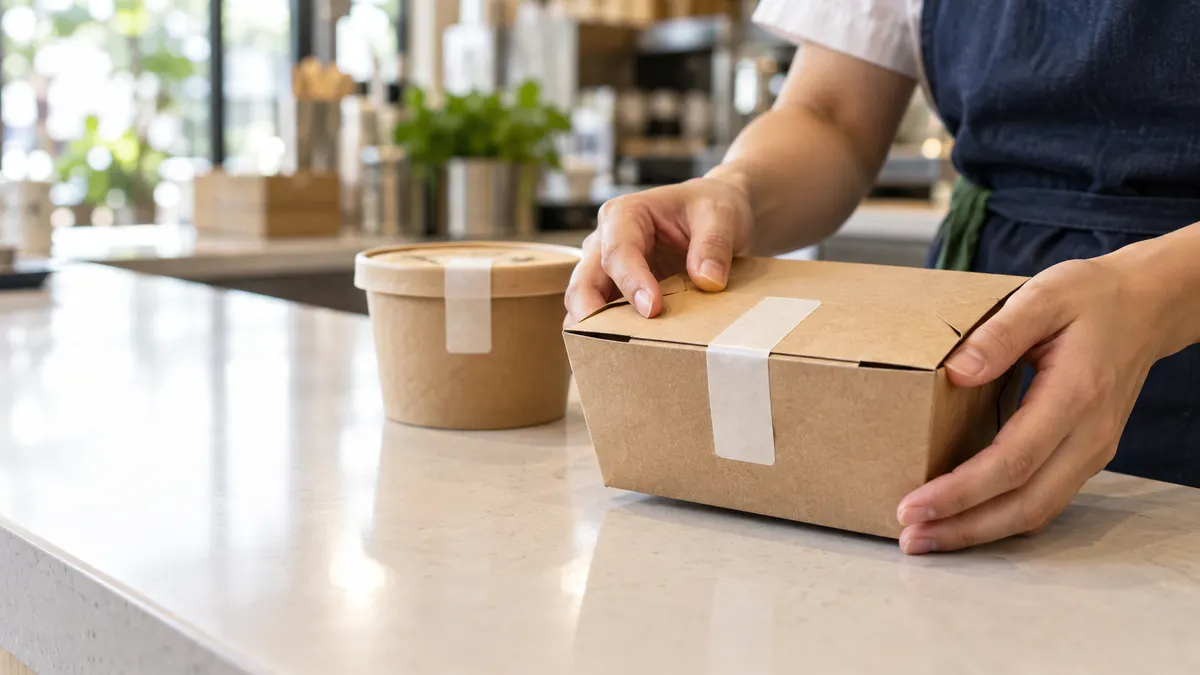
A label can look secure at the packing bench, then lift on a chilled cup or tear during stacking. For Malaysian takeaway owners, purchasing teams, outlet supervisors and packing staff, choosing tamper evident takeaway packaging means finding a closure that reveals opening, survives normal delivery handling and can be checked before the rider leaves.
Key takeaway: Approve the pack, closure and application method together. The feature must survive intended handling, show a lasting change after opening and give staff a clear reason to release or hold the order.
A stronger adhesive alone does not answer those questions. Start by identifying what the closure should reveal, then test it on the actual pack.
By FoodPackLab Editorial Team
Understand the limits of tamper evident packaging
A tamper-evident feature is designed to leave a visible, lasting change when opened or disturbed. Examples include a fragmented label, a removed tear strip or a separated hinge. Supplier TamperTech describes this as evidence that supports detection and deterrence, rather than a physical barrier against every opening attempt. See TamperTech — Frequently Asked Questions.
An intact-looking seal cannot prove that no interference occurred. A damaged seal cannot identify who caused the damage. After an opened pack is reclosed, the original first-opening evidence should remain recognisable.
A seal provides a point to inspect; it cannot determine whether food is safe.
Preparation, temperature control, contamination prevention and allergen management remain separate. These subjects appear in the delivery best practices highlighted by the US FDA; that guidance is not a Malaysian legal requirement. See FDA — Highlights Best Practices on Food Safety for Online Delivery Services, published 9 December 2022.
Define what each seal lets staff inspect. A sealed outer bag provides evidence about opening that bag. It does not independently verify every container inside, or prove that staff packed the correct items.
Compare three closure approaches against your existing packs
Check compatibility before comparing prices. When comparing tamper evident takeaway packaging, establish whether an option can be added to current stock or requires a different bag, lid or container.
| Closure type | Compatibility | Visible opening evidence | Operational trade-offs | Accidental-damage risks to test | Customer opening considerations |
|---|---|---|---|---|---|
| Added closure label | May retain existing tubs, folded bags and bakery boxes, subject to surface and opening-path trials. | Specified security cuts, fragmentation or another removal indicator. | Application labour, consistent placement, adhesive dwell time and replacement-label stock. | Lifted edges, rubbing, stretching across gaps and tearing during stacking. | Can customers locate the opening point and break the feature without pulling the pack apart? |
| Built-in tear strip | Usually requires a bag or pack manufactured with the feature. | A removed or visibly broken first-opening strip. | Different pack stock and a closing method that must preserve the strip. | Snagging, premature tearing and incomplete separation. | Check grip, tear direction and loose pieces; some designs allow later reclosure. |
| Integrated breakaway feature | Requires the specified container and compatible lid or hinged assembly. | A separated tab, hinge or other designed break point. | Possible container replacement, staff training and checks for full closure. | Damage from squeezing, stacking or handling exposed features. | Check visibility, opening effort and whether loose pieces remain; designs differ. |
Distinguish security labels from ordinary stickers
When requesting tamper evident labels for takeaway containers, ask what happens during removal. Avery distinguishes permanent-adhesive closure seals from labels with security cuts that break apart and prevent intact reapplication. This is a supplier explanation, not independent validation of a particular label on your pack. See Avery — What Tamper-Evident Food Labels Do You Need?.
A sticker that holds two surfaces together may still peel off intact. Ask for a demonstration on your own packaging, including an attempt at ordinary reclosure.
Separate first-opening evidence from later reclosure
Great American Packaging provides an example of tear strip takeaway packaging. Its described bag has a perforated top strip and a zipper below it. The zipper remains usable after the strip breaks, but closing the zipper does not restore the original evidence. See Great American Packaging — Secure & Tamper Evident.
For takeaway containers with breakaway tabs, Anchor Packaging's SAFE PINCH sandwich wedge offers another mechanism. The supplier describes a hinge that visibly separates and becomes opening tabs, without loose tear-strip pieces. That claim belongs to this design, not all breakaway containers. See Anchor Packaging — SAFE PINCH Tamper-Evident Sandwich Wedge.
These examples explain mechanisms. They do not establish Malaysian availability, local pricing or suitability for your menu. In particular, a sandwich-pack example should not be treated as evidence of suitability for hot curry.
Match adhesion to the surface and handling conditions
Build a pack register before requesting samples. Record each pack's stock code, material, coating or print finish, closure shape, available label area and the parts that separate during opening.
For tamper evident label adhesion, supplier TamperTech identifies differences between dusty or absorbent kraft, coated board, varnished surfaces and plastics. It also identifies curvature, condensation, hot or chilled contents and temperature at sealing as relevant variables. See TamperTech — Fast Food Tamper Evident Delivery Labels.
Use those variables to write separate trial briefs:
- For a hot meal tub, record the pack surface temperature at sealing. Check whether filling curry or soup contaminates the external application area.
- For a chilled drink cup, record whether the surface is dry when labelled and whether condensation develops later. Inspect the label around the cup's curve.
- For a bakery box, test the actual printed or coated board. Check whether lifting the lid stresses the intended feature or allows access through another flap.
A successful bakery-box trial does not validate a chilled cup. Application conditions and later delivery conditions are different: a dry pack at the bench may encounter moisture, abrasion or pressure in transit.
Request written instructions for compatible surfaces, application temperature, pressure, dwell time and storage. Dwell time is the time the adhesive needs to develop its specified bond after application.
For its particular 7871V material, 3M specifies clean, dry surfaces and explains that increased rubdown pressure improves adhesive contact. This illustrates why application instructions matter; it is not a recommendation to use that material as a takeaway security label. Do not transfer its temperature limits or preparation methods to another product. See 3M — Versatile Polyester Label Material 7871V Technical Data Sheet, August 2019; accessed 30 October 2026.
If normal production cannot meet the shortlisted closure's instructions, change the process or test another closure.
Set tamper evident seal placement for each opening path
Complete the item, quantity and order checks before applying the final closure. Then identify which parts move apart when the pack opens.
TamperTech describes labels bridging bag folds or lid closures, with dimensions chosen to span the opening. A label placed entirely on one stationary panel cannot reveal opening of a separate lid. See TamperTech — Fast Food Tamper Evident Delivery Labels.
Use this proposed placement check:
- Position the feature across the intended opening, with the supplier's required contact area on each side.
- Check other edges and access points. Establish whether the contents can be reached without disturbing the feature.
- Apply the specified pressure and allow the required dwell time.
- Check whether gripping, stacking or bag handles pull on the closure during normal work.
- Record the approved placement and expected intact appearance in a short pack-specific instruction.
Do not assume that one label suits every lid shape. Adding more labels without testing can increase packing time and customer effort without resolving an overlooked opening path.
Use three approval gates when testing takeaway seals under delivery conditions
TamperTech recommends testing on actual packs at operating speed and temperature, allowing the required dwell time, photographing evidence states and repeating checks after a real or simulated journey. See TamperTech — Frequently Asked Questions.
The following is a proposed outlet trial, not a report of completed testing. Approve tamper evident takeaway packaging only after checking all three gates.
| Gate | What to do | What the result must establish |
|---|---|---|
| 1. Survives handling | Pack representative contents at normal speed. Include relevant hot or chilled conditions, dwell time, stacking, rubbing and delivery-bag handling. | The feature remains attached and its intact state is clear after the intended journey. |
| 2. Reveals opening | Open controlled test samples, then attempt ordinary reclosure. Keep these samples out of customer orders. | A persistent, recognisable change remains after opening and reclosure. |
| 3. Opens manageably | Observe representative users finding, gripping and opening the feature. | Users can follow the intended opening method without excessive struggle, spillage or troublesome loose pieces. |
Inspect after packing, after the specified dwell time and after a representative journey. Record the pack SKU, closure specification, operator, application conditions, elapsed time and result. Photograph intact, deliberately opened and failed samples for an internal reference.
When assessing tamper evident packaging opening effort, include people with different hand strength or dexterity where practical. Observe actual behaviour rather than accepting "easy opening" as a universal claim. Anchor's pinch-to-open mechanism is one design to compare; its product description does not establish an accessibility rating.
Set pass/fail criteria before buying. This article does not prescribe a universal sample count, opening-force limit or acceptable failure percentage. Retest when the pack surface, adhesive, supplier, closure design or packing process changes.
Keep leakage on a separate test record. For that assessment, use the hot food delivery packaging selection and testing guide.
Propose takeaway seal integrity checks at handover
Grab Malaysia's merchant code recommends a final check for missing or incorrect items before packing, sealing bags and products, and attaching the receipt for validation. See Grab Malaysia — Code of Conduct: Merchant.
Its rider collection guidance calls for showing the order ID, checking completeness with restaurant staff, ensuring containers are sealed and avoiding opening food containers. See Grab Malaysia Help Centre — What Should I Do When I Reach the Restaurant?.
The sequence below is a proposed outlet procedure informed by that guidance. It is not a nationwide statutory checklist.
- Before final sealing, the packer matches the order ID, items, quantities and requested extras to verify the contents.
- The packer closes the pack fully, applies the approved closure and meets its application and dwell requirements.
- On the finished pack, the packer confirms placement, attachment and intact strips or tabs. They investigate unexplained tears or lifted edges.
- Dispatch staff assemble the order and confirm the bag count and separate components, including drinks. They keep the order identifier visible externally.
- Staff and rider confirm collection by matching the order ID and declared package count. They inspect accessible closure features without opening food containers.
- Pause release if a required seal is missing, broken, lifting or too ambiguous to assess. The supervisor resolves the exception.
- Staff record release in the normal order record, capturing handover and any resolved exception with detail proportionate to the operation.
For example, staff and rider should externally confirm the package count for an order containing two meal bags and one drink carrier. The rider does not need to break seals to repeat the kitchen's item check.
Where an outer bag hides inner closures, the packer checks those closures before closing the bag. Handover staff then check the accessible outer feature and the package count. Be explicit about what each stage can inspect.
Create a process for handling damaged or missing takeaway seals
Define exception triggers in the work instruction: an absent required closure, broken strip or tab, fragmented label, lifting that weakens the intended bridge, damaged packaging or an uncertain evidence state.
Damage alone does not prove deliberate interference. Uber's Australian guidance acknowledges that packaging can tear or become damaged during delivery. Use that observation without treating it as Malaysian platform policy. See Uber — Item Tampering, published 6 June 2017; accessed 30 October 2026.
- At the packing bench, keep the order under staff control. Authorise a contents and condition recheck, replace the affected label or pack as appropriate, and record the reason.
- After a legitimate order correction, repeat the packing check and apply a fresh closure. A broken single-use feature may require a new container.
- At rider collection, pause release and refer the order to the designated supervisor. The rider should not open the container to investigate.
- Where access history or food condition is uncertain, follow the outlet's food-safety and replacement procedure. Resealing does not resolve the uncertainty.
- After dispatch or at receipt, record the order, time and observed condition, obtain photographs where practical, and use the outlet or platform support process. Do not ask a customer to taste food to assess it.
Do not cover unexplained damage with another sticker to make the order look intact. Record observable facts without assigning blame.
Hong Kong's Centre for Food Safety similarly advises checking received prepackaged food for broken seals or damaged packaging and reporting doubtful products. This supports inspection and escalation, but is overseas guidance rather than a Malaysian legal requirement. See Centre for Food Safety, Hong Kong — Simple Steps to Avoid Tampered Prepackaged Food, September 2025; accessed 30 October 2026.
Review recurring failures by pack, closure specification, application method and handling stage. Use the findings to decide whether staff need retraining, the closure needs repositioning or the design needs changing.
Request evidence and compare cost per dispatched order
Give shortlisted suppliers a pack-specific brief, rather than asking only for a price per roll or carton.
- Request samples for every relevant surface and size.
- Ask for the expected opening evidence and examples of intact and disturbed states.
- Obtain application instructions, compatible pack SKUs and storage requirements.
- Confirm lead time, minimum order quantity and shelf life where specified.
- Ask how the supplier will communicate material or specification changes.
- Include application time, rejected packs, repacking and any container change in the cost comparison.
A useful internal measure is total closure-related cost divided by successfully dispatched orders. Compare labels as a possible retrofit and integrated features as a possible pack replacement using the same approval gates.
Keep leak resistance, food-contact documentation and environmental claims as separate procurement checks. For document review, use the Malaysian food-contact packaging declaration checklist. Passing an opening-evidence trial does not establish food-contact suitability or environmental performance.
Prioritise pack-specific instructions and trial records for this decision. Request certification evidence only where a relevant procurement brief calls for it; a generic badge cannot replace performance testing.
After rollout, track seal exceptions, repacking time and customer opening complaints alongside dispatch volume. Test whether an approved placement instruction reduces avoidable seal exceptions. Compare results with the outlet's own baseline; do not assume improvement before measuring it.
For later ASEAN expansion, repeat local supply, platform and operating-condition checks rather than carrying Malaysian findings across unchanged.
Common operational questions
Is a strong permanent sticker automatically tamper-evident?
No. Check whether opening leaves a persistent, visible change. Adhesive strength alone does not establish that evidence.
Is sealing the outer delivery bag enough?
Define what you need to inspect and test the bag's opening paths. An outer seal provides evidence about that bag opening; it does not independently verify each inner container.
Does a lifted label prove deliberate interference?
No. Adhesion failure or accidental damage may explain it. Treat the condition as an exception requiring a decision, not proof of blame.
Can a pack still be reclosable?
Yes. Some designs retain a zipper or reclosable lid after the first-opening feature breaks. Reclosure does not restore the original evidence.
Should a rider open containers to verify the contents?
Use the order identifier, staff confirmation and external checks. Follow the relevant platform's current collection instructions; Grab Malaysia's cited guidance says not to open food containers.
Does an intact seal mean the food is safe?
No. Safe preparation, temperature control, allergen management and other food-safety measures remain separate.
Sources and product examples
Supplier sources describe their own products or recommended methods; they are not independent findings. Sources were checked on 30 October 2026. Grab's rider guidance was checked through indexed Help Centre content because the direct page required JavaScript. Publication dates are included where displayed; the 3M, Uber and Hong Kong sources are dated and linked beside their relevant passages.
- TamperTech — Frequently Asked Questions. Publication date not displayed.
- Avery — What Tamper-Evident Food Labels Do You Need? By Melanie Neff. Published date displayed as 01/10/2023; updated 30 July 2026.
- TamperTech — Fast Food Tamper Evident Delivery Labels. Publication date not displayed.
- Great American Packaging — Secure & Tamper Evident. Publication date not displayed.
- Anchor Packaging — SAFE PINCH Tamper-Evident Sandwich Wedge. Product TE74SW, SKU 4512040. Publication date not displayed.
- Grab Malaysia — Code of Conduct: Merchant. Publication date not displayed.
- Grab Malaysia Help Centre — What Should I Do When I Reach the Restaurant? Publication date not displayed in retrieved content.
- FDA — Highlights Best Practices on Food Safety for Online Delivery Services. Published 9 December 2022.
Start with your main packs and one clear instruction for each
Choose tamper evident takeaway packaging by the opening evidence it leaves on your actual packs, then support it with a consistent handover check and a clear exception process.
Document your main packs' surfaces, opening paths and handling conditions. Shortlist compatible closures, request samples and run the three approval gates. For each selected combination, approve one placement instruction and one release-or-hold decision process.
Prepare that pack-and-closure trial brief before requesting quotations or committing to a large order.
- Tamper-evident closures
- Takeaway packaging trials
- Delivery handover checks
- Packaging procurement
- Seal exception handling