FoodPackLab Editorial Team
Meal-specific takeaway cutlery selection: usability checks before bulk purchase
A proposed meal-specific assessment for Malaysian F&B buyers comparing takeaway spoons, forks and knives before bulk purchase. It covers rice, curry, noodles and firm foods, with checks for comfort, flex, breakage and rough edges, a blank decision template, and clear boundaries between research, supplier claims and actual sample results.
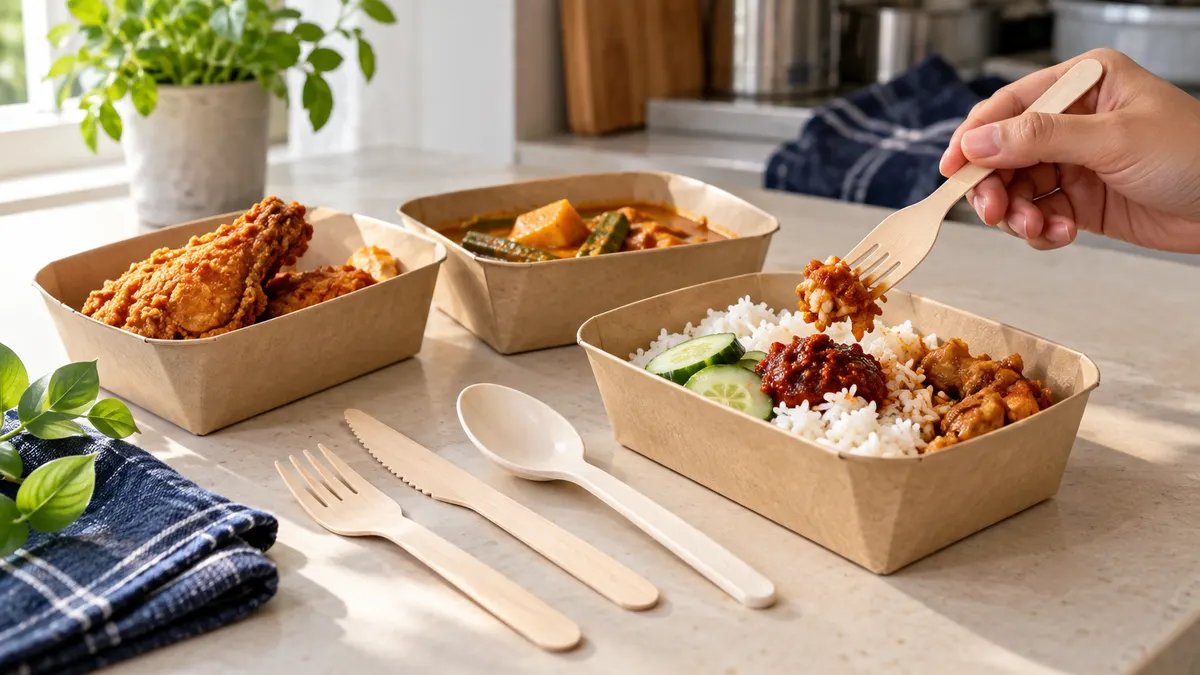
A spoon that carries rice comfortably may spill curry. For Malaysian takeaway restaurant owners, caterers and F&B procurement buyers, takeaway cutlery selection starts with checking whether each utensil can handle the meals customers actually eat. A bulk order saves little if diners need extra utensils to finish lunch.
Key takeaway: Approve a specific utensil for a defined meal and use condition. Compare representative samples, agree observable rejection limits before testing, and keep defects separate from ordinary performance scores.
This article outlines a proposed assessment. It does not report completed supplier-sample tests, product rankings or verified performance results. It gives cafes, catering teams and cloud kitchens a way to gather evidence for purchasing decisions.
Start with the meal task that can fail
A utensil can work well for one action and struggle with another. Gathering loose rice, retaining curry, lifting noodles and cutting chicken place different demands on its shape, finish and strength.
Research by International Islamic University Malaysia researchers separated five eating tasks: rice, cereal with milk and soup using a spoon, and noodles and vegetables using a fork. That provides a research precedent for separating tasks; it does not establish that any takeaway product passes them. Human Hand Motion Analysis during Different Eating Activities.
Approve the utensil for the meal, not the material for the whole menu. Use your existing takeaway containers during the assessment so reach, corners and eating movements reflect the intended experience.
| Menu item | Eating task | Utensil needed | Likely difficulty | Observation to record |
|---|---|---|---|---|
| Nasi lemak rice | Gather loose grains and lift a consistent bite | Spoon | Grains escape; bowl cannot reach corners | Gathering attempts, lost grains and corner access |
| Curry or soup | Carry liquid and ingredients, then empty the spoon | Spoon | Spills during transfer; awkward emptying | Loaded amount, spills and mouth comfort |
| Noodles | Catch, lift and release a portion | Fork | Noodles repeatedly slip off | Failed lifts, dropped portions and extra attempts |
| Firm vegetables | Pierce and lift a piece | Fork | Excessive force or tine bending | Piercing attempts, deflection and retained pieces |
| Boneless fried chicken | Steady the piece and cut through crust and interior | Fork and knife | Slipping, excessive sawing or buckling | Cutting strokes, incomplete cuts and control |
Set up a takeaway cutlery sample assessment before bulk purchase
Label each candidate with its supplier, product code, material, finish, dimensions and sample batch where available. Request samples representing the proposed bulk specification. Record any uncertainty about whether the samples match production stock.
Choose the number of unused units and users in advance. Compare several units per candidate across several users, with a fresh utensil for each user's assessment. A small internal trial supports a buying decision; it is not statistical proof of batch quality.
- Keep portions, food consistency, piece dimensions, containers, transfer distance and task sequence comparable.
- Measure food temperature and record contact duration. Include conditions representative of delivery and eating, within the exact product's stated use limits.
- Agree limits for spills, failed lifts, cutting strokes and discomfort before comparing candidates.
- Inspect each utensil before food use. Exclude visibly defective samples from eating trials and record the rejection.
Keep four evidence categories distinct: published research, supplier claims, proposed checks and observations from tests actually completed. An unperformed check remains "not assessed".
This distinction matters even with published research. The direct material assessment in The Sensory and Emotional Response to Different Tableware Materials used eight experienced assessors and one repetition. It was not repeated durability testing of your supplier's samples.
Assess takeaway spoons for rice and curry
Compare takeaway spoon depth and capacity
Record bowl depth, width and shape alongside usable liquid capacity. Here, usable capacity means the amount carried during the agreed task, rather than the amount that fits when filled to the rim.
Compare shallow and deeper bowls using identical curry or soup transfers. Record the amount loaded, number of transfers, spills and whether users can empty the bowl comfortably. A deeper bowl may hold the intended portion but make users move their mouths awkwardly to empty it.
LAYANA describes increased depth as a way for its Tang soup spoon to retain liquid and ingredients. This is the manufacturer's design claim about its own product, not independent evidence for disposable takeaway spoons. LAYANA Deep Depth Soup Spoon Taiwan Tang — designer's product listing.
Assess rice separately. Observe whether the spoon gathers loose grains, supports a consistent bite and reaches food near the container corners. A successful rice task does not establish successful curry handling.
Proposed rejection criteria: Spilling exceeds the agreed limit, the spoon cannot carry the agreed portion, or users repeatedly struggle to empty the bowl comfortably.
Assess takeaway fork grip for noodles and firm pieces
Compare tine length, spacing, curvature, tip shape and head angle. Lift equal portions of the noodles actually served, including the usual sauce. Count failed lifts, dropped portions and extra attempts to gather a bite.
Then assess equal-sized firm vegetable pieces. Record piercing attempts, slipping and tine deflection, and observe whether each piece stays on the fork during transfer.
Nendo's specialised noodle fork uses tine spacing and shape intended to catch curled noodles, with a head angle and central depression intended to support ingredients. It also has separate right-handed and left-handed versions. These are documented design intentions, not a controlled demonstration of better performance across noodle dishes. Nendo — cup noodle THE FORK.
Include right- and left-handed users when assessing asymmetric handles or angled heads. Observe whether users can reach food in the existing container without awkward wrist movement.
Proposed rejection criteria: Failed lifts or repeated attempts exceed the agreed limit, the fork cannot pierce the intended food, or tine bending prevents a controlled lift.
Assess takeaway knife performance on firm foods
Use consistent pieces of an actual menu item, such as boneless fried chicken or firm vegetables. Keep preparation, temperature and dimensions comparable. Pair every knife with the same suitable fork first, then assess each proposed fork-and-knife combination together.
Record cutting strokes, incomplete cuts, blade slippage, bending and difficulty maintaining control. Assess the cutting edge and blade geometry separately from stiffness: a rigid knife can still require excessive sawing.
CATRA evaluates sharpness, blade geometry, strength and durability as separate attributes. Its approach supports looking beyond apparent stiffness, but this kitchen assessment is not a CATRA laboratory test or a quoted CATRA acceptance standard. CATRA — Product Testing.
Proposed rejection criteria: The knife cannot complete the cut within the agreed stroke limit, repeated slippage prevents controlled cutting, or the blade buckles. Stop immediately if cracking, breakage or loose fragments appear.
Assess takeaway cutlery handle comfort through a complete meal
Compare handle width, thickness, length, contour and surface finish. Ask several users to complete the relevant meal tasks and record slipping, repeated regripping, pressure points and awkward wrist positions.
A study of standard and enlarged spoon handles found that larger handles required less finger and thumb joint movement in its healthy adult female sample. It did not establish a universally comfortable takeaway handle size. Effectiveness of adaptive silverware on range of motion of the hand.
Use a consistently defined discomfort scale. One proposed scale is 0 for no discomfort, 1 for noticeable discomfort without changing grip, 2 for discomfort requiring a grip change, and 3 for discomfort requiring the task to stop. This is an internal recording aid, not a validated research scale; set your rejection threshold before starting.
Record where discomfort occurs and whether control changes near the bottom or corners of the container. Assess mouthfeel only after visual inspection, noting drag or discomfort at spoon rims and fork contact surfaces. Stop if a defect becomes apparent.
Proposed rejection criteria: Discomfort exceeds the agreed threshold, repeated slipping interrupts the task, or the handle prevents usable control for intended users.
Conduct takeaway cutlery flexing and breakage checks
Observe flex during scooping, lifting, piercing and cutting. Arbitrary overload demonstrations do not substitute for realistic meal tasks. Slight flex that recovers is not automatically a failure.
Record recoverable flex separately from permanent bending, softening, warping, cracking and breakage. Reassess after representative food contact at documented temperatures and durations within the product's stated use conditions.
Published sensory research treats flexibility, handle slipperiness, surface roughness and edge sharpness as distinct attributes. Keeping these observations separate helps explain why a candidate failed instead of assigning one vague "quality" score. The Sensory and Emotional Response to Different Tableware Materials.
Proposed rejection criteria: Permanent deformation, heat-related loss of usable stiffness, cracks, broken parts, or flex that prevents task completion or causes loss of control.
Perform a takeaway cutlery rough edge inspection before and after use
Under adequate light, inspect spoon rims, fork tines, knife handles and utensil necks. Look for visible splinters, lifting fibres, loose fragments, cracks, broken tines and unintended sharp burrs. Distinguish an intended knife cutting edge from an unintended sharp defect.
Reject affected samples and pause bulk approval pending investigation. Do not average these findings into an otherwise acceptable performance score.
CATRA includes defects, safety and fitness for purpose in its cutlery testing. The stop rule above is a proposed buyer criterion, not a published CATRA acceptance threshold. CATRA — Product Testing.
Make a takeaway cutlery design and material comparison
Compare more than one design within a material where practical. If material, thickness and head shape all change together, the assessment cannot isolate which difference caused the result.
For takeaway cutlery selection, use the comparison to choose utensils for each meal. You do not need to name an overall material winner.
| Candidate | Design or finish variable | Potential trade-off | Evidence type | Proposed meal check |
|---|---|---|---|---|
| Wooden utensils | Coated versus uncoated finish | Surface feel may differ after food contact | Supplier mouthfeel claim; requires sample observations | Compare roughness, lip drag and lifting fibres after the intended meal contact |
| Polypropylene utensils | Thickness, neck design and edge finish | Flex may remain usable or impair control; assess edges separately | Published results for specific specimens only | Observe flex, finish and task completion on the supplied units |
| PLA utensils | Exact formulation and stated use conditions | Warm-food suitability depends on the supplied product | Product-specific supplier specification | Check for softening, warping and loss of control within stated limits |
| Spoons within one material | Bowl depth, width and shape | Liquid retention and comfortable emptying may differ | Design hypothesis to assess | Record liquid transfers and rice handling separately |
| Forks and knives within one material | Tine geometry, head angle and cutting edge | Specialisation may help one task without helping another | Design hypothesis to assess | Compare noodles, piercing and cutting as separate tasks |
Huhtamaki lists coated and uncoated birchwood cutlery and describes its coated range as having a smooth mouthfeel. That is a supplier-reported claim specific to its range. Compare finishes after contact with your food; reject splintering or abrasive edges and assess acceptable mouthfeel with users. Huhtamaki Henderson Catalogue 2025 — Coated and Uncoated Wooden Cutlery.
In the sensory study, tested polypropylene specimens showed more pronounced flexibility and edge sharpness than tested wooden and stainless-steel items. Those findings do not describe every polypropylene product. The Sensory and Emotional Response to Different Tableware Materials.
GoodBioPak's brochure specifies a temperature-resistance range of −10°C to +80°C for its listed PLA knives, forks and spoons. That supplier specification does not establish a range for all PLA cutlery or prove performance for every contact duration. Obtain the exact candidate's use conditions before assessing warm or hot meals. GoodBioPak PLA Products Brochure.
Apply takeaway cutlery sample rejection criteria and document the decision
Set your thresholds before observing results. This article supplies no universal pass limit for spills, failed lifts, cutting strokes or discomfort. Your limits should reflect the meal and the eating experience you need to deliver.
| Field | Buyer entry |
|---|---|
| Supplier, product code, material and finish | ________________ |
| Dimensions, sample batch and bulk specification match | ________________ |
| Sample count and user count | ________________ |
| Food task, portion and piece dimensions | ________________ |
| Container and transfer distance | ________________ |
| Measured food temperature and contact time | ________________ |
| Product's stated use conditions | ________________ |
| Agreed task limit and discomfort threshold | ________________ |
| Pre-use and post-use defect observations | ________________ |
| Task observations and discomfort location | ________________ |
| Failed units / units assessed | ________________ |
| Failed attempts / total attempts, where relevant | ________________ |
| Unperformed checks | ________________ |
| Decision, approved meal and use conditions | ________________ |
| Corrective action and reassessment required | ________________ |
Use three distinct decision types:
- Sample defect: Reject affected samples and pause bulk approval for cracks, splinters, loose fragments, broken tines or unintended sharp burrs. Require a corrective explanation and fresh representative samples before reconsideration.
- Task failure: Reject the candidate for the meal when spilling, failed lifts, cutting difficulty, unusable flex or discomfort exceeds the agreed limit.
- Incomplete evidence: Mark unperformed tasks "not assessed" and withhold approval for those uses.
Report failures with denominators, keeping defective units separate from failed task attempts. Keep individual defect findings visible even when other samples perform acceptably.
Once you have established suitability, compare unit price and minimum order quantity among candidates that pass. Consider whether separate utensils for different meals justify extra stock management. The guide to sustainable packaging price factors provides further purchasing context.
Documented takeaway cutlery selection supports a purchasing decision. It does not establish the quality of every unit in a future shipment.
Keep environmental claims separate from usability findings
Passing a meal assessment does not establish an environmental advantage. Product weight, production, transport and actual disposal routes affect the comparison.
A Danish government life-cycle assessment found wooden cutlery performed, on average, better than or similarly to plastic cutlery in its baseline scenario. It also identified product weight as important. This is conditional overseas evidence, not a ranking for Malaysian products or waste systems. Danish Environmental Protection Agency — LCA of Single Use Plastic Products in Denmark.
Another study modelled fossil-based tableware going to landfill and bio-based tableware going to composting; reusable-system impacts depended strongly on washing and number of uses. Its conclusions depend on those scenarios. Comparative life cycle analysis of disposable and reusable tableware: The role of bioplastics.
A composting benefit requires a suitable collection and treatment route serving the intended users. Do not assume that route exists nationwide in Malaysia. Use the guide to validating local packaging recovery pathways when checking disposal claims.
Common purchasing questions
Can one cutlery set serve the whole menu?
Possibly, if it passes each required task under the intended conditions. Passing a rice assessment alone does not approve the same set for noodles, curry or firm chicken pieces.
Does a thicker utensil automatically perform better?
No. Thickness is only one variable. A stiff knife can still cut poorly, and a deeper spoon can still be uncomfortable to empty. Assess the complete design.
How many samples are enough?
This article specifies no statistically validated sample size. State your chosen counts before testing and use several units across several users. If you need shipment-level assurance, establish a separate acceptance sampling approach with appropriate expertise.
- Takeaway Cutlery
- Sample Assessment
- Meal-Specific Usability
- Cutlery Design and Materials
- Procurement Decisions
- Environmental Claims