FoodPackLab Editorial Team
Sustainable Packaging Price Factors Buyers Should Know
A lower price per piece can cost more once you add lids, freight, rejected packs and delivery failures. Malaysian cafe owners, caterers, bakeries, cloud kitchens, food truck operators and procurement teams need to compare the complete specification and the cost of each usable pack.
A lower price per piece can cost more once you add lids, freight, rejected packs and delivery failures. Malaysian cafe owners, caterers, bakeries, cloud kitchens, food truck operators and procurement teams need to compare the complete specification and the cost of each usable pack.
Key takeaway: Compare the landed cost and packaging cost per usable unit. Include material specifications, quantity, printing, tooling, freight, storage, failures and end-of-life evidence before choosing a supplier or committing to a large order.
A dry bakery box and a takeaway container for hot curry may look equally simple. The curry container may need better liquid barriers, heat performance and lid security, making it a different product with a different risk profile.
Why Two Similar Packs Can Have Very Different Prices
A packaging quotation reflects what must be manufactured, printed, packed, transported and supported. Two containers with the same stated capacity may use different material grades, wall thicknesses, coatings, closures or carton configurations.
The nine main price drivers are:
- Base material and construction.
- Food, temperature and hold-time requirements.
- Dimensions, weight and performance specifications.
- Order quantity and production efficiency.
- Printing and finishing.
- Tooling and setup.
- Freight, handling and storage.
- Rejected packs, operational failures and replacements.
- Certification and end-of-life requirements.
Compare the cost of a complete usable pack and the cost of delivering an order successfully.
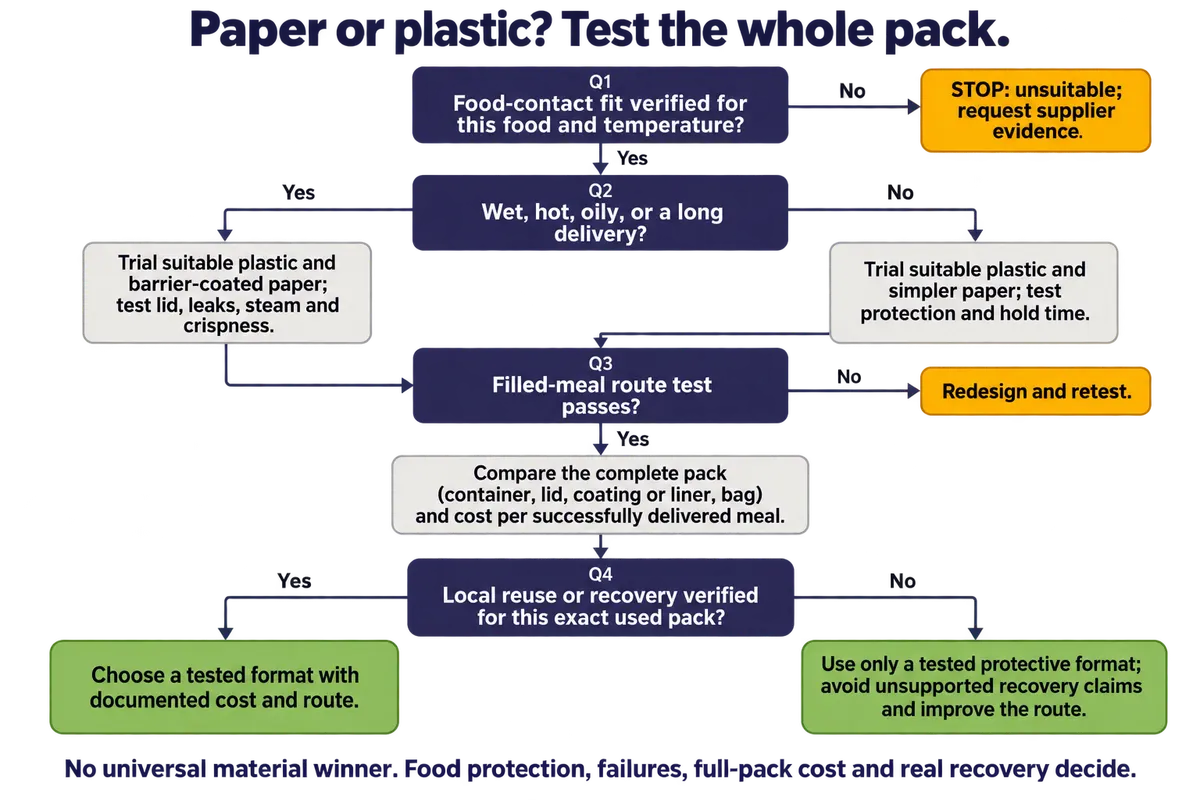
No packaging material is universally cheaper or more sustainable. The appropriate choice depends on the food, operating conditions, distribution route and realistic recovery options.
Material And Construction Set The Starting Price
Base Material Is Only The First Variable
Fibre, paperboard, moulded pulp, coated paper, bioplastic and conventional plastic involve different feedstocks, conversion processes and supply conditions. A broad label such as “paper” or “plant-based” does not establish grade, performance or environmental outcome.
The packaging material cost can change with board grade, fibre weight, resin content and the number of layers. Ask each supplier to identify the exact material grade and construction rather than relying on a general product description.
Buyers considering moulded fibre can also review bagasse packaging performance and specification trade-offs before comparing it with coated paper or other constructions.
Thickness And Rigidity Need A Practical Target
Grammage, wall thickness, flute profile, reinforcement, lid fit and compression strength affect both price and performance. Using less material can reduce the quotation but increase crushing, leakage or deformation during service.
More material is not automatically better. Unnecessary thickness can increase purchasing and freight costs without improving the outcome required by the business.
Coatings, Adhesives And Colourants Are Part Of The Pack
Grease, moisture, oxygen or heat resistance may require coatings or treatments. Fried food and nasi lemak may need grease resistance, while soup and curry may need a liquid barrier, reliable closure and heat performance.
Dry bakery products may need less barrier performance, depending on their fat content, humidity exposure and hold time. The complete pack, including coatings, adhesives, inks and colourants, should suit its intended food and use conditions.
Food-contact evaluations consider whether substances may migrate under the intended conditions. Material claims should therefore be reviewed against evidence for the complete construction, not inferred from the base material alone.
Food Use, Temperature And Hold Time Change The Specification
Before requesting prices, document the real operating conditions:
- Food type and fat content.
- Serving and filling temperature.
- Maximum contact and delivery time.
- Refrigeration, reheating or freezing requirements.
- Whether packs are stacked or carried at an angle.
- Expected exposure to humidity and condensation.
Compare Operational Specifications, Not Nominal Capacity
A useful comparison covers internal dimensions, usable capacity, closure type, leak resistance, grease resistance, temperature tolerance, stack strength and ventilation. It should also identify any sleeve, liner, tamper-evident feature or secondary bag needed in normal service.
For a hypothetical comparison, consider two 750 ml bowls. Bowl A costs RM0.05 less but needs a separately priced lid and frequent secondary bagging. Bowl B has a reliable fitted lid and does not need those additions for the intended menu. Bowl A is not necessarily the lower-cost system.
Before adding performance, ask whether the specification covers the worst normal use case or adds features the business does not need.
Order Volume Affects Unit Price, Cash Flow And Inventory Risk
Why Minimum Quantities Exist
The economics behind minimum order quantity packaging usually start with fixed production work. Machine setup, calibration, prepress, cutting preparation, print preparation and initial production waste must be covered whether a run produces 5,000 or 50,000 units.
Larger runs generally reduce unit price because fixed costs are spread across more units and equipment can run more efficiently. That does not mean the largest available tier produces the lowest total business cost.
Model Realistic Quantity Tiers
Request quotations at realistic monthly, quarterly and higher-volume quantities. For each tier, record the unit price, total cash outlay, lead time, storage requirement and risk that artwork or specifications will change.
Use this calculation:
Months of stock = ordered quantity ÷ average monthly usage
A lower unit price may be poor value during a new menu launch, seasonal promotion, pack-size trial or brand redesign. Excess stock ties up cash, occupies dry storage and leaves the business exposed to obsolete artwork.
Digital printing can make smaller trials or multiple artwork versions practical because it usually avoids printing plates. Its unit price may remain higher than an efficient long run, so request the quantity at which the preferred printing method changes.
Printing, Finishing And Tooling Create Visible And Hidden Charges
Separate The Printing Components
The custom packaging printing cost should be broken down into artwork checks, prepress, plates or cylinders, setup, colour calibration, inks, coatings, cutting, folding, gluing, proofs and production samples.
Heavy ink coverage, several colours, close colour matching and special finishes can increase material use, setup time or waste. Ask which charges recur on every order and which apply only to the first production run.
Compare Printing Methods At The Right Volume
Digital printing can suit tests, shorter runs and frequently changing artwork. Conventional printing may become more economical at sufficient volume but can require plates, longer setup and a larger production commitment.
Do not assume either process is cheaper. Ask for the crossover quantity using the same pack specification, artwork coverage and delivery basis.
Clarify Tooling Ownership
Custom packs may require cutting dies, moulds, plates or specialised fixtures. Establish whether each tooling charge is one-off or recurring, who owns the tool, how long it will be retained and who pays for wear-related replacement.
Also ask whether tooling can be used by another approved manufacturer. A distinctive custom shape can create supplier lock-in and make later switching more expensive.
Printing Has Food-contact Implications
Exterior printing should not automatically be treated as isolated from food. Some printing substances may migrate through packaging or transfer between surfaces under certain conditions.
The ink system, curing process, functional barriers and migration evidence may therefore affect the required specification and price. Do not describe an ink as suitable for food packaging without evidence covering the complete intended application.
Freight, Storage And Handling Determine The Delivered Cost
Light Packaging Can Still Be Expensive To Move
The sustainable packaging freight cost can be driven by transport space rather than product weight. Empty cups, bowls and clamshells may be light but bulky, so nesting efficiency, carton dimensions and pallet utilisation matter.
Carriers may compare actual weight with volumetric weight and use the applicable higher figure. Distance, route, transport mode, delivery speed, special handling, insurance and warehousing can add further costs.
A freight rule you can verify
The DHL Express Malaysia 2026 Service and Rate Guide, page 15 calculates volumetric weight for each piece as length × width × height in centimetres ÷ 5,000. Its shipment-weight guidance explains why a large, light carton can be charged by the space it occupies when volumetric weight exceeds actual weight. This is documented carrier guidance, not a result from a FoodPackLab shipment.
Record measured carton dimensions, packed weight and the quoted carrier service together. Confirm the divisor, rounding and surcharges for that service before comparing freight; the DHL Express rule is not a universal tariff for every carrier.
Calculate The Complete Landed Cost
For packaging landed cost Malaysia comparisons, use a consistent delivery destination and quantity:
Landed cost = goods + allocated tooling and setup + printing + freight + insurance + handling + applicable duties or taxes + local delivery + storage + expected loss
Confirm whether a quotation is ex-factory, delivered or based on another stated delivery term. Applicable import requirements, duties and taxes must be checked for the actual product, origin and effective date rather than estimated from an unrelated shipment.
Storage Belongs In The Calculation
Storage costs include rent or occupied shelf space, handling labour, stock counts, pest and moisture controls, damaged cartons and obsolete branding. Humidity, crushing, contamination and ageing adhesives can reduce the number of usable units.
Record cartons per 1,000 units and usable units per square metre. A cafe group may receive an attractive large-run price yet incur higher total cost because its outlets lack suitable dry storage.
Failures And Rejects Can Reverse An Apparent Saving
Packaging testing and failure costs include more than visibly defective stock. They can include leaks, lid separation, grease penetration, crushing, warping, condensation, jammed packs, print defects and extra materials needed by staff.
Under-packaging may lead to food remakes, refunds, repeat delivery fees, complaints and food waste. Over-packaging raises direct material, transport and storage costs. The target is sufficient performance with a reasonable margin for normal operating variation.
Calculate The Cost Per Successful Order
Effective packaging cost per successful order = total packaging and failure-related cost ÷ successful orders delivered
Consider a hypothetical week with 1,000 delivered meals. Option A costs RM300 for primary packaging but causes RM120 in replacement food, labour, refunds and extra bags. Its effective cost is RM420, or RM0.42 per successful order if all replacements eventually reach customers.
Option B costs RM360 and causes RM20 in related losses. Its effective cost is RM380, or RM0.38 per successful order. In this illustration, the higher-priced pack costs less in operation. An actual decision needs data from the business's own trial.
Put Defect Terms In Writing
Ask about acceptable defect levels, inspection methods, reporting deadlines, replacement terms and batch traceability. Inspect incoming cartons before distributing them across several outlets, where identifying and isolating a defective batch becomes harder.
Testing Should Reproduce Delivery And Handling Conditions
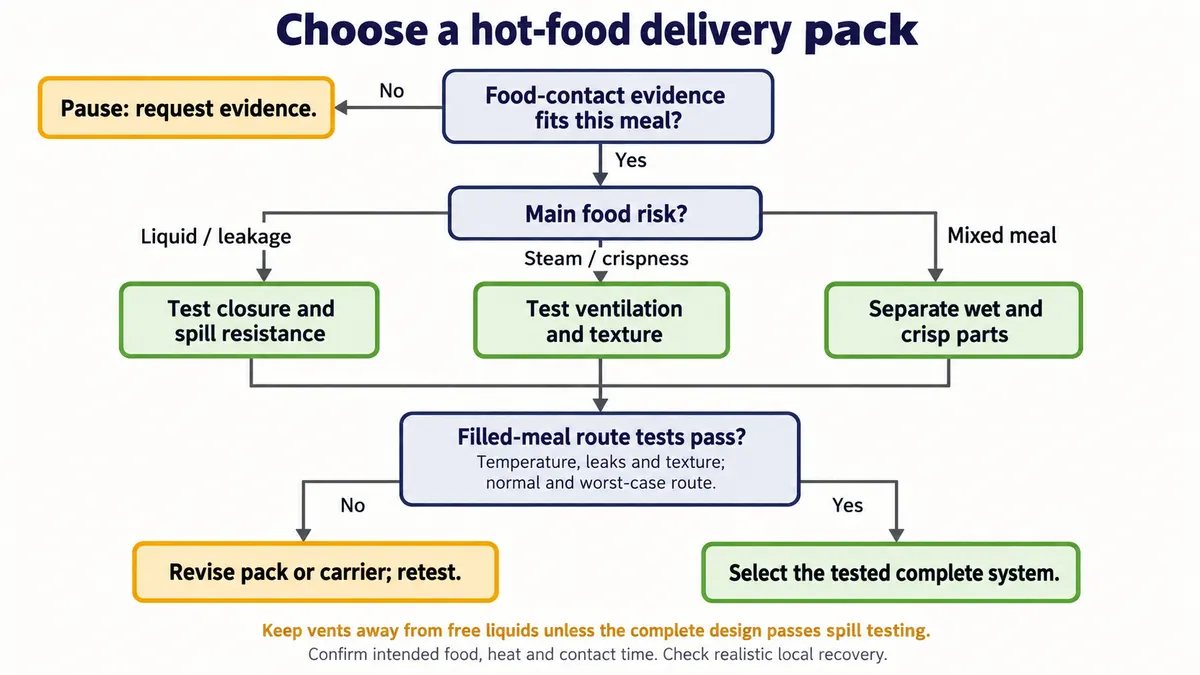
Trial the complete pack with the intended food, or an appropriate controlled substitute, at the real fill temperature and normal maximum hold time. Use the actual closure, liner, sleeve, bag and transport arrangement.
A practical operational trial can include:
- Leak and tilt checks.
- Stack and compression checks.
- Drop and handling checks.
- Heat and condensation observations.
- Grease-resistance observations.
- Staff packing-speed trials.
- Delivery-driver handling trials.
Distribution performance can change with drops, vibration, compression, temperature, humidity, storage duration and repeated handling. A container that looks stable on a desk may behave differently during a 40-minute motorcycle delivery.
Retest after changing material, supplier, wall thickness, grammage, coating, adhesive, closure, food, fill temperature, route, hold time, carton configuration or pallet pattern. A simple operational trial does not replace formal food-contact, safety, certification or distribution testing where those are required.
End-of-life Claims And Certification Also Carry Costs
Material Claims Are Not Verified Outcomes
Recyclable, compostable, biodegradable and bio-based describe different matters. They should not be used as interchangeable claims or treated as proof that a package will achieve a particular outcome in Malaysia.
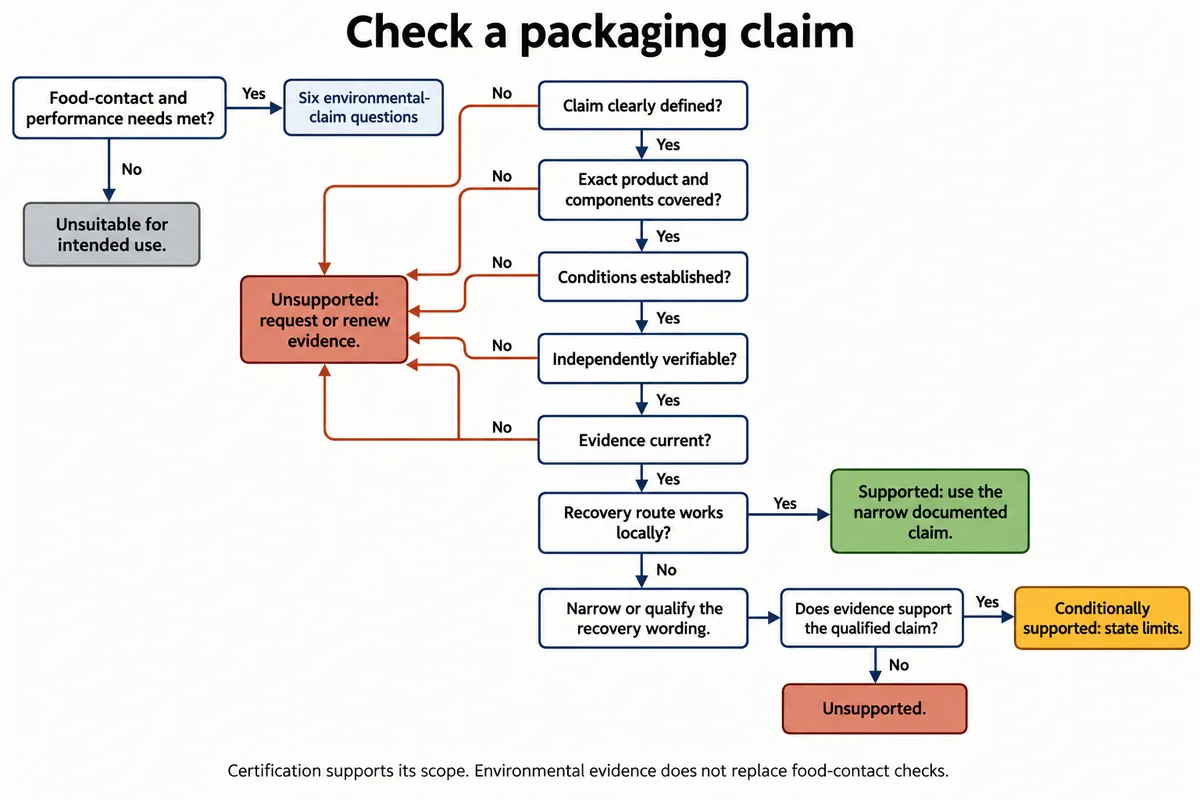
Ask for the applicable standard, claim conditions, certificate holder, exact product coverage and validity period. Record unsupported claims as “not verified” rather than filling the evidence gap with an assumption.
Certification Is Part Of The Specification
The compostable packaging certification cost can include laboratory testing, audits, licence terms, documentation and renewal. These are genuine specification expenses rather than decorative wording.
Industrial-compostability testing uses controlled conditions. This does not mean a certified item will break down quickly in soil, the sea, a home bin or another uncontrolled environment.
Certification scope, status and effective dates should receive documented human review before publication or purchasing claims are approved.
Check The Realistic Malaysian Recovery Route
Ask whether the item is accepted by the relevant collector or treatment facility, whether residue or liners must be removed and whether separate collection exists where the pack will be discarded. Also establish what happens when it enters general waste.
Businesses seeking an independent Malaysian environmental-verification route may assess the SIRIM Eco-Labelling Scheme. This does not mean every packaging product needs or qualifies for the scheme. Its applicable criteria, product scope and current status must be checked.
Bins, signage, staff training, contamination monitoring, collection contracts, temporary storage and evidence retention can add to the sustainable packaging cost. Include them when a business intends to support a recovery or environmental claim.
A Practical Method For Comparing Packaging Quotations
The clearest way to assess sustainable packaging price factors is to place every quotation in the same table. Use the same quantity, delivery location and food-use requirements.
| Area | Information to record |
|---|---|
| Pack | Material construction, capacity, dimensions, unit weight, coating, adhesive, ink and closure. |
| Intended use | Food type, temperature, contact time, stacking and supporting evidence. |
| Order | Quantity, minimum order, unit price, lead time and quotation validity. |
| Fixed charges | Setup, tooling, artwork, proofs and ownership terms. |
| Delivery | Carton quantity, dimensions, weight, freight basis and delivered price. |
| Operating risk | Storage requirement, expected usable rate, defect remedy and secondary packaging. |
| Claims | Tests, certificates, exact scope, validity and realistic end-of-life route. |
| Decision figure | Total landed cost and cost per usable unit. |
Use a quote-and-trial worksheet
Use one row per supplier and SKU at the same quantity, delivery destination and intended food use. This worksheet joins the quotation to the trial result, so an apparent saving must survive both checks.
| Record | What to enter or calculate | Check before comparing |
|---|---|---|
| Identity and scope | Supplier, SKU, quote date, validity, food-use evidence and trial conditions | Compare equivalent complete packs; hold unsuitable products outside the cost shortlist. |
| Total procurement cost | Goods plus required parts, allocated setup, freight and other applicable costs | If a delivered quote already includes a cost, do not add it again. |
| Usable units | Units received minus rejected or damaged units | Record the inspection count; do not assume every unit is usable. |
| Procurement cost per usable unit | Total procurement cost ÷ usable units | Zero usable units means reject or investigate; do not divide by zero. |
| Order outcome | Unique customer orders successfully fulfilled and incremental packaging-related failure costs | Count a remade order once when eventually fulfilled. Do not count an attempted delivery as a separate successful order. |
| Operating cost per successful order | Packaging cost consumed plus incremental failure costs, divided by unique successful orders | Use the same trial period. Count a replacement cost once; reconcile refunds and remakes against the incident log. |
For a hypothetical procurement example, Supplier A quotes RM300 delivered for 1,000 complete packs and inspection rejects 20. Its procurement cost per usable unit is RM300 ÷ 980, or about RM0.306. Supplier B quotes RM310 delivered for 1,000 complete packs with no rejects: RM0.310 per usable unit. The difference is about RM0.004 per usable pack before any trial failures. These invented figures illustrate the calculation; they are not market prices or measured supplier performance.
Choose a candidate only after its food-use evidence and operational trial pass. Keep the quote, inspection count, failure log and recovery-route evidence beside the calculation so another buyer can reproduce the comparison.
Use A Four-step Buying Decision
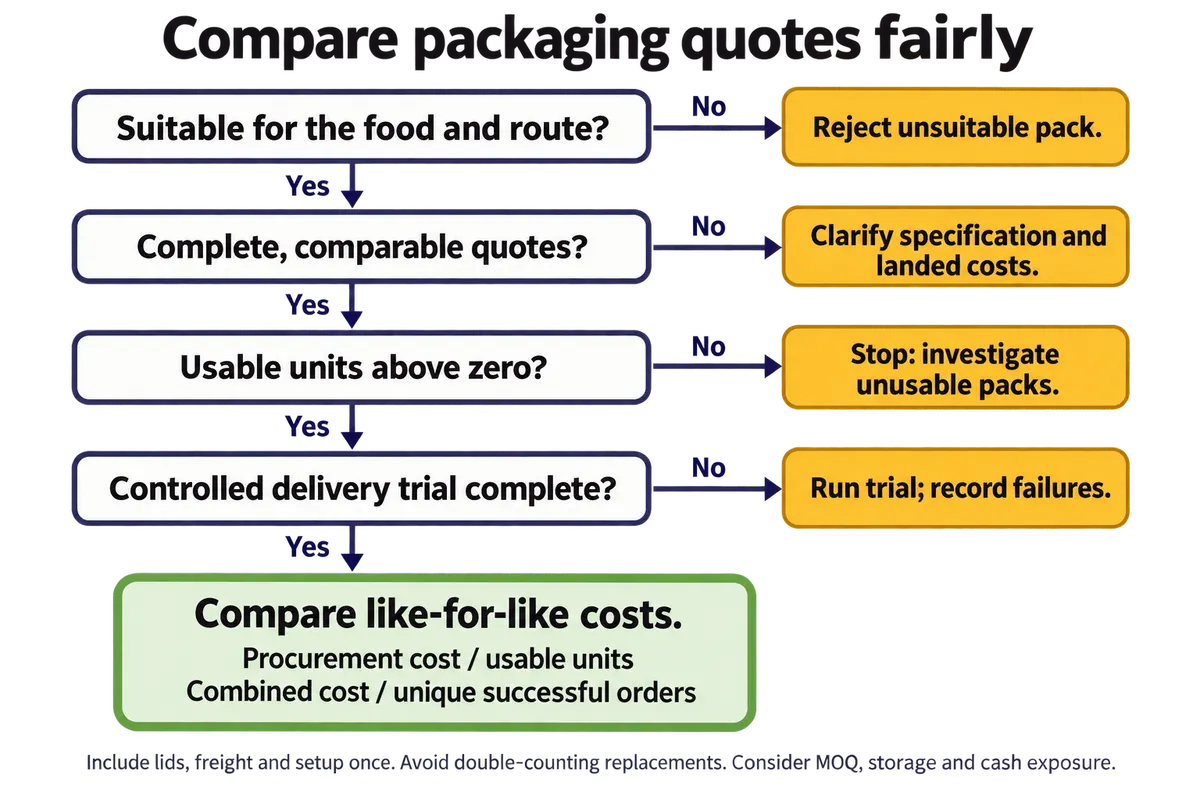
- Eliminate packs that do not meet the intended food-use and operational requirements.
- Compare total landed cost at the same quantity and delivery location.
- Adjust for storage, failures, secondary packaging and the expected usable rate.
- Review sustainability evidence and whether the intended recovery route is realistically available.
Questions To Send Every Supplier
- What exact material grade and construction are quoted?
- Which food, temperature and contact-time conditions does the evidence cover?
- Are lids, liners, sleeves and secondary packaging included?
- Which charges are one-off, recurring or refundable?
- What changes at the next quantity tier?
- What are the packed-carton dimensions and weight?
- Is freight calculated using actual or volumetric weight?
- What defect tolerance and remedy apply?
- Which tests and certificates cover this exact product?
- What collection or treatment conditions are necessary for the environmental claim?
For further comparisons, browse the packaging buying guides or compare packaging materials and use cases.
Frequently Asked Questions
Why Does Sustainable Packaging Sometimes Cost More Per Unit?
The pack may use a different grade, coating, construction or production process. Testing, certification, lower production volume and limited local availability can also affect its price. Compare equal performance requirements before attributing the difference to sustainability alone.
Does A Higher Order Quantity Always Reduce Total Business Cost?
No. It can reduce the quoted price per unit while increasing cash commitment, storage costs and exposure to obsolete artwork or specifications. Model months of stock and total cash outlay before accepting the larger tier.
Why Is Freight Expensive For Lightweight Containers?
Empty containers can occupy substantial transport space. If the shipment's volumetric weight exceeds its actual weight, freight may be priced using the larger measure.
When Is Custom Printing Worth The Setup Cost?
It may be justified when branding or customer instructions create enough operational value and demand is sufficiently stable. For early tests or frequently changing artwork, labels, sleeves or digital printing may reduce commitment, subject to food-use and recycling implications.
Does Compostable Packaging Automatically Suit Malaysian Waste Systems?
No. A useful composting outcome depends on suitable separation, collection and treatment under the required conditions. Verify acceptance with the relevant operator instead of relying only on the material claim.
Choose On Total Cost And Controlled Evidence
Sustainable packaging price factors should be assessed as one operating-cost and risk decision. The lowest unit price is incomplete if the pack needs extra bags, occupies excessive storage, fails during delivery or carries an environmental claim that cannot be supported.
Shortlist two or three specification-compliant options. Request itemised delivered quotations, then run a controlled trial before placing a large custom order.
Copy the comparison table and complete it using current supplier documents and your actual food, delivery and storage conditions. Food-contact, safety, legal, certification and environmental wording should receive documented human approval. If a purchasing issue remains unclear, you can submit a packaging question for future editorial coverage.