FoodPackLab Editorial Team
How Malaysian F&B Buyers Can Avoid Packaging Greenwashing: A Six-Part Evidence Checklist
A leaf logo or an environmental claim can look convincing without covering the pack you are buying. Malaysian restaurant, cafe, bakery, cloud kitchen, catering and food truck buyers can use this six-part checklist to check the claim definition, product scope, conditions, verifier, evidence date and actual recovery route.
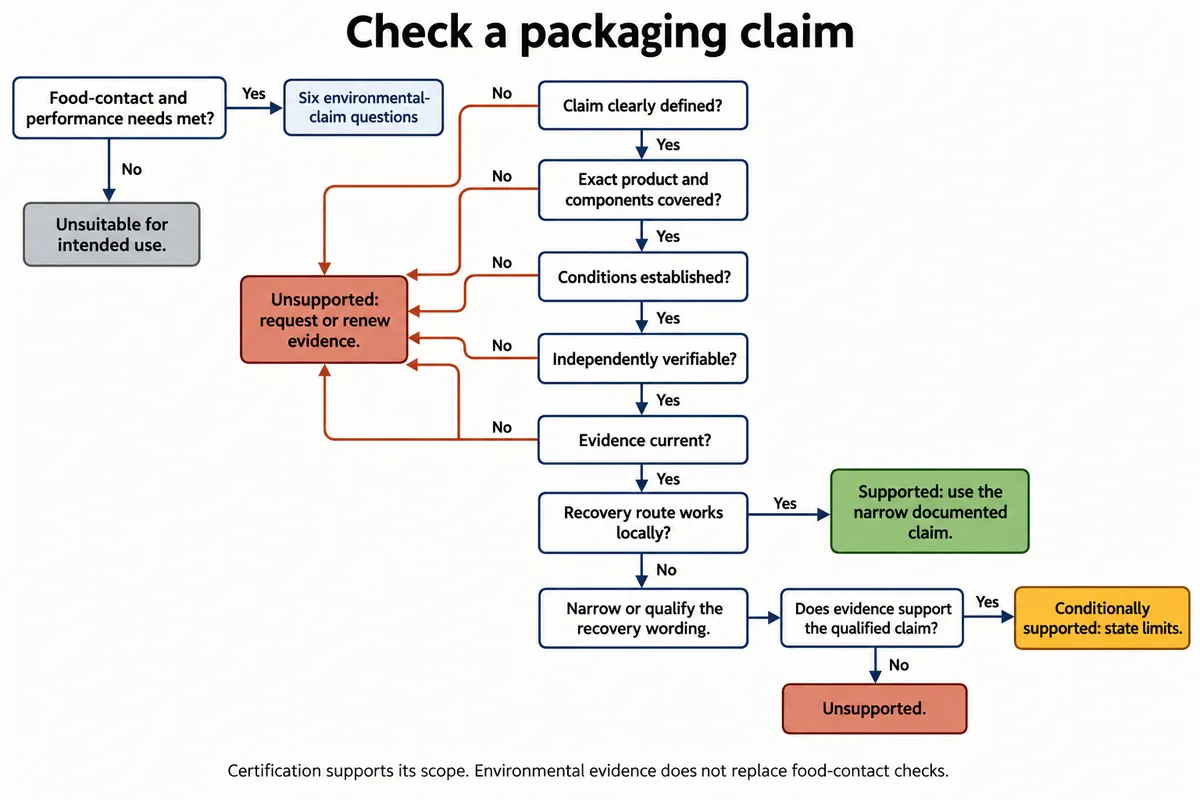
A leaf logo or an environmental claim can look convincing without covering the pack you are buying. Malaysian restaurant, cafe, bakery, cloud kitchen, catering and food truck buyers can use this six-part checklist to check the claim definition, product scope, conditions, verifier, evidence date and actual recovery route.
The short answer: approve only the narrowest environmental statement supported by current evidence for the exact packaging SKU and a realistic recovery route. One preferable attribute does not make the complete package preferable for every food, outlet or disposal system.
Why Vague Environmental Claims Create Purchasing Risk
Discussions about environmental packaging claims Malaysia often begin with broad words such as “green”, “planet safe” or “environmentally friendly”. These expressions create an overall impression but may not identify a measurable product attribute.
A narrower statement is easier to test. “The bottle body contains 30% post-consumer recycled material” identifies a percentage, a component and a type of recovered material. It does not claim that the cap is included or that the finished bottle will be recycled after use.
Malaysia’s Consumer Protection Act 1999 prohibits false or misleading representations about matters including the standard, quality, composition, approval, endorsement, performance characteristics, uses and benefits of goods. Unsupported packaging wording may therefore create procurement, customer-trust and compliance risk when a supplier or F&B business repeats it.
This is general purchasing information, not legal advice. Any interpretation of Malaysian law should receive qualified human review before publication or use in a commercial decision.
ISO 14021:2026 provides a relevant framework for self-declared environmental claims communicated through words, symbols or graphics on products, packaging, advertising and digital channels. A statement that something is “ISO compliant” is not enough on its own. Request the applicable version, assessment method, evidence date and identity of the product assessed.
Record the claim definition, the product it covers and the route available after use before relying on it.
Use A Six-part Packaging Greenwashing Checklist
The following test can be used before approving samples, quotations or purchase orders. Passing one row does not compensate for failing another. A valid sourcing certificate, for example, does not establish local recyclability.
| Test | Buyer question | Evidence to request | Warning sign |
|---|---|---|---|
| Definition | What exactly does the claim mean? | A written definition and referenced criterion | Vague language with no measurable attribute |
| Scope | Which product, component and SKU are covered? | Product name, brand, model, material layers and certificate schedule | A company certificate presented as proof for every item |
| Conditions | What temperature, time, facility or preparation is required? | Test conditions and disposal instructions | An unqualified claim that omits necessary conditions |
| Verification | Who tested or certified it, and against what criterion? | Issuer, certificate number, standard and report | A logo with no searchable record |
| Date | Does the evidence still apply? | Issue date, expiry date and current product specification | An undated report or expired certificate |
| Recovery route | Who will collect and process the used package? | A named collection point, collector or facility acceptance record | “Technically recyclable” with no practical route |
Record the answers in the same supplier-comparison sheet used for price, minimum order quantity, lead time and functional performance. This prevents a polished presentation from receiving more weight than comparable evidence.
Define The Claim Before Accepting It
Biobased Describes Feedstock Origin
Biobased means that some or all of a material comes from biological feedstock. It does not automatically mean the material is biodegradable, compostable or recyclable.
Ask which component is biobased, what percentage applies and how that percentage was assessed. A partial biobased content claim should not be expanded into a statement about the complete package.
Biodegradable Needs An Environment And Timeframe
The useful question is not simply whether something biodegrades. Ask where it biodegrades: soil, freshwater, marine conditions, home composting or a controlled industrial facility. Then ask for the required temperature, humidity, duration and assessment method.
A claim with no environment or reasonable timeframe gives the buyer little basis for comparison. It can also encourage disposal behaviour that the available evidence does not support.
Biodegradable Vs Compostable Packaging
Compostability is a more specific claim. It generally requires evidence that all covered materials become usable compost safely under defined conditions and within an appropriate period. Industrial compostability may depend on controlled temperatures, separate collection and acceptance by a suitable facility.
Ask whether the claim covers industrial or home composting. If industrial conditions are required, identify a Malaysian collection and processing route before presenting compostability as a practical benefit.
Recyclable Requires Access, Not Just Material Theory
A material may be technically compatible with a recycling process but have no collection or processor access where the package becomes waste. Coatings, food residue, dark colours, labels or mixed components may also alter acceptance.
Recycled Content Is Different From Recyclability
A package can contain recovered material and still be difficult to recycle after food use. Ask for the exact percentage, the component covered and whether the content is post-consumer material or manufacturing scrap diverted from the waste stream.
Check Whether The Evidence Covers The Complete Package
Evidence often covers the simplest component rather than the complete item supplied. Map every claim against the base tray, bowl, cup or box; barrier coating or lining; lid or window film; label and adhesive; printing inks; and any cutlery or sachets included in the order.
Consider a curry container with a certified fibre base, a plastic lining and a separate lid. The certificate for the fibre does not automatically describe the end-of-life route of the lining or lid. A test on an uncoated tray also does not establish the same result for a coated, printed and labelled version.
Match the evidence to the exact formulation, thickness, coating, colour, ink and component combination in the quotation. If a supplier cannot complete that mapping, treat the uncovered components as evidence gaps.
How To Verify Eco Labels Malaysia Buyers Encounter
A certification can support a defined attribute without validating every environmental implication around the product. Compare the quotation, physical sample, specification, certificate schedule and official directory entry line by line.
SIRIM Eco-Labelling Verification
The SIRIM Eco-Labelling Scheme is recognised as Malaysia’s national eco-labelling programme and independently verifies products against specified environmental criteria. Certification depends on compliance with the applicable standard or SIRIM Eco-Label Criteria, together with a factory quality-control system intended to maintain continuing compliance.
Request the exact certificate or licence details, applicable criterion, certified product description, model and current validity. “SIRIM approved” is too broad when the precise certification and covered product are not identified.
MyHIJAU Mark Verification
Product eligibility depends on qualifying certification or performance-standard compliance from a verification body recognised by MGTC. Check the product rather than relying on a supplier’s general association with the programme.
The directory can show the certificate number, certified date, expiry date, product name, brand and model. A product certificate lasts no more than three years from approval or until its supporting certification expires, whichever occurs first.
FSC Certificate Verification
FSC chain of custody concerns the sourcing and traceability of forest-based material through production and distribution. It does not, by itself, prove that a coated paper cup or food box is recyclable or compostable through a Malaysian system.
Check the certificate holder, validity, scope and whether the claim applies to the supplied product. Keep the forest-sourcing claim separate from any end-of-life claim.
Scheme terminology, rules and certificate validity can change. A qualified human should confirm certification language and official records immediately before publication or procurement approval.
Match Dates, Versions And Product Identity
Evidence becomes stale when certificates expire, criteria change, factories move or suppliers change coatings, inks and component vendors. A report may also describe an earlier product code that looks similar to the current sample.
- Record the quoted product code and revision.
- Match that identity to the physical sample and specification sheet.
- Match it to the test report or certificate schedule.
- Check the issue date, expiry date and applicable standard version.
- Confirm whether the material, factory or process has changed since assessment.
Add a “verified on” date to the procurement file. Reassess the claim before certificate expiry and whenever the specification, manufacturing location or supporting process changes.
An older report is not automatically invalid. The supplier should, however, show why it continues to represent the product currently offered.
Test Recyclable Packaging Malaysia Claims Against A Real Route
Technical capability is not the same as practical recovery. A credible route needs a place where the waste arises, a person or process that separates it, and a collector or facility that currently accepts the complete used package.
SWCorp Drive-Thru Recycling Centres are intended for recyclables that users have already separated. This does not mean every centre accepts every food-packaging material or condition.
- Identify the outlet, event or customer setting where the package becomes waste.
- Decide who will separate and store it.
- Name the collection point, contracted collector or processing facility.
- Confirm current acceptance of the exact complete package.
- Ask about food residue, coatings, films, lids, labels and inks.
- Confirm cleaning, minimum-volume, storage and transport requirements.
- Recheck acceptance periodically because services and commercial viability can change.
A clean bakery carton may face different acceptance conditions from an oil-stained fried-food box. A catering operation may control separation more easily than a takeaway order delivered to a customer. An industrially compostable cup provides no practical recovery benefit if it enters general waste and no contracted composting route exists.
External guidance uses availability to at least 60% of consumers or communities as a threshold for an unqualified recyclable claim. That figure can be a useful screening reference, but it is not Malaysian law and does not establish Malaysian collection access.
When recovery is limited, qualify customer-facing wording. Naming participating outlets or a contracted collection programme is more defensible than implying nationwide availability.
Keep Environmental Evidence Separate From Food Contact Safety Testing Malaysia
Environmental credentials do not establish food-contact suitability or functional performance. Malaysia’s Food Regulations prohibit packaging that releases or may release poisonous, harmful or deteriorative substances into food.
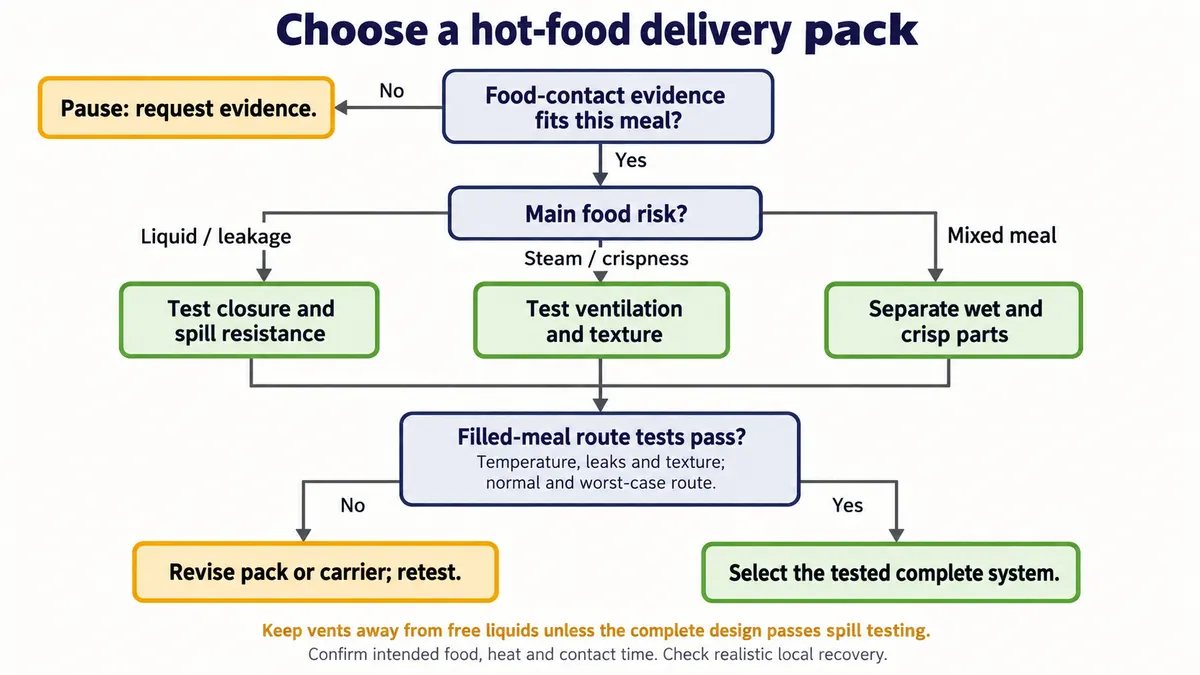
Match food-contact evidence to the intended food, contact temperature, duration, oil exposure, acidity and moisture. Microwave, reheating, freezing and prolonged holding need separate support when those uses are claimed.
- Hot soup and curry require checks for heat, liquids and contact time.
- Fried food requires oil-resistance and ventilation checks.
- Cold drinks and bakery items create different exposure conditions.
A package can have a credible environmental attribute and still be unsuitable for a specific menu item. Food-contact, migration and safety statements require qualified human review before publication or purchase approval.
Sustainable Packaging Procurement Checklist For An RFQ
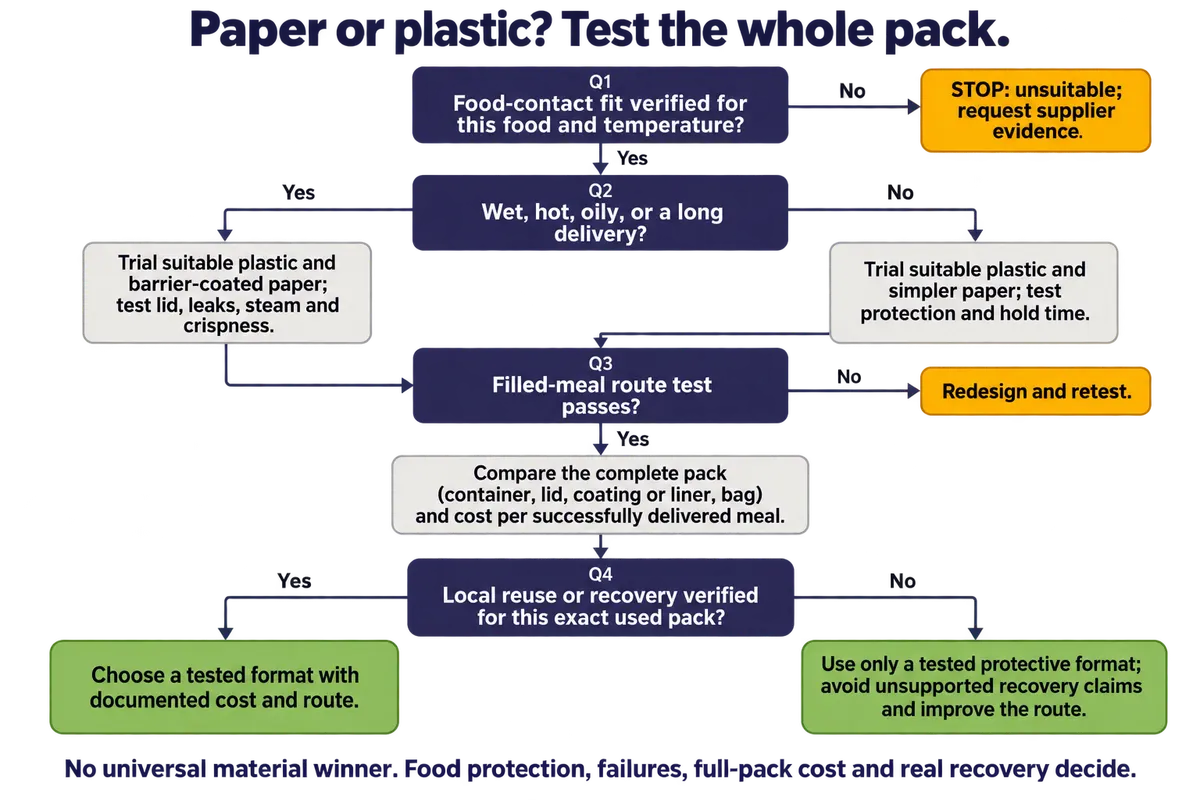
Copy these questions into a supplier enquiry. Record unanswered questions as evidence gaps rather than silently converting them into assumptions.
- What precise environmental claim are you making?
- What definition, criterion or standard supports it?
- Which exact product code, brand, model and components are covered?
- Does the evidence include coatings, lids, labels, adhesives and inks?
- Who issued the certificate or test report?
- What are the certificate number, report number, issue date and expiry date?
- Can the record be checked in an official directory?
- What conditions are required for biodegradation, composting or recycling?
- Which Malaysian collector or facility currently accepts the used package?
- What sorting, cleaning, volume, storage or transport conditions apply?
- What recycled-content percentage is present, and is it post-consumer material or manufacturing scrap?
- Has the formulation, coating, factory or process changed since testing?
- What food-contact evidence supports the intended food, temperature and contact time?
- What limitations must appear in customer-facing wording?
| Field | Your record |
|---|---|
| SKU | ________________ |
| Supplier | ________________ |
| Certificate or report number | ________________ |
| Expiry date | ________________ |
| Confirmed recovery route | ________________ |
| Verification date | ________________ |
| Reviewer | ________________ |
| Evidence gaps and claim limitations | ________________ |
Turn The Evidence Into A Defensible Buying Decision
A practical way for Malaysian F&B buyers to avoid packaging greenwashing is to assign one of four statuses to each claim:
- Supported
- A defined claim, exact SKU match, current evidence and workable recovery route are documented.
- Conditionally supported
- Evidence exists, but the wording must state conditions, exclusions or limited availability.
- Not yet supported
- Evidence is missing, expired, mismatched or cannot be independently verified.
- Unsuitable for the use case
- The environmental evidence may be valid, but functional or food-contact requirements are not met.
A simple process for a smaller F&B business
- Use one spreadsheet row per packaging SKU.
- Save the quotation, specification, certificate and official-directory record.
- Record the recovery-route confirmation and verification date.
- Approve only the narrowest statement supported by the evidence.
A process for multiple outlets
- Maintain an approved-claims register.
- Set certificate-expiry reminders.
- Require suppliers to notify the buyer of specification and factory changes.
- Sample-check supplied stock against approved specifications.
- Revalidate recovery routes before expanding into another market.
Evidence and infrastructure must be assessed separately in each country. Malaysian verification should not be copied across Southeast Asian markets without reviewing local certification rules, collection access and processing conditions.
Common Questions About Environmental Packaging Claims
Can A Certified Package Still Carry A Misleading Environmental Message?
Yes. Certification supports its documented scope. Other explicit or implied statements still need evidence, including claims about the complete package or its local recovery route.
Does Biodegradable Packaging Break Down In A Malaysian Landfill?
Do not assume that it does. Performance depends on the environment, conditions and timeframe covered by the evidence. A general biodegradable claim does not establish degradation under landfill conditions.
Does An FSC Label Mean A Paper Food Box Is Recyclable?
No. The label addresses forest-based material sourcing and traceability. Local collection and processing of the finished, coated and food-contaminated box must be assessed separately.
How Often Should Environmental Packaging Evidence Be Checked?
Check it during supplier onboarding, before certificate expiry, after a product, process or factory change, and whenever collector or facility acceptance changes.
Start With One High-volume Packaging SKU
The practical lesson for Malaysian F&B buyers is to reduce each broad environmental promise to a precise definition, exact scope, stated conditions, current evidence and a real recovery route. Certification supports only its documented scope and does not replace packaging-performance or food-contact checks.
Apply the six-part checklist to one high-volume takeaway SKU before changing the whole range. Document the gaps, test the package against its intended food and compare suppliers on the same evidence basis.
For broader material comparisons, visit the packaging buyer guides or review the different eco packaging types, including the guide to bagasse food packaging. Buyers who need help structuring an enquiry can use the neutral packaging enquiry form.
References
- Malaysia Consumer Protection Act 1999 (Act 599)
- ISO 14021:2026 : Self-declared environmental claims
- US Federal Trade Commission : Environmental Claims: Summary of the Green Guides
- SIRIM QAS : Eco-Labelling Scheme
- SIRIM QAS : Eco-Labelling Certification Scheme Information
- MGTC : Guideline for Registration of MyHIJAU Mark Product
- MGTC : MyHIJAU Mark Product Registration Guideline
- MyHIJAU Directory : Product List