FoodPackLab Editorial Team
Malaysian Food Contact Packaging Declaration Checklist: Documents, Testing And Approval
A supplier says a takeaway container is “food grade”. But does the document cover the exact container, its coating, hot oily food, two hours of delivery and microwave reheating? This food contact packaging declaration checklist helps Malaysian F&B procurement buyers, restaurant operators, caterers and cloud kitchens answer those questions before approving a sample, issuing a purchase order or changing supplier.
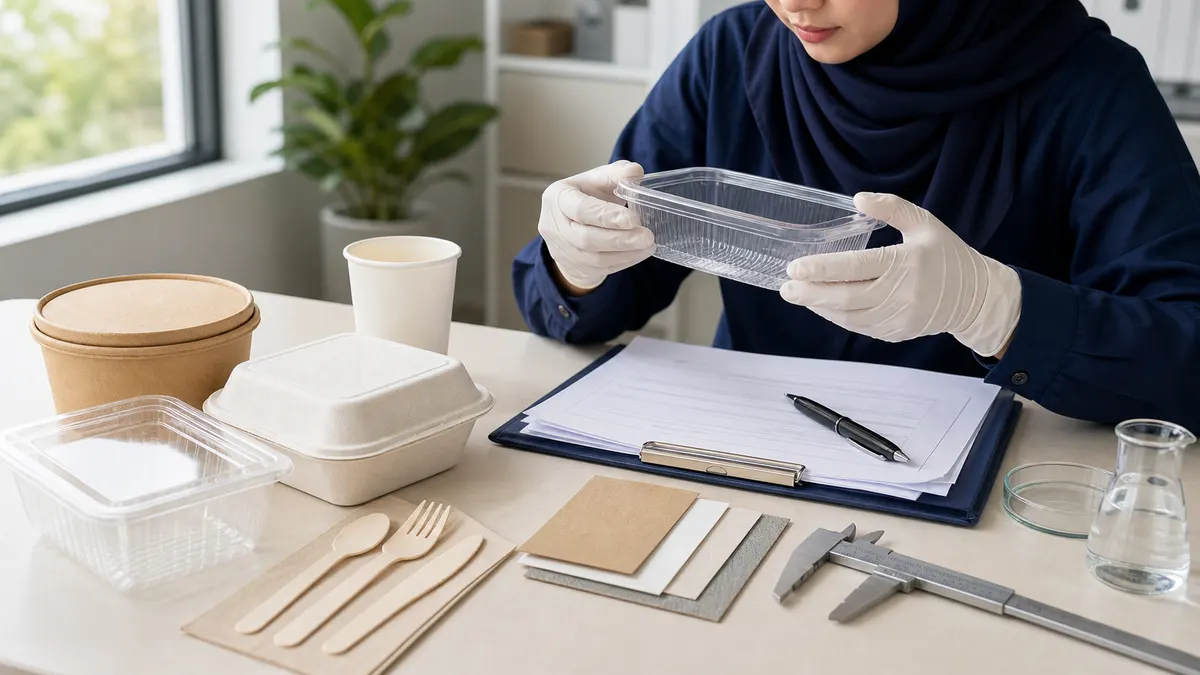
A supplier says a takeaway container is “food grade”. But does the document cover the exact container, its coating, hot oily food, two hours of delivery and microwave reheating? This food contact packaging declaration checklist helps Malaysian F&B procurement buyers, restaurant operators, caterers and cloud kitchens answer those questions before approving a sample, issuing a purchase order or changing supplier.
A useful declaration must identify the exact packaging supplied, describe its complete food-contact construction, state the conditions under which it is suitable, and point to current evidence covering those conditions. A generic certificate, resin statement or report for a different product is not enough.
Food Contact Packaging Declaration Checklist At A Glance
For a fast first pass, use the six checks below before reviewing the detailed requirements.
- Identify the product: Match the declaration, quotation, sample, specification and delivered SKU.
- Confirm the construction: Check the main material, layers, coatings, inks, adhesives, barriers and relevant variants.
- Define the intended use: Record the food type, fill temperature, contact duration, delivery, storage and reheating conditions.
- Match the testing: Confirm that test samples, simulants, time, temperature and article configuration represent the intended use.
- Resolve limitations: Obtain clarification, matched evidence, qualified review or a documented restriction for every material gap.
- Control approval: Retain traceability records and require notification before relevant supplier, material or process changes.
The checklist covers declaration of compliance, material composition, intended-use conditions, migration testing, supporting documents, supplier change notification and traceability for food contact packaging in Malaysia.
What This Checklist Should Help You Decide
The purpose is not to collect the largest possible folder of certificates. It is to decide whether the available evidence supports a defined packaging application.
A bakery tray used at room temperature presents different conditions from a container holding hot, oily curry during delivery. Evidence that supports one application does not automatically support the other.
Use the checklist to:
- confirm that a declaration covers the exact SKU being purchased, rather than only a resin family or similar container;
- compare the reported food, temperature, contact time, transport and reheating conditions with actual operations;
- identify missing information that needs supplier clarification, further evaluation or qualified review;
- build a procurement record that can be retrieved by supplier, product, batch and document revision; and
- record any approved limitations in specifications, purchasing controls and staff instructions.
Documents support a buying decision, but they do not replace incoming inspection or practical trials for sealing, leakage, stacking and delivery performance. They also do not replace qualified legal, compliance or food-contact review where the risk or uncertainty requires it.
A declaration is useful only when you can draw a straight line from the tested sample to the delivered pack and its real use.
Start With The Malaysia Food Regulations 1985 Packaging Requirements
Regulation 27 provides the general Malaysian baseline. It prohibits the import, manufacture, sale or use of a package, appliance, container or vessel that yields or could yield a toxic, injurious or tainting substance to food, or contributes to food deterioration.
For buyers, the practical action is to obtain product-specific evidence and check whether it represents the foreseeable application. Possession of a certificate does not prove that every food, temperature, duration or method of use is supported.
Additional Checks For Particular Materials
Regulation 28 addresses enamelled or glazed earthenware intended for food use. If this type of article is being considered, request the applicable prescribed acid-resistance results and results relevant to lead, antimony, arsenic and cadmium. Do not assume that this list represents the complete evaluation needed for every product or use.
For rigid or semi-rigid polyvinyl chloride food-contact packaging, Regulation 29 sets a limit of 1 mg/kg vinyl chloride monomer in the packaging. Regulation 30 sets a limit of 0.05 mg/kg vinyl chloride monomer in food packed in that packaging.
These numerical limits are concrete reasons to ask what material is being supplied and which evidence applies. A general statement about “food-grade plastic” does not answer a material-specific question.
This article is a procurement aid, not legal advice. The applicable legal text, amendments and transaction-specific obligations should be checked before publication and approval. Certification, legal, food-contact and safety conclusions should receive qualified human review, especially for regulated materials, unfamiliar constructions or high-severity uses.
Request A Product-specific Food Packaging Declaration Of Compliance
A supplier may call the document a declaration, compliance statement, conformity declaration or another similar name. The title, legal basis and mandatory status can depend on the material, jurisdiction and supply chain.
What matters to the buyer is the content and product link. An overseas declaration format can be a useful evidence model, but it should not be described as Malaysian approval unless a competent review supports that conclusion.
Declaration Identity Checklist
Ask the issuer to state:
- the legal name and address of the business issuing the declaration;
- the manufacturer and importer, where either differs from the issuer;
- the manufacturing site or source covered, where this is needed to distinguish production;
- the exact product name, supplier code, buyer code and SKU;
- the packaging form, dimensions, capacity, colour and relevant variant;
- the material or finished article covered;
- the declaration date, revision number and effective date;
- the name, position, signature or controlled approval of the responsible issuer;
- the market or regulatory basis claimed; and
- all exclusions, limitations and conditions of use.
Product Matching Check
Compare the identifiers on the declaration with the quotation, sample label, product specification, purchase order and delivered item. Check colour, dimensions, thickness, capacity, manufacturing source and any printed or coated variant.
Wording such as “all plastic containers”, “made from approved resin” or “food-grade material” is insufficient unless the supplier can connect it to the purchased article and applicable evidence.
If a food contact material supplier declaration covers only an upstream resin, ask how that declaration connects to the converter’s finished article. Forming, printing, coating, adhesive use and other conversion steps may introduce conditions that the resin statement does not address.
Complete The Packaging Material Composition Checklist
Request enough information to connect the supplied packaging with the tested sample. This does not necessarily require the supplier to disclose every confidential formulation detail to procurement staff.
Basic Article Details
- Main material and grade, or another sufficiently specific material designation.
- Single-use or repeat-use status.
- Nominal thickness and permitted thickness range, basis weight or weight per unit area, as applicable.
- Maximum use level or concentration for relevant food-contact components where needed.
- Colourants, fillers, additives or other components that are restricted or relevant to the evidence.
- Product dimensions and food-contact surface area.
- Manufacturing method where it affects identity, construction or migration performance.
Multilayer, Coated And Printed Packaging
- Complete layer order and approximate thickness of each layer.
- Clear identification of the food-contact side.
- Coatings, sealants, adhesives, printing inks and barrier layers.
- Whether printing is on the food-contact side or could transfer through set-off.
- Any functional barrier and the evidence supporting its claimed conditions.
- Variations by colour, print design, size, manufacturing site or production line.
A declaration naming only the main resin may miss the part that matters. For example, the sealant, coating or adhesive could differ between two containers that otherwise look identical.
A Controlled Route For Confidential Information
Allow the supplier or upstream manufacturer to send restricted formulation or substance information directly to an appointed laboratory or qualified adviser. This can protect legitimate confidentiality while allowing technical review.
Confidentiality is not a sufficient reason to provide no product linkage, no use limitations and no route for review. Procurement can still require a clear description of what the evidence covers.
Define The Food Packaging Intended Use Conditions
Complete the intended-use worksheet internally before asking a supplier whether the pack is suitable. The supplier cannot assess an application that has been described only as “for takeaway food”.
Food And Beverage Conditions
- Record whether the food is dry, aqueous, acidic, alcoholic, fatty or mixed.
- Name representative foods, such as nasi lemak, oily curry, soup, fried food, bakery items, chilled drinks or hot drinks.
- State whether food may contact the lid, liner, seal, coating, print, straw or cutlery.
- Record whether the food is freshly prepared, chilled, frozen or shelf-stable.
Complete Time And Temperature Sequence
- Temperature when the food enters the pack.
- Hot-fill or cold-fill conditions.
- Expected holding and takeaway-delivery duration.
- Chilled or frozen storage duration.
- Expected delay before consumption.
- Reheating method, power or temperature and duration, where intended.
- Oven, steaming, boiling or direct-hot-surface exposure, where applicable.
- Number and type of cycles if the article is intended for repeat use.
Physical Use Conditions
- Fill volume and headspace.
- Food-contact surface-area-to-volume ratio.
- Upright, tilted or inverted transport.
- Stacking, sealing and internal pressure conditions.
- Contact with sharp, heavy or greasy foods.
- Use with lids, liners or components supplied separately.
Ask the supplier to confirm the exact conditions supported. “Heat resistant” and “microwave safe” are incomplete statements unless the temperature, duration, food type, article configuration and evidence basis are defined.
Match Food Contact Migration Testing Requirements To The Real Use
Migration testing is use-dependent. There is no universal report that supports every food and every temperature.
Review The Report Scope
For each report, check:
- the exact sample identity and whether it matches the supplied SKU, formulation, thickness and construction;
- the laboratory identity, report number, issue date and report status;
- the test method, referenced standard and jurisdictional framework;
- the overall migration, specific migration or material-specific tests performed;
- the food simulants and the reason they represent the intended foods;
- the contact time and temperature;
- the surface-area-to-volume ratio and any reduction factors or assumptions;
- the result units, detection limits, applicable limits and conclusion;
- all deviations, exclusions, untested components and laboratory remarks; and
- whether any claimed accredited scope covers the reported method.
Do not infer laboratory accreditation from a logo alone. Check the accreditation body, certificate status and scope where accreditation is material to the decision.
Check Whether The Simulants Represent The Food
Aqueous, acidic, alcoholic and fatty foods may require different simulants or evaluations. A dry-food report or an ambient-water test does not, by itself, support hot fatty curry, extended soup contact or another materially different use.
Under the EU plastics model, articles represented as suitable for all food types are generally assessed using simulants A, B and D2, subject to that framework’s rules and exceptions. Treat this as a practical benchmark when relevant, not as automatic Malaysian approval.
Check The Worst Foreseeable Sequence
The evidence should represent the most severe foreseeable combination of contact time and temperature. If the pack is hot-filled, stored and later reheated, ask whether the evaluation covers the applicable successive stages rather than only one isolated stage.
Do not accept extrapolation from a milder condition without a documented technical basis. If the evidence supports ambient filling only, the practical options are to obtain matched evidence, change the packaging or restrict the operating condition.
Request Information About Restricted Substances And Material-specific Risks
Ask the supplier to identify substances subject to applicable restrictions and provide relevant migration information. Where details are confidential, use a controlled route to a laboratory or qualified reviewer.
Confirm whether restrictions depend on food type, contact temperature, duration, article thickness, contact ratio or another condition. Avoid creating a universal prohibited-substance list without first defining the regulatory framework and obtaining current expert review.
- Rigid or semi-rigid PVC: request evidence relevant to the Malaysian vinyl chloride monomer limits.
- Enamelled or glazed earthenware: request the applicable heavy-metal and acid-resistance results.
- Paper, board and moulded fibre: request evidence for the complete article, including any coating, additive, adhesive, ink or liner relevant to food contact.
- Other materials: request evidence appropriate to the actual construction and claimed market basis rather than applying a plastics-only checklist.
Add Extra Checks When Recycled Plastic Is Proposed
A recycled-content percentage is not a food-contact assessment. The relevant questions concern the source, process, contaminant controls, layer location and intended application.
- State the recycled-content percentage and the layer in which it is used.
- Confirm whether recycled material is intended to contact food directly.
- Identify the recycling process and responsible operator.
- Request controls on feedstock sources and prevention of unsuitable material entering the stream.
- Request contaminant-removal or challenge-test evidence where relevant.
- Ask how non-compliant additives and incidental contamination are controlled.
- Match the evidence to the food type, temperature, duration and single-use or repeat-use conditions.
- Identify whether a virgin functional-barrier layer or another restriction forms part of the supporting basis.
Recycled content is not automatically safer, less safe or environmentally preferable. Those conclusions depend on the application, recovery system and evidence.
Assemble The Food Contact Packaging Supporting Documents
Core Document Pack
- Signed, product-specific declaration.
- Current product specification and controlled drawing where applicable.
- Referenced migration and material-specific test reports.
- Evidence connecting every tested sample to the product supplied.
- Intended-use statement covering food, contact time and temperature limitations.
- Restricted-substance information relevant to the claimed framework.
- Manufacturing-site and product identifiers needed for traceability.
Add These Documents Where Relevant
- Multilayer construction and functional-barrier statement.
- Recycled-plastic process, feedstock-control and contaminant-removal evidence.
- Heavy-metal and acid-resistance reports for enamelled or glazed earthenware.
- Vinyl chloride monomer evidence for applicable PVC packaging.
- Repeat-use test basis and number of cycles.
- Microwave, hot-fill, freezing or reheating evidence tied to defined conditions.
- A letter linking an upstream report or declaration to the converter’s finished article.
Check Document Quality, Not Just Document Quantity
- Is the complete report available rather than only a cropped result page?
- Is it readable, dated and revision-controlled?
- Does the sample description match the product specification?
- Are the claimed methods and standards named?
- Are review dates, expiry claims or surveillance conditions stated where applicable?
- Are pages missing or alterations and inconsistencies unexplained?
- Has a qualified person reviewed material legal, certification, food-contact and safety conclusions?
Keep Food Contact Packaging Traceability Records
The evidence pack should connect procurement approval with actual deliveries. A good declaration that cannot be matched to the received product is difficult to use as a control.
Records To Retain
- Supplier and manufacturing source.
- Buyer, purchase and delivery records.
- Product code, batch or lot identifier and production date where available.
- Purchase order, goods-received record and approved specification.
- Signed declaration and all referenced reports.
- Sample approval, performance-trial results and non-conformance history.
- Document revision and internal approval history.
Require Packaging Supplier Change Notification
Ask for written notice before a changed product is supplied where the change could affect the evidence or approved use. The agreement should cover:
- formulation, additives, colourants or raw-material source;
- recycled-content percentage or feedstock source;
- thickness, layer structure, coatings, adhesives or inks;
- manufacturing site, process, equipment or critical processing conditions;
- dimensions or food-contact surface;
- the applicable legal basis or test method; and
- new scientific information affecting the supporting assessment.
Require a revised declaration and updated evidence when the change affects the compliance basis. Do not assume one universal notice period; agree the timing contractually according to operational risk and lead time.
Use This Evidence Decision Table
This table turns document review into a procurement decision. A warning sign does not always prove that a product is unsuitable, but it identifies a question that should be resolved before approval.
| Buyer question | Acceptable evidence | Warning sign | Buyer action |
|---|---|---|---|
| Does this document cover the purchased SKU? | Exact identifiers or a clear, signed product link. | A generic resin certificate or a declaration for a similar item. | Request a signed product-specific link covering the supplied article. |
| Do the tests cover the intended food? | Relevant simulants or justified food-specific evidence. | Dry-food-only evidence for curry, soup or another different application. | Obtain a suitable evaluation or restrict the food application. |
| Do time and temperature match? | Equal or more severe documented conditions with a relevant technical basis. | Ambient testing for hot fill, prolonged delivery or reheating. | Obtain matched evidence, change the pack or restrict the use. |
| Is the complete construction covered? | Information covering layers, coatings, inks, sealants and adhesives. | A statement naming only the main resin. | Request finished-article evidence and construction details. |
| Is the evidence current? | Controlled revisions and confirmation that the product is unchanged. | Undated documents or unexplained product and process changes. | Hold approval pending clarification and updated evidence. |
| Can deliveries be traced? | Product and batch links to purchase and receiving records. | Delivered goods cannot be linked to an approved source or version. | Improve supplier identification and receiving controls before volume use. |
Copy-ready Supplier Request Template
Subject: Food-contact documentation request for [exact packaging SKU]
We are evaluating the following packaging for a defined food-contact application:
- Product name and SKU: [insert]
- Intended foods and representative applications: [insert]
- Fill temperature: [insert]
- Maximum contact temperature: [insert]
- Storage, delivery and total contact duration: [insert]
- Reheating, freezing, repeat use or other special conditions: [insert]
- Packaging configuration, including lid or liner: [insert]
Please provide:
- A signed declaration identifying the issuer, manufacturer, manufacturing source where relevant, exact product, declaration date, revision and claimed regulatory basis.
- The material designation and enough construction information to connect the supplied article to the tested samples, including layers, coatings, adhesives, inks and barriers where applicable.
- Complete migration and material-specific test reports, together with an explanation of the test-sample link to the supplied SKU.
- The supported food types, contact times, temperatures, treatment methods and any surface-area-to-volume limitations.
- Relevant restricted-substance information or an appropriate confidential route for review.
- Product and batch traceability information.
- A written commitment to notify us before supplying changes that may affect the declaration, evidence or approved use.
- A list of limitations, exclusions and unsupported uses.
Requested response date: [insert]
Contact for technical questions: [insert]
Please do not substitute a generic food-grade statement for the declaration and supporting evidence. If any requested information is confidential, identify a controlled route for review by our appointed laboratory or qualified adviser.
Red Flags That Should Pause Approval
- The declaration does not identify the exact product.
- The supplier provides only a material certificate or marketing statement.
- Reports cover different colours, thicknesses, formulations or constructions without a documented technical link.
- Simulants, time or temperature do not represent the intended application.
- Microwave, hot-fill or repeat-use claims have no defined limits.
- The report omits pages, sample details or test conditions.
- The supplier cannot explain changes between document revisions.
- A recycled-plastic claim lacks process and feedstock-control information.
- Legal or safety conclusions rely only on overseas wording without assessment of the Malaysian application.
A red flag is a reason to investigate, not a reason to invent a conclusion. Resolve it through supplier clarification, matched evidence, a qualified assessment, a packaging change or a clearly recorded restriction.
Practical Approval Path
- Complete the food contact packaging declaration checklist using the actual kitchen, storage and delivery conditions.
- Obtain the declaration, specification and referenced reports before commercial approval.
- Compare the documents with the exact sample and intended operating conditions.
- Resolve gaps with the supplier, laboratory or qualified adviser.
- Run practical trials for sealing, leakage, oil resistance, heat, stacking and delivery performance. These trials do not replace food-contact evidence.
- Record approved limitations in the specification, purchasing controls and staff instructions.
- Retain the evidence pack and review it after relevant product, process, supplier or regulatory changes.
For early material screening, compare packaging materials and use cases before requesting detailed supplier evidence. If moulded fibre is being considered, the bagasse food packaging guide can help frame questions about heat, liquids and coatings.
Common Buyer Questions
Is A Food-grade Certificate Enough?
Usually not by itself. Check whether it identifies the exact finished article, complete construction, intended foods, contact time, temperature and supporting evidence. A material certificate may be one part of the file without covering conversion into the finished package.
Can An EU Declaration Be Used For A Malaysian Purchase?
It can provide a useful structure and supporting evidence when relevant to the material and supply chain. It should not be presented as Malaysian approval. The Malaysian application and current local requirements still need to be assessed.
Does A Hotter Test Always Cover A Longer Contact Time?
Do not assume so. Time and temperature interact with the test framework, material and conditions of use. Accept a different test condition only when a documented technical or regulatory basis supports the comparison.
How Recent Must A Declaration Be?
There is no useful universal age limit for every document. Check revision control, whether the supplied product and manufacturing basis remain unchanged, and whether regulatory or scientific developments require review. An older controlled report may remain relevant, while a recent generic statement may not.
Should Every Supplier Provide The Complete Formulation?
Not necessarily to the buyer. The supplier should still provide enough product and construction information for matching, identify limitations and arrange a confidential review route when restricted details are needed.
Complete The Request Before Placing A Volume Order
Copy this food contact packaging declaration checklist, complete the intended-use section with kitchen and operations staff, and send the product-specific request to shortlisted suppliers. Doing this early can expose evidence gaps before they affect material selection, lead time, price or launch plans.
If the application involves an unfamiliar material, regulated construction or unresolved document gap, request help reviewing the packaging requirement or appoint an appropriately qualified laboratory or adviser. The final approval should record what the packaging is allowed to do, not merely that a document was received.
References
- Ministry of Health Malaysia — Mikroplastik: Perundangan Keselamatan Makanan di Malaysia
- Malaysia Food Regulations 1985 — Part VI, Packages for Food
- Commission Regulation (EU) No 10/2011 — Declaration of Compliance Requirements and Annex IV
- Commission Regulation (EU) No 10/2011 — Annex IV Specifications on Use and Multilayer Functional Barrier Declaration