FoodPackLab Editorial Team
Best Hot Food Delivery Packaging In Malaysia: Selection And Testing Guide
Hot curry that leaks and fried food that turns soggy need different packaging. For Malaysian restaurants, cloud kitchens, caterers and delivery teams, start with the meal, its packing temperature and the route. Then choose the container, closure, ventilation and carrier that handle its steam, oil, liquid and contact time.
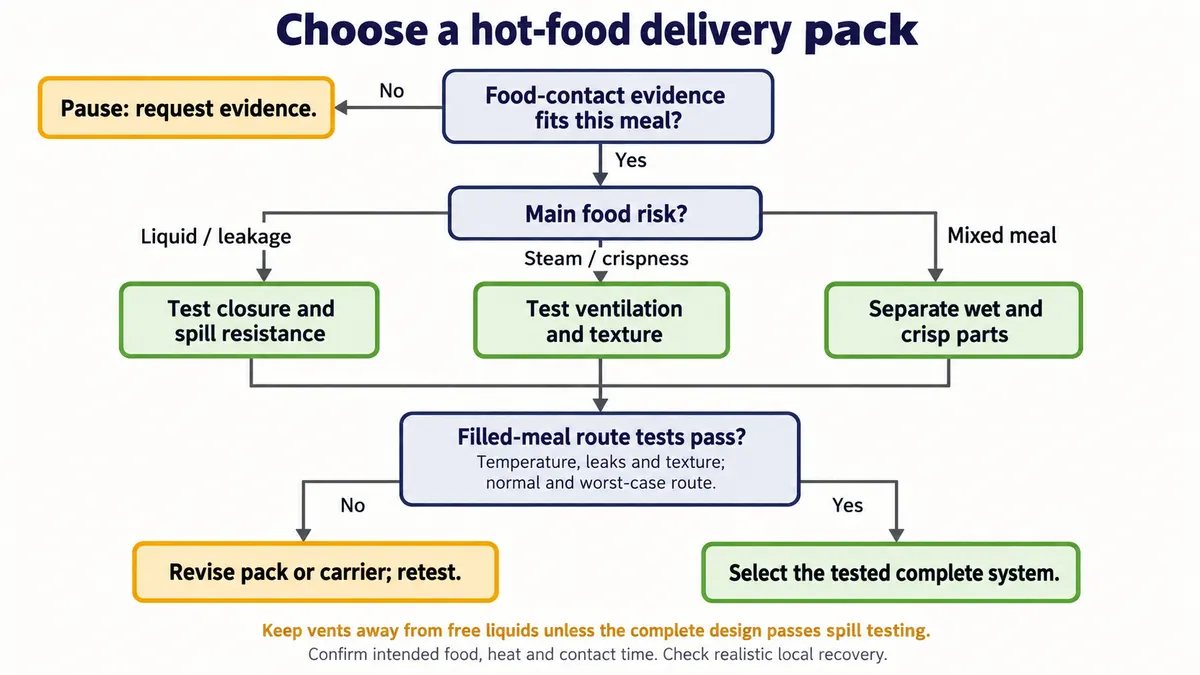
Hot curry that leaks and fried food that turns soggy need different packaging. For Malaysian restaurants, cloud kitchens, caterers and delivery teams, start with the meal, its packing temperature and the route. Then choose the container, closure, ventilation and carrier that handle its steam, oil, liquid and contact time.
This practical guide explains how to compare hot food delivery packaging in Malaysia, including food-grade containers, leak-resistant packaging for soups and curries, vented packaging for fried food, insulated carriers, material options and filled-meal testing.
The primary container, lid or seal, insulated carrier and delivery route must work together. Paper, bagasse, aluminium and plastic can all be useful, but a material name alone does not prove that a package will retain heat, prevent leakage or protect food quality.
Use This Six-step Selection Order
- Define the meal, portion and expected fill temperature.
- Set the maximum delivery and holding time.
- Choose the required leak, oil, grease and ventilation performance.
- Confirm food-contact suitability for the intended temperature, duration and food type.
- Test the complete filled package and transport carrier.
- Check the realistic reuse, recycling, composting or disposal route.
Malaysia’s food-hygiene framework treats preparation, handling, storage, packaging and transportation as connected controls. That is the practical reason an empty-container comparison is not enough.
Shortlist materials using the food-contact specification, then compare complete systems in a filled-meal delivery test.
Start With The Meal, Not The Packaging Material
Build a short worksheet before requesting samples. The worksheet gives suppliers a clearer brief and gives your team consistent pass-or-fail conditions.
| Factor | What to record | Why it matters |
|---|---|---|
| Temperature | Temperature when packed and target temperature on arrival | Sets the heat and holding conditions the system must handle |
| Time | Normal route, rider wait and worst-case delivery duration | Longer contact can affect temperature, texture and package performance |
| Steam | Low, moderate or heavy steam after closing | Condensation can soften food and fibre-based packs |
| Free liquid | Soup, sauce or gravy volume | Determines the required rim, closure, headspace and containment |
| Oil and acidity | Grease exposure and acidic components such as sambal or some sauces | Affects barrier needs and the food-contact evidence to request |
| Quality goal | Crispness, separation, appearance and portion control | May require vents, compartments or inner cups |
| Load | Portion weight, headspace and stacking arrangement | Influences deformation, lid release and crushing |
| Route | Motorcycle vibration, cornering, rain, stops and shared loads | Exposes failures that a stationary bench test will miss |
A tray that performs well with dry rice may soften, stain or leak when filled with hot curry. A tightly sealed curry tub may contain liquid well but trap enough steam to make fried food soggy.
Use hot food delivery packaging to mean the complete container-and-transport system. This includes the base, lid, seal, inner cup, liner, carry bag, divider and insulated rider carrier where used.
Food-contact Suitability Comes Before Appearance
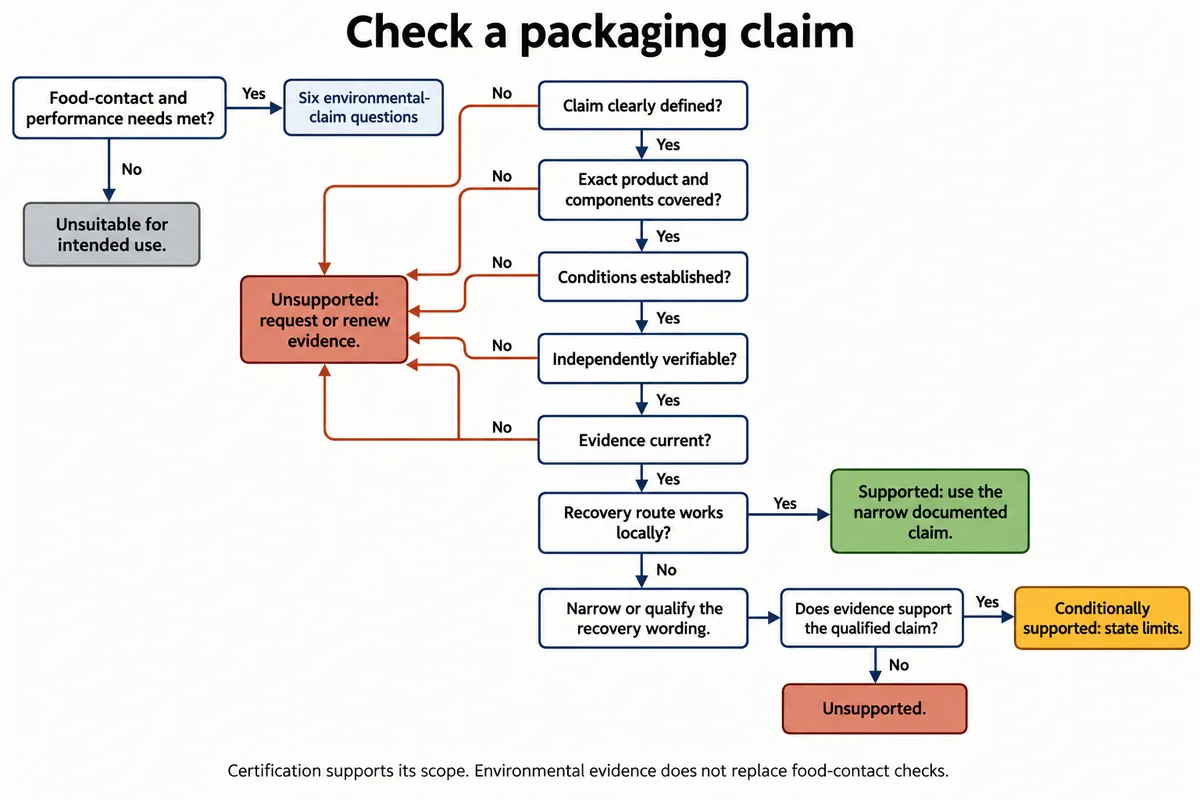
Malaysia describes food grade as safe for food contact and provides a voluntary Food Grade Certification programme for relevant materials used in food preparation, processing, packaging, storage and delivery. Certification scope matters: the presence of a food-grade statement does not establish suitability for every hot, fatty, oily, acidic or long-contact application.
Food-contact assessment is use-specific. Representative testing may account for the food category, contact temperature and contact duration, with different test conditions or simulants used for foods such as acidic products.
Heat, time and food composition can affect chemical transfer from packaging components. This makes the documented conditions especially relevant for hot curry, oily sambal and similar foods.
Evidence To Request For Food-grade Packaging For Hot Food
- Material identity and complete package construction.
- Intended food types, including fatty or acidic food where relevant.
- Maximum stated contact temperature and duration.
- A supporting declaration or test report showing the tested conditions.
- The scope and current status of any Malaysian or overseas certification.
- Confirmation of whether lids, coatings, inks, adhesives and seals are included.
- Batch or product codes that connect the paperwork to the supplied item.
Do not assume that evidence for a container base also covers its lid or printed coating. Have certification, legal, food-contact and food-safety claims checked by a suitably responsible person before approving the specification or publishing customer-facing claims.
How To Keep Food Hot During Delivery
Temperature retention depends on the starting temperature, portion, headspace, container, carrier, waiting time and route. A thick curry in a full container cools differently from a small portion of fried snacks in a large vented box.
A widely cited US hot-holding reference is 60°C or above. This is external guidance, not a statement of Malaysian law. A Malaysian operator should establish operating limits through its food-safety controls and obtain appropriate local advice where needed.
Control The Process As Well As The Package
- Pack promptly at a controlled starting temperature.
- Reduce waiting between cooking, packing and rider collection.
- Use a suitable primary container with a secure closure.
- Pre-condition the carrier if the equipment instructions and operating procedure permit it.
- Reduce unnecessary empty space and repeated carrier opening.
- Separate hot and cold products where practical.
- Limit route duration and multi-order delays.
- Measure actual arrival temperature with a suitable food thermometer.
In one simulated hot-meal delivery study, the tested polypropylene tray took about 50 minutes longer than the tested sugarcane-bagasse tray to cool to the study’s critical temperature. Changing the tested secondary carrier delayed cooling by about another 15 minutes.
Those are notable differences, but they are not universal ratings for polypropylene, bagasse or insulated boxes. They apply to the specific products, meal, setup and measurement method used in that study.
Insulated food delivery packaging is therefore not an automatic temperature guarantee. Set a tested operating window for each major menu family instead of copying a general heat claim from a catalogue.
Match The Container To The Main Failure Risk
Soups, Curry And Other Free Liquids
Prioritise lid engagement, rim cleanliness, seal integrity, deformation resistance and suitable headspace. A dirty rim or overfilled tub can defeat an otherwise capable closure.
Treat leak-proof containers for soups and curries as a performance requirement to verify, not an absolute label to trust. Test the hottest, oiliest and most mobile recipe rather than water alone.
Where leakage would create a serious handling problem, consider a sealed primary container plus a secondary bag or containment measure. Keep vents away from free liquids unless the completed design has passed spill testing.
Nasi Lemak, Rice Meals And Mixed Dishes
Decide whether sambal, gravy and crunchy components need separation. Compartments or inner cups are worthwhile only when they protect texture, portion control or handling enough to justify their cost and extra parts.
Hot rice can create condensation that softens fried anchovies, peanuts and coated foods. Oily or acidic components must also remain within the package’s documented food-contact conditions.
Fried Chicken, Chips And Other Crisp Foods
Steam, condensate and residual oil contribute to lost crispness. Vented packaging for fried food allows some moisture to escape, but the trade-off is usually faster heat loss.
Compare vents in lids, side walls or breathable areas according to spill risk, stacking and the orientation of the package inside the carrier. Avoid sealing food while it is releasing heavy steam unless temperature retention is more important than texture.
The correct vent area cannot be selected from a material name. It must be checked using the actual portion, closing time and route.
Bakery Items And Café Takeaway
Separate dry baked goods from hot filled pastries, melted toppings and greasy items. Bakery packs often need crushing resistance, grease control and moderate ventilation rather than liquid-tight containment.
If the package has a window, coating or adhesive, confirm that those components are covered for the intended hot-contact conditions.
Catering And Multi-portion Meals
Large catering packs introduce deeper food masses, longer holding periods, stacking loads and repeated opening during service. A format that transports well may not present or dispense food well.
Use separate transport and service components where one pack cannot perform both functions reliably. Controlled reusable systems may also be practical when collection and washing can be managed.
Compare Material Families Without Naming A Universal Winner
| Material family | Typical strengths | Common limitations | Evidence to request | Priority tests |
|---|---|---|---|---|
| Rigid plastic, including polypropylene | Secure closure options, liquid resistance and useful heat retention in some designs | Possible deformation, staining and uncertain local recycling acceptance | Temperature, duration, oil and acid scope; base-and-lid construction | Hot-fill deformation, lid fit, leak, stain and route tests |
| Paperboard or coated paper | Low weight, printability and formats suited to some dry or vented foods | Softening, seam leakage and multi-material recovery issues | Coating type, grease resistance, moisture resistance and contact conditions | Seam, soak, condensation, stacking and heat-retention tests |
| Moulded fibre or bagasse | Rigid meal-tray formats for some dry, mixed or moderately moist meals | Absorption, lid compatibility, deformation and variable barrier treatments | Coating or additive disclosure, oil scope and lid documentation | Absorption, closure, oil penetration, stacking and cooling tests |
| Aluminium | Heat tolerance and useful multi-portion catering formats | Denting, hot handling, lid variation and microwave incompatibility | Food-contact scope, including acidic food where relevant, and lid construction | Lid seal, dent, stacking, handling and route tests |
| Reusable rigid containers | Repeated use and robust closures in managed return loops | Loss, reverse logistics, washing, inspection and replacement | Material scope, washing instructions and expected-use evidence | Return trial, repeated washing, closure wear and damage inspection |
Rigid Plastics
A result from one polypropylene tray does not rate every plastic container. Wall thickness, geometry, fill mass, headspace and closure design can change performance substantially.
Confirm the stated temperature and duration range, oil and acid suitability, deformation risk and lid fit. Check actual local recycling acceptance rather than relying on a resin code.
Paperboard And Coated Paper
The word “paper” can describe a package with a polymer coating, window, adhesive or other components. It does not automatically mean the used package will be recyclable or compostable.
Ask what provides the grease and moisture barrier. Test seams, folds and lids after realistic contact with steam, oil and gravy.
Moulded Fibre And Bagasse
Bagasse can suit some dry, mixed and moderately moist meals, but performance varies by design and treatment. Buyers should check absorption, oil resistance, deformation and lid compatibility.
Readers comparing this family can review the separate guide to bagasse food packaging. The controlled study result described earlier should not be generalised to every bagasse or polypropylene design.
Aluminium Containers
Aluminium can work for high-temperature and catering applications, but the complete specification still matters. Check the lid seal, denting, hot handling, acidic-food scope and whether customers may try to microwave the pack.
Do not make broad safety or recyclability claims without product-specific evidence and a realistic local recovery route.
Reusable Rigid Containers
Reuse depends on achieved uses, not intended uses. Track return rate, washing controls, inspection, loss and replacement before making an environmental claim.
Reusable delivery packaging is generally easier to manage in controlled office, campus, catering or café-return arrangements than in untracked nationwide delivery.
Build The Transport System Around The Route
Food delivery packaging Malaysia buyers evaluate should include the rider bag, box, dividers and load arrangement. The route can expose closure and temperature failures that remain invisible during a kitchen bench test.
- Motorcycle vibration, braking and cornering.
- Rain and high ambient heat.
- Long rider collection waits.
- Several customer stops in one trip.
- Hot and cold items sharing a carrier.
- Heavy containers stacked over lighter packs.
- Frequent opening of the carrier.
A soft insulated bag may be sufficient for a short, light route. A rigid insulated box, divider or cup holder may improve stability for taller stacks or mixed orders.
Whatever the format, check that the carrier can be cleaned and that its closures remain effective during use. Do not transfer the 15-minute cooling difference from one controlled study to a different carrier, load or Malaysian delivery route.
Run Hot Food Packaging Temperature Testing Before A Large Order
A repeatable qualification test provides more useful evidence than an empty sample or a supplier’s broad description. Test the menu items most likely to fail, not only the easiest ones.
Minimum Filled-meal Test Protocol
- Select a worst-case meal: the hottest fill, highest liquid or oil content, largest portion or most texture-sensitive product.
- Fill and close the package using normal staff, utensils and equipment.
- Record the fill temperature and closing time.
- Place the meal in the real rider bag or box with a realistic delivery load.
- Reproduce the normal route and a defined worst-case duration.
- Record arrival temperature with a suitable calibrated thermometer and note the measurement location.
- Inspect leakage, lid release, deformation, oil penetration, condensation and texture.
- Repeat the test enough times to reveal inconsistent filling or closure.
Transport checks should use complete, filled packages. Add a short road or vibration trial, cornering and tilt exposure, realistic stacking, repeated bag opening, and post-test inspection of rims, seams and lids.
Formal transport standards include random-vibration methods for assessing filled packages and the protection provided to their contents. An informal motorcycle route test can use the same practical principle, but it is not a claim of standards certification.
| Menu item | Package code | Fill temperature | Route time | Arrival temperature | Leak result | Texture result | Decision |
|---|---|---|---|---|---|---|---|
| Example: thin curry | Record batch or sample code | Record °C | Record minutes | Record °C and location | Pass, fail or observation | Pass, fail or observation | Approve, modify or reject |
| Example: fried chicken | Record batch or sample code | Record °C | Record minutes | Record °C and location | Pass, fail or observation | Pass, fail or observation | Approve, modify or reject |
Compare Suppliers By Total Operating Cost
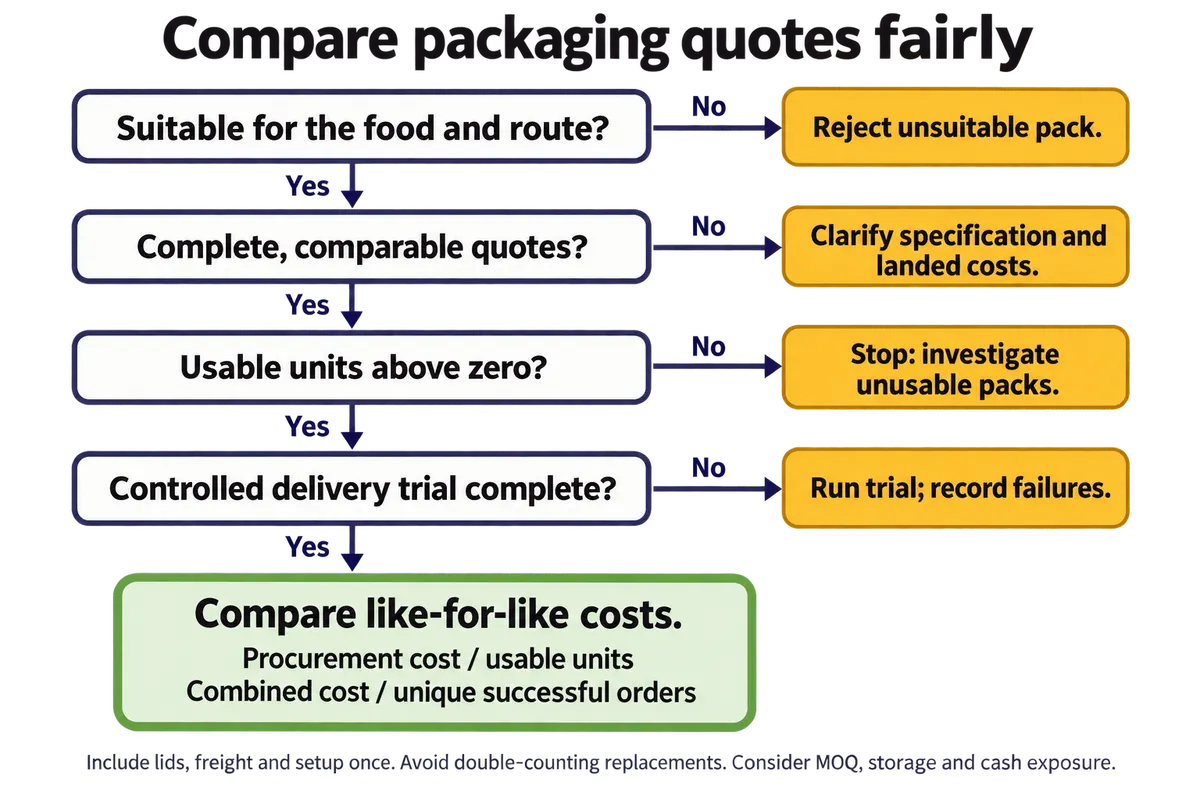
The lowest container price may not produce the lowest packed-meal cost. A cheaper base can require a separate lid, liner or sauce cup, occupy more storage space, slow staff or cause more remakes.
Quotation Checklist
- Unit price at realistic order quantities.
- Minimum order quantity and carton quantity.
- Lid, seal, liner and sauce-cup costs.
- Carton dimensions and required storage volume.
- Lead time and continuity of supply.
- Compatibility across container sizes.
- Material and food-contact documentation.
- Tested temperature, time and food conditions.
- Batch consistency and dimensional tolerance.
- Samples for filled-meal testing.
- Printing, tooling and plate charges where applicable.
Calculate the cost per delivered meal, including packaging parts, labels, storage, packing time, leakage, remakes and rider handling. A small operational trial should confirm staff usability and route performance before a nationwide change.
Check The Recovery Route Before Making Environmental Claims
Sustainable food delivery packaging Malaysia decisions depend on what happens after use. Material descriptions matter, but collection, contamination, sorting, washing, composting and return logistics determine the credible recovery route.
Recyclable Options
A recycling symbol or resin number does not prove that a local programme accepts a used food container. Confirm the actual Malaysian collection and processing route, account for food residue, and check whether lids, coatings or other components require separation.
Compostable Options
Commercially compostable service ware needs an accepting facility and a working collection route. Compostable plastic should not be placed in conventional plastics recycling because it can contaminate that stream.
Confirm local acceptance before printing disposal instructions or making environmental claims. Certification without access to the required end-of-life system does not complete the recovery route.
Reusable Options
Measure returns, washing, inspection, damage and loss. Validate durability through actual use and washing cycles, then restrict claims to the system that is genuinely operating.
Describe the material, certification scope, disposal conditions and available recovery route precisely. Avoid broad environmental language that cannot be supported under the real operating conditions.
For a broader material comparison, visit the guide to common packaging material types.
Buyer Decision Matrix: Choose By Failure Risk
| Meal or service | Priority controls | Trade-off or risk to check |
|---|---|---|
| Soup or thin curry | Sealed closure, clean rim, headspace and vibration-tested leak resistance | Overfilling and free liquid reaching vents |
| Thick curry or sauced rice | Oil resistance, secure seal and documented fatty or acidic food-contact scope where relevant | Staining, softening and long hot contact |
| Nasi lemak or mixed meal | Separation, condensation control and stable compartments | Extra parts, cost and trapped steam |
| Fried food | Controlled ventilation and grease resistance | Better moisture release may reduce heat retention |
| Bakery or hot pastry | Crushing resistance, grease control and suitable ventilation | Hot fillings, toppings and adhesive scope |
| Long-hold catering | Measured temperature retention, stacking strength and managed service handling | Repeated opening and deep fill masses |
| Controlled-return service | Collection, washing, inspection and loss tracking | Low return rates can undermine the operating model |
The best packaging for hot food delivery is the option that passes the business’s meal, route and recovery tests at an acceptable total cost and with consistent supply.
Frequently Asked Questions
What Temperature Should Hot Delivered Food Maintain?
Widely used US guidance refers to holding hot food at 60°C or above, but this should not be presented as Malaysian law. Define the applicable food-safety control for your operation, measure actual arrival temperatures and obtain local professional guidance where necessary.
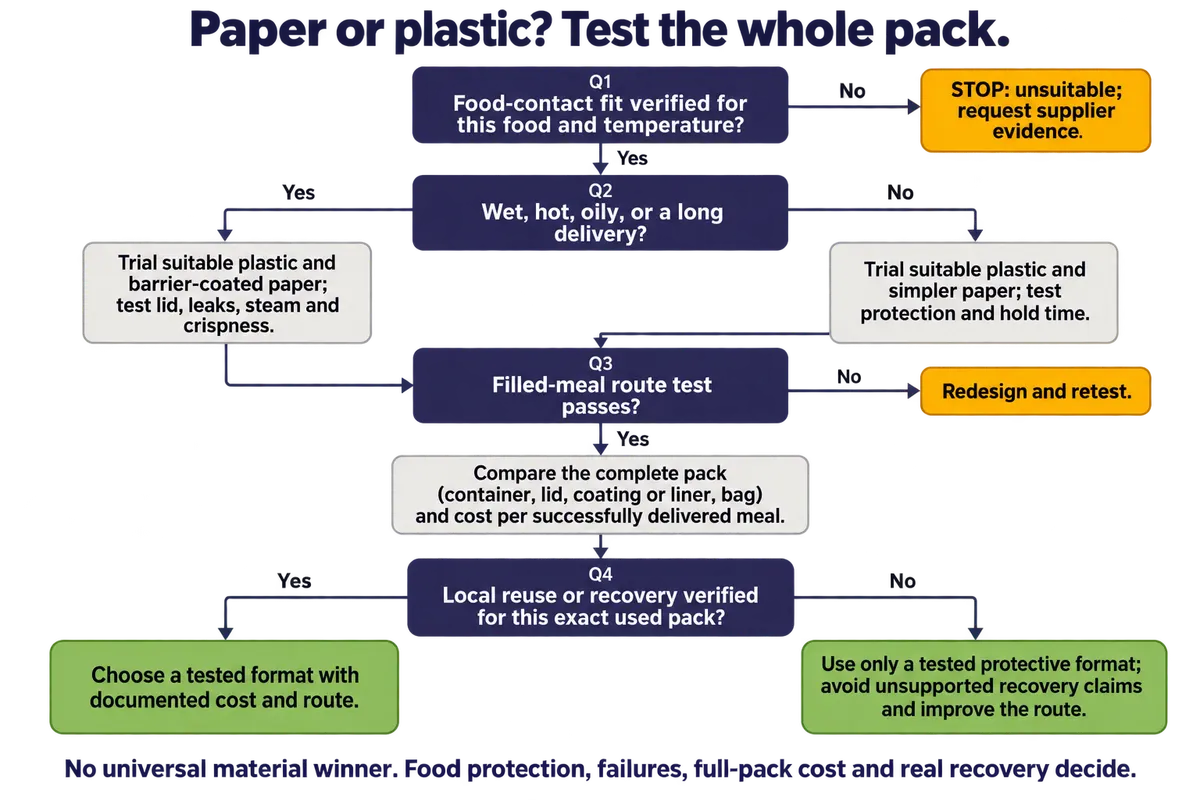
Is Paper Or Plastic Better For Hot Food Delivery?
Neither material is better for every meal. The result depends on construction, coating, closure, portion, steam, oil, contact time, route and recovery system. Compare complete products under the same filled-meal test.
How Should A Restaurant Test A Soup Container For Leakage?
Use the actual hottest and oiliest soup, leave the intended headspace, clean the rim and close the lid using normal staff procedures. Place the filled pack in the real carrier, reproduce vibration, tilt, stacking and route time, then inspect the lid, rim, seams and secondary containment.
Does Venting Keep Fried Food Crisp?
Venting can release moisture that would otherwise condense around fried food. It can also increase heat loss, so test vent size and position with the actual portion and route rather than assuming that more ventilation is always better.
Can Hot Takeaway Containers Be Recycled Or Composted In Malaysia?
Only where an appropriate collection and processing route accepts the used package in its real condition. Confirm local acceptance, contamination limits and component-separation requirements before giving customers disposal instructions.
When Is Reusable Delivery Packaging Practical?
Reuse is most practical when collection, washing, inspection and return can be controlled, such as an office, campus, catering or café-return loop. Track actual return and loss rates before expanding the system.
Make The Decision With Two Systems And Three Meals
Define the meal first. Set the delivery window, confirm the food-contact scope, select the closure and ventilation, test the filled system, and verify the recovery route.
Prepare three representative meals and test two shortlisted systems on a normal route and a defined worst-case route. Record fill temperature, arrival temperature, leakage, deformation and texture before committing to volume.
If the brief still contains unclear material, compliance or route requirements, request help reviewing the packaging brief before placing a large order.
Choosing the best packaging for hot food delivery is a measured operating decision, not a contest between material names.
References
- Ministry of Health Malaysia : Food Safety and Quality Programme
- Ministry of Health Malaysia : Food Grade Certification
- European Commission : Food Contact Materials Legislation
- European Food Safety Authority : Food Contact Materials
- FoodSafety.gov : Keeping Hot Foods Hot and Cold Foods Cold
- USDA FSIS : Safe Handling of Take-Out Foods
- Key Factors Influencing Bacillus cereus Contamination in Hot Ready-to-Eat Meal Delivery