FoodPackLab Editorial Team
Paper Vs Plastic Food Packaging In Malaysia: A Practical Guide For F&B Businesses
Choosing the wrong takeaway pack can cost more than choosing the wrong material. For Malaysian cafe owners, restaurant operators, cloud kitchens, caterers and procurement teams, paper vs plastic food packaging is not a simple choice between “good” and “bad”. A pack must first protect the food, survive the delivery journey and avoid creating unnecessary waste.
Choosing the wrong takeaway pack can cost more than choosing the wrong material. For Malaysian cafe owners, restaurant operators, cloud kitchens, caterers and procurement teams, paper vs plastic food packaging is not a simple choice between “good” and “bad”. A pack must first protect the food, survive the delivery journey and avoid creating unnecessary waste.
This practical guide compares paper and plastic food packaging in Malaysia by food protection, coatings, weight, delivery performance, recyclability, compostability, reuse and total operating cost.
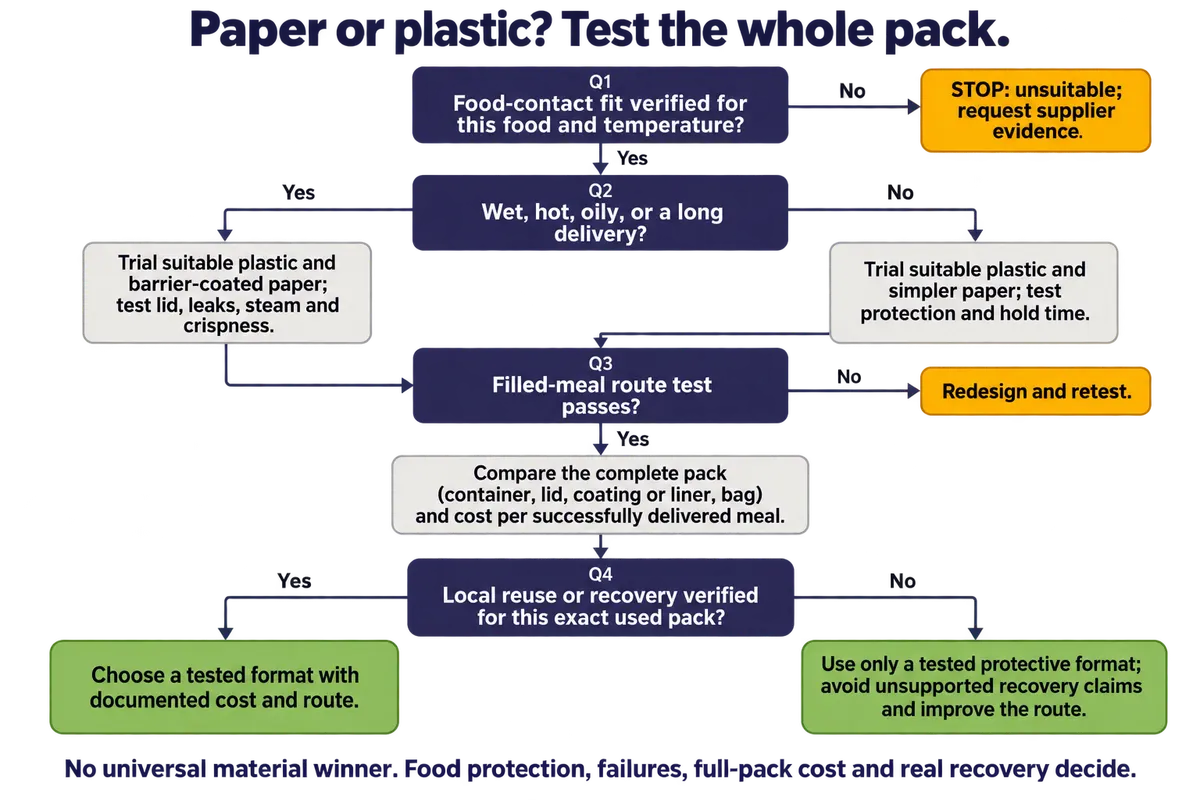
The short answer: choose the lightest practical pack that protects the food under real service conditions, then check whether it has a credible reuse or recovery route. A paper bowl may need a plastic barrier to hold curry. A lightweight plastic container may prevent leaks efficiently but still have little chance of being recycled after use.
The key question is not “Which material looks greener?” It is “Which complete packaging system delivers the food with the least avoidable material, failure and end-of-life burden?”
Compare the complete pack, including its lid, coating, liner and delivery bag—not just the main container.
Choose By Food, Journey And End-of-life Route
A useful paper vs plastic packaging decision begins with performance. Packaging should prevent contamination, leakage, crushing, moisture loss and premature spoilage. If a material switch causes damaged meals, double-bagging, refunds or food waste, its apparent environmental benefit may disappear.
Use a three-part buying test:
- Required performance: What must the pack withstand?
- Least practical material: Can weight or components be reduced without increasing failures?
- Realistic destination: Will the used pack actually be reused, collected, sorted and processed?
Appearance is not evidence. Brown paper is not automatically plastic-free or recyclable, while a recycling symbol on plastic does not prove that a local operator accepts it.
| Buyer condition | Paper may be suitable when | Plastic may be suitable when | Check before buying |
|---|---|---|---|
| Dry bakery items | The pack can remain clean and dry | Visibility or moisture retention is necessary | Humidity, grease and holding time |
| Curry or soup | A verified barrier and secure lid can withstand service conditions | Leak resistance and low weight are priorities | Temperature, seal, coating and delivery movement |
| Fried food | Breathability and grease resistance are balanced | Suitable vents can control condensation | Crispness after the expected hold time |
| Closed operational loop | Durable fibre formats are assessed for repeated use | Washable containers or crates can complete repeated loops | Return rate, loss, washing and reverse logistics |
Food Protection Comes Before Material Preference
The connection between food packaging and food waste prevention is easy to overlook. Paper, plastic, glass and metal packaging can protect food from contamination, physical damage and moisture loss. Removing necessary packaging without preserving these functions can increase spoilage and the environmental burden of wasted food.
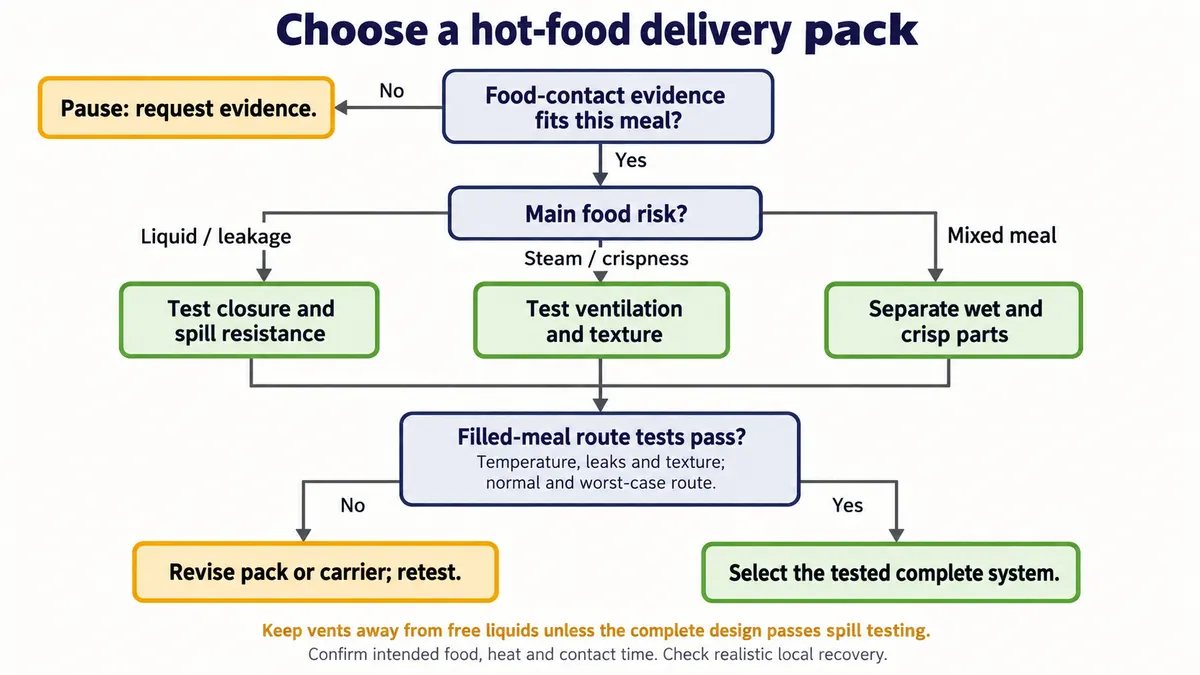
Start with the meal rather than the material. Is it hot, wet, oily, acidic, fragile or sensitive to outside odours? How long will it remain packed? Will it be stacked, tilted or carried over uneven roads?
Nasi lemak needs grease and moisture control. Soup needs reliable containment and a lid that remains secure during movement. Bakery products may require crush protection, while crisp fried food needs enough ventilation to limit condensation.
A slightly heavier container can be the lower-waste choice if it prevents leaks, replacements and double-packing. Conversely, excessive material is difficult to justify when a lighter format passes the same service test.
Where Paper Performs Well—and Where It Needs Help
Paper provides useful stiffness, printability and familiar handling. Boxes, sleeves and bags can work well for dry bakery products, secondary packaging and short-hold foods that remain reasonably clean and dry.
Untreated paper loses strength when exposed to water, heavy grease or prolonged condensation. Wet food, oily sauces and long holding periods can therefore require a coating, liner or thicker structure.
The paper packaging vs plastic packaging environmental impact cannot be reduced to one measure. Fibre production can involve climate, water, land and processing impacts. Plastic creates different burdens, including persistence, litter risk and weak recovery for many formats.
This is why paper vs plastic packaging comparisons should examine impact shifting. A heavier paper format may use renewable fibre but require more storage and transport space. A lighter plastic format may use less material but lack a viable recovery route.
Promising paper applications include dry pastries, sandwich sleeves, secondary cartons and short-hold foods with limited grease. Exercise more caution with soup, heavy curry, wet noodles, high-grease meals and packs exposed to prolonged steam.
Where Plastic Performs Well—and Where Its Burden Appears
Plastic remains common in direct food-contact packaging because it can be lightweight, flexible, moisture-resistant and comparatively inexpensive. Low unit weight can reduce material use and transport load, especially for businesses handling high delivery volumes.
Those advantages do not resolve end-of-life impacts. Conventional plastics can persist when discarded, contribute to litter and depend mainly on fossil resources. Collection and recovery also vary sharply between packaging formats.
Rigid bottles or tubs may face different collection conditions from films, sachets, foams, black plastic and multilayer packs. A resin identification code describes a material family; it does not guarantee local collection, successful sorting or reprocessing.
The gap between technical possibility and actual recovery is substantial. Globally, only 9% of plastic waste was recycled in 2019. Although 15% was collected for recycling, roughly 40% of that collected amount was lost as processing residues.
A technically recyclable pack is not recovered until collection, sorting and reprocessing actually happen.
These global figures should not be presented as a Malaysian recycling rate. They demonstrate why buyers should ask what happens to a specific format instead of relying on a generic recyclable label.
Coatings Can Turn Paper Into A Mixed-material Pack
Barrier coatings for food packaging help resist water, oil, oxygen or gas transfer. They make paper more useful for takeaway bowls, drink cups, beverage cartons, lined bags and moisture-resistant plates.
The functional benefit can be important. Curry and soup need liquid resistance, fried food needs grease control, and drink cups must retain their shape while holding liquid. Without an adequate barrier, paper may soften, leak or fail.
The trade-off appears after use. Thin plastic layers, adhesives and multilayer construction may be difficult to separate during ordinary paper processing. They can also complicate organic-waste treatment.
Plastic coated paper packaging recycling depends on the coating, item design, contamination level, collection programme and processing capability of the receiving mill. There is no reliable answer based only on the pack’s paper-like appearance.
Before approving a coated format, request:
- The full material structure, including the lid and liner
- The coating type and coating weight, where available
- The intended food types and temperature range
- Storage and holding-time limitations
- Disposal instructions and the conditions behind them
- The standard, product scope and validity of any certification claim
- Confirmation that the relevant local operator accepts the exact item
Descriptions such as “paper-based”, “plant-based” or “coated with less plastic” do not, by themselves, establish recyclability, compostability or lower overall impact.
Weight, Storage And Delivery Failures Change The Calculation
Compare unit weight, carton dimensions, storage footprint and payload—not only material names. A bulky format may require more warehouse space and more inbound deliveries even when each individual pack appears simple.
However, the lightest container is not automatically the most efficient. A pack that collapses, leaks or needs a second bag can consume more material and staff time than a slightly stronger design.
Calculate the complete system:
- Container and lid
- Coating, liner or absorbent sheet
- Sleeve, label and seal
- Cutlery and condiment packaging
- Secondary delivery bag
A cloud kitchen should test that complete system on its longest normal delivery route. A pack that looks secure at the counter may behave differently after 35 minutes of vibration, stacking and trapped steam.
Record packaging grams per served meal, packed-carton dimensions, leak rate, deformation rate and replacement rate. These figures make supplier comparisons more useful than broad claims about one material being lighter or greener.
Contamination Often Decides Whether Recovery Is Realistic
Ordinary recycling systems generally expect plastic containers to be empty and rinsed. Paper normally needs to be empty, clean and dry. Wet or heavily food-soiled paper is generally unsuitable for conventional paper recycling.
Curry residue, oil, sauces and drink remnants reduce recovery prospects. Plastic layers, adhesives and coatings can also contaminate recovered-paper streams. When contamination is excessive, a mill may reject an entire bale rather than recover the clean fraction.
Technical recyclability is only one stage. Four separate events must occur:
- The item is placed in the correct collection stream.
- The collection operator accepts that exact format.
- The sorting facility identifies and separates it successfully.
- A processor turns it into usable recovered material.
A clean corrugated delivery carton and a greasy coated food box should not be assumed to share the same destination. Bin signage and staff separation help only when a confirmed collector accepts the stated items.
Malaysia’s National Rate Does Not Predict One Pack’s Outcome
Malaysia reported a national recycling rate of 37.9% for 2024. About 5.40 million tonnes of material were reported recycled, including 2.04 million tonnes of plastic and 1.49 million tonnes of paper.
These are economy-wide material figures. They are not recycling rates for takeaway tubs, coated cups, food-soiled boxes or any other individual packaging format.
The packaging recovery infrastructure Malaysia businesses encounter can differ by state, federal territory, council, building and private collector. A 2025 national review reported that the Solid Waste Management and Public Cleansing Act 2007 had been adopted by six states and two federal territories, with expansion efforts continuing at that time.
Regulatory coverage and operating arrangements should be rechecked before publication or procurement because adoption and collection conditions can change. Do not convert national tonnage into unsupported claims about a specific item.
Verify three points in the area where the waste is generated:
- Who collects the material?
- Does that operator accept the exact used item, including its coating and level of food residue?
- Is the collected material sent for sorting and reprocessing?
Recyclable Vs Compostable Packaging Requires A Real Operating Route
Recyclable vs compostable packaging is a systems question, not a competition between printed labels. Neither claim creates collection infrastructure or guarantees processing.
Industrially compostable plastic is designed for controlled conditions involving temperature, moisture, oxygen, microorganisms and sufficient processing time. It is not a promise that the item will break down quickly in soil, drains, waterways or the open environment.
A compostable pack needs separate collection and acceptance by a compatible treatment facility. If it enters conventional plastic recycling, it may be treated as an impurity. Some composting facilities also screen packaging out with ordinary plastic.
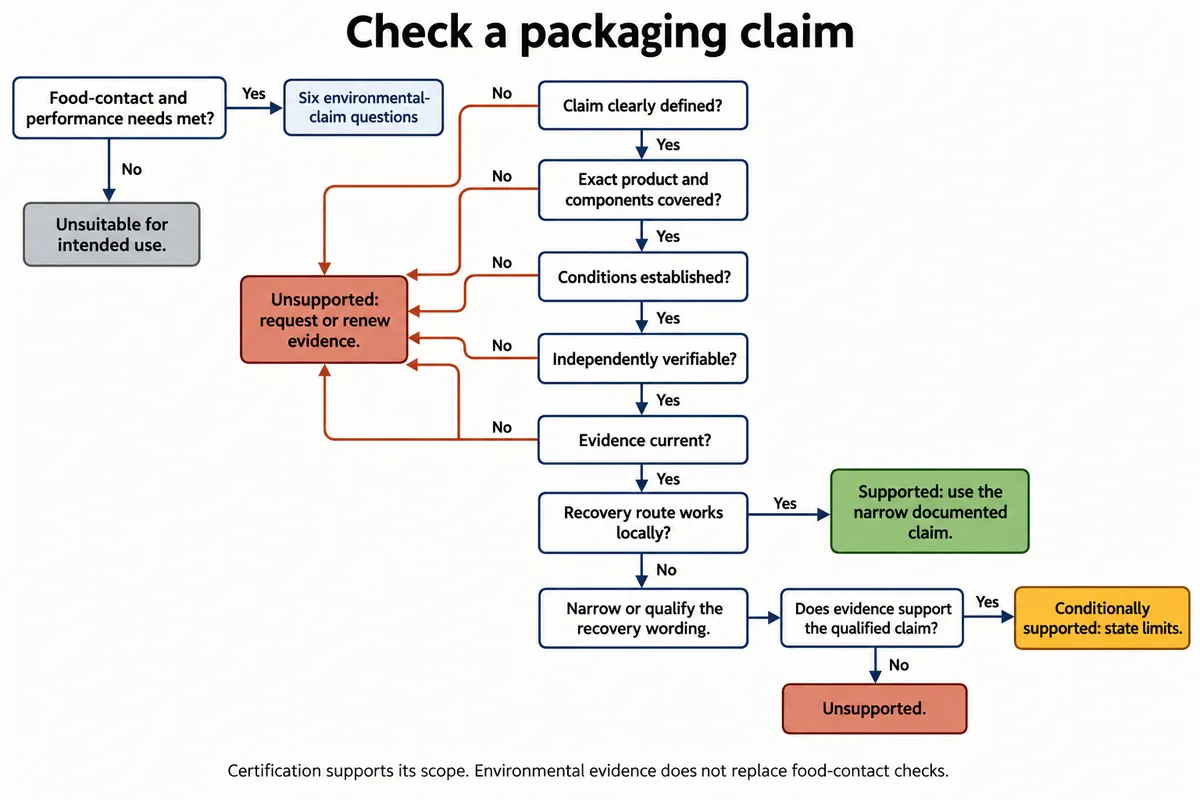
Before using a compostability claim, verify:
- The certification standard and the exact products covered
- The validity and scope of the supporting certificate
- The labelling permissions and required wording
- The separate collection route
- Acceptance by the intended treatment facility
- Controls that keep conventional plastic out of the stream
Certification, legal, compliance and environmental-claim wording should receive qualified human review before publication or use on packaging.
Reuse Works Through Completed Loops, Not Reusable Labels
Reusable food packaging systems spread production impacts across repeated uses only when containers return and complete enough service loops. A durable pack with a low return rate can perform poorly because more replacement units must be produced.
Return rates, losses, washing, drying, storage and reverse transport all affect the result. Modelling has found savings for some rigid returnable formats at an 80% return rate and roughly five loops, but that is not a universal break-even point. Lightweight disposable formats may require a more efficient and collaborative return system before reuse produces a benefit.
Controlled catering, central kitchens, offices, events and supply chains with regular return journeys are promising settings. Anonymous takeaway customers, wide delivery areas and special trips made only to collect empty packs are more difficult.
Reusable bulk plastic crates show how a managed loop can work. They can protect produce from compression and abrasion and may remain in service for up to ten years when maintained, cleaned and returned properly. Longevity alone is not enough; the operating loop completes the benefit.
A reuse pilot should measure:
- Units issued and units returned
- Completed loops per container
- Loss and damage rates
- Water, energy and labour used for washing
- Storage and drying requirements
- Additional transport created by returns
A Buyer-first Framework For Paper Vs Plastic Packaging
This framework is a practical starting point for sustainable food packaging Malaysia decisions. It is not a universal scoring formula.
- Define the food. Record temperature, oil, liquid, acidity, aroma, portion weight and expected moisture movement.
- Define the journey. Record hold time, stacking, vibration, delivery distance, storage humidity and customer handling.
- Set pass or fail conditions. Specify acceptable leakage, deformation, condensation, crispness, temperature retention and lid security.
- Compare the whole format. Include lids, coatings, liners, labels, sleeves and secondary bags.
- Reduce where safe. Remove a component or reduce material thickness only after confirming that protection is maintained.
- Verify claims. Request evidence for composition, intended food-use conditions, certification scope and disposal statements.
- Check the actual route. Confirm collection, acceptance, sorting and destination with the relevant operator.
- Run a small trial. Test representative foods under normal and demanding service conditions.
- Measure business results. Track unit cost, packing time, occupied storage volume, failures, complaints, food loss and recovery participation.
- Review periodically. Recheck prices, availability, collection arrangements and regulatory or certification conditions using effective dates.
A Simple Trial Scorecard
| Measure | What to record | Possible pass condition |
|---|---|---|
| Food protection | Leaks, crushing, moisture change and temperature | No critical failure across the normal delivery window |
| Material efficiency | Grams per meal and number of components | No unnecessary layer or duplicate item |
| Operations | Packing time, storage volume and lid fit | Fits the existing workflow without excess handling |
| Recovery | Collector, accepted condition and final destination | Exact item and condition confirmed in writing where possible |
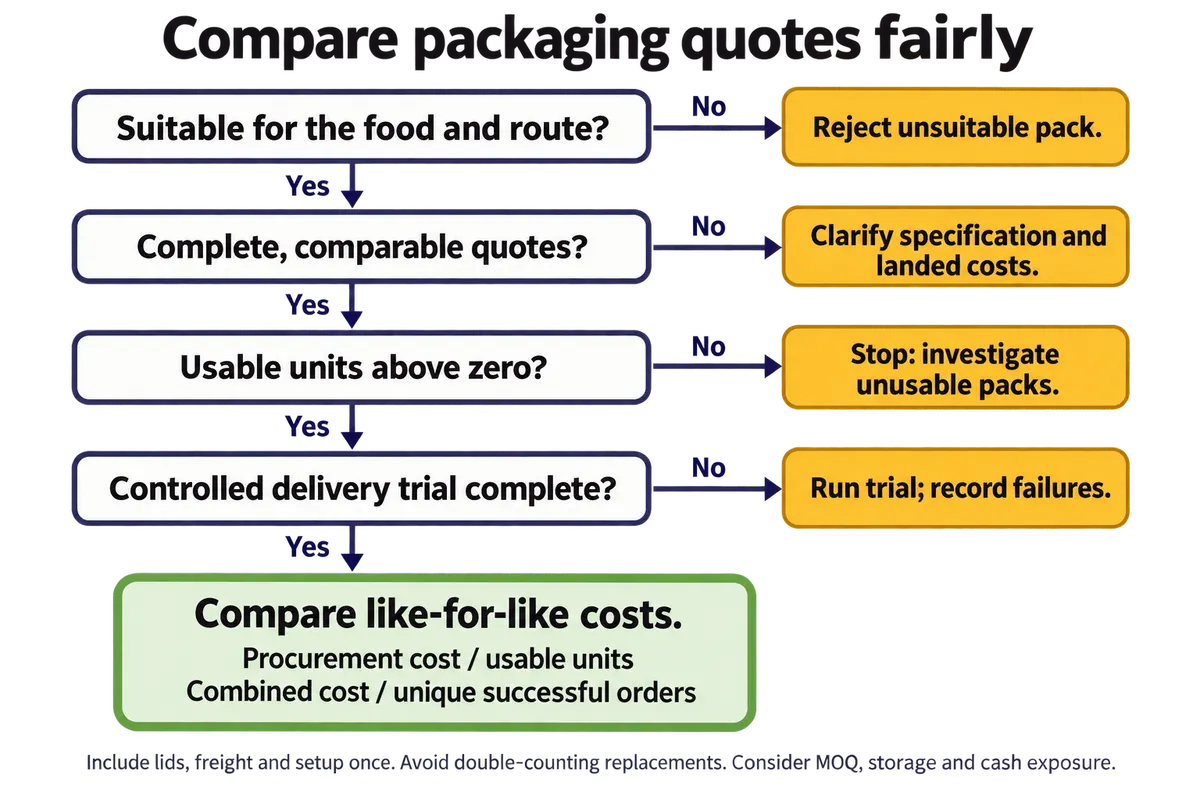
| Commercial result | Unit cost, minimum order quantity and replacement rate | Acceptable total cost per successfully delivered meal |
The most useful comparison is total cost per successfully delivered meal, not price per empty container. This captures failures that a quotation alone cannot show.
Common Questions From F&B Buyers
Is Paper Packaging Always More Environmentally Responsible Than Plastic?
No. The result depends on food protection, material and coating use, weight, transport, contamination, reuse and actual recovery. A weaker pack that causes food waste or needs extra layers may shift impacts rather than reduce them.
Can Coated Paper Food Containers Be Recycled?
Sometimes, but not automatically. Acceptance depends on the coating, food contamination, collection programme, sorting process and mill capability. Confirm the exact item with the relevant local operator.
Does A Recycling Symbol Mean A Plastic Takeaway Container Will Be Recycled?
No. A resin code does not confirm collection, sorting or reprocessing. Flexible films, foams and multilayer formats can face different conditions from commonly collected rigid containers.
Is Compostable Packaging Suitable For Every Malaysian F&B Business?
Only when a credible separate collection route and compatible treatment facility accept the item. Certification alone does not create the required infrastructure.
When Is Returnable Packaging Worth Considering?
It is most promising when the business can achieve high return rates, repeated loops and efficient washing and reverse logistics, such as in controlled catering or closed delivery networks.
The Practical Conclusion
Paper can be suitable when it provides enough protection and remains compatible with a credible recovery route. Plastic can be suitable when lightweight barrier performance prevents leaks and food loss, but its actual end-of-life prospects still need to be counted.
A food packaging life cycle assessment can reveal trade-offs across climate, water, land use, litter and waste. Its result depends on the product, geography, assumptions and system boundaries, so a single result should not be stretched into a universal material rule.
The central problem is often unnecessary single use rather than one material alone. Reducing avoidable components and operating an effective reuse system may achieve more than a blanket material switch.
For more context, visit the packaging buyer guides or compare another fibre option in the guide to bagasse food packaging.
Next step: Shortlist two or three paper vs plastic packaging formats, request their full material specifications, and test them with your actual food, hold time and delivery route before committing to volume. If you need to organise the questions for a supplier discussion, use the requirements contact form as an optional starting point.
References
- Food and Agriculture Organization — Reduce, reuse, recycle: a mantra for food packaging
- US Environmental Protection Agency — Emerging Issues in Food Waste Management: Plastic Contamination
- US Environmental Protection Agency — Frequent Questions on Recycling
- US Environmental Protection Agency — Recovered Paper Quality
- OECD — Plastic pollution is growing relentlessly as waste management and recycling fall short
- Department of Statistics Malaysia — National recycling rate and materials recycled, 2024
- Ministry of Economy Malaysia — Malaysia Voluntary National Review 2025
- Ellen MacArthur Foundation — Unlocking a reuse revolution: scaling returnable packaging (2023)