FoodPackLab Editorial Team
How To Choose Moulded Fibre Food Containers For Hot Meals In Malaysia
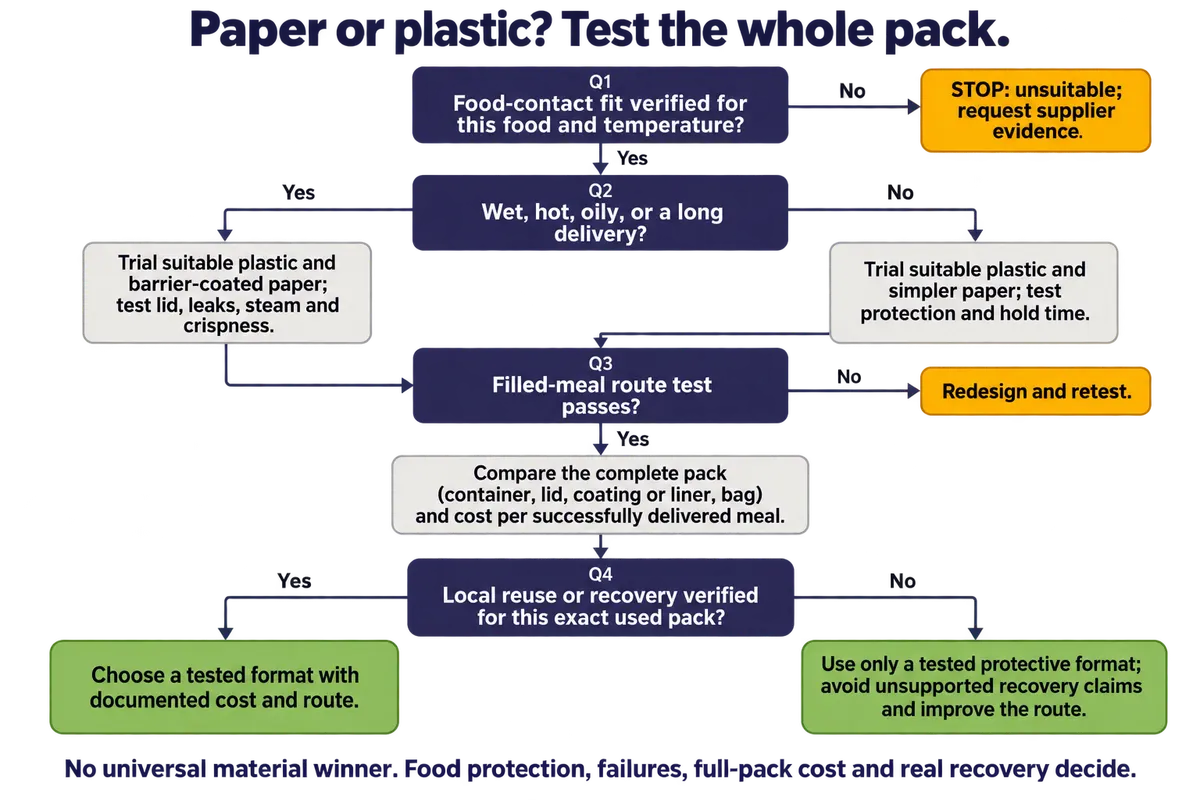
Moulded fibre food containers can handle some hot meals, but the fibre label alone tells a Malaysian restaurant, caterer or cloud kitchen very little about real performance. The exact container must survive the food, filling temperature, oil and liquid exposure, holding time, stacking load and delivery journey.
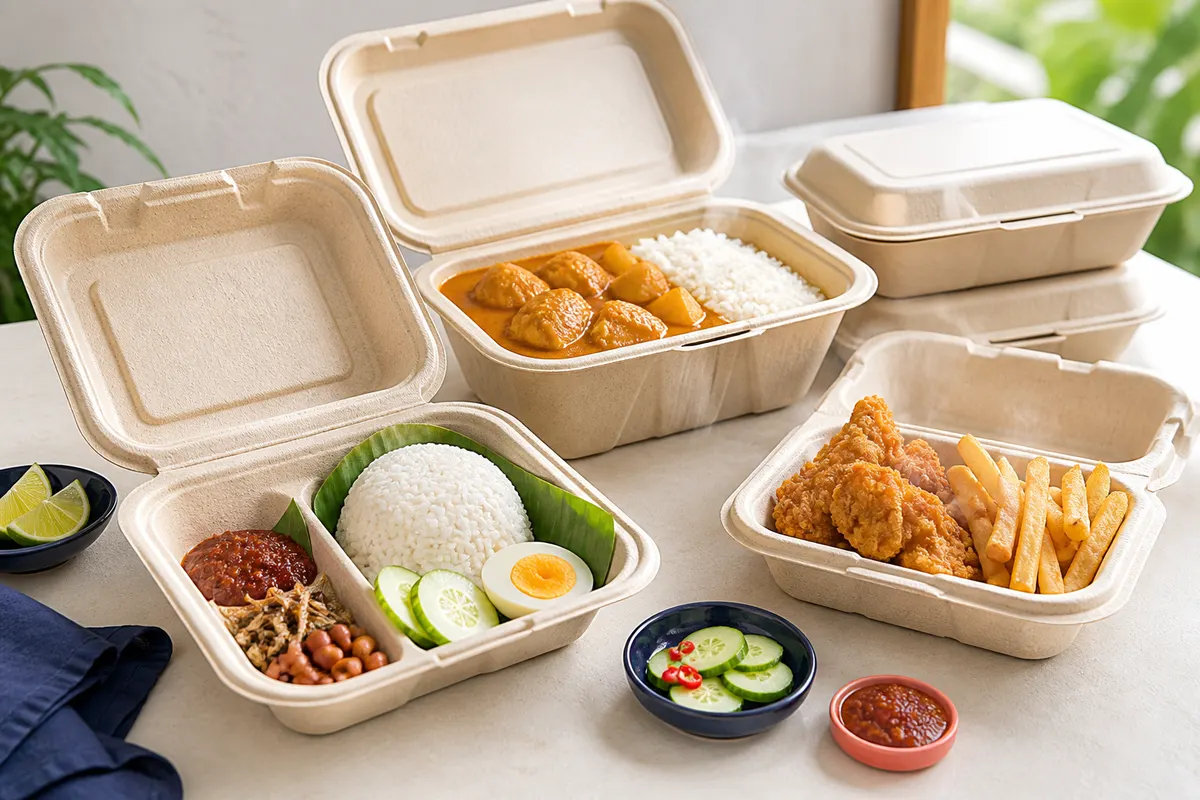
Moulded fibre food containers can handle some hot meals, but the fibre label alone tells a Malaysian restaurant, caterer or cloud kitchen very little about real performance. The exact container must survive the food, filling temperature, oil and liquid exposure, holding time, stacking load and delivery journey.
A pack that works for a bakery item or briefly held fried food may soften, leak or open when filled with curry, sambal or an oily rice meal. The practical answer is to assess the base, lid and barrier treatment as one packaging system under realistic service conditions.
Key takeaway: define the meal and delivery journey first, request evidence for the exact SKU, and then run a repeatable kitchen-and-delivery trial. Do not approve a container from its appearance, fibre source or a brief room-temperature demonstration.
Start With The Meal And Journey, Not The Fibre Label
The first procurement task is to document what the container will actually experience. “Hot takeaway food” is too broad to be a useful specification.
- Identify the food type, portion weight and maximum normal fill.
- Measure the food temperature immediately before packing.
- Classify the meal as dry, moist, oily, acidic or containing free-flowing liquid.
- Calculate the credible contact time from filling until the customer opens or transfers the meal.
- Record whether the pack is used for counter collection, catering, rider delivery or another journey.
- Include normal stacking height, insulated-bag conditions and movement during transport.
Nasi lemak, for example, can expose the base to oil, sambal and trapped condensation. Curry and soup add sustained liquid pressure. Fried food creates a different problem because trapped steam can damage crispness even when the container itself remains intact.
Assess the exact base and its intended lid or closure together. A strong base with a loose lid is still a weak delivery system.
Buyers comparing broader material families can first review the Eco Packaging Types hub.
What The Material Category Actually Tells A Buyer
Moulded fibre food containers are generally formed by depositing an aqueous plant-fibre slurry onto a three-dimensional screened mould, followed by drying or pressing. This describes a manufacturing category, not a single formulation or performance grade.
Products may differ in fibre source, fibre blend, wall thickness, additives, coatings, surface treatment, pressing conditions and container geometry. Two brown or off-white packs that look almost identical can therefore behave differently with the same meal.
Bagasse is one possible fibre input, not an automatic synonym for all moulded pulp. Buyers considering bagasse containers for hot food should still verify the finished SKU rather than treating the source material as proof of heat, oil or liquid resistance.
The material name is a category label, not a performance specification.
Hot Food Container Heat Resistance Depends On Time And Load
Hot food container heat resistance is a combination of temperature, exposure time and structural performance. A maximum-temperature statement is incomplete unless it also defines the food, contact duration and test conditions.
Separate the assessment into four questions:
- Does the container soften, warp or lose rigidity?
- Does the base sag under the maximum portion weight?
- Does the water or grease barrier continue working at the stated temperature?
- Does the closure remain secure after steam and condensation develop?
A short fill test cannot represent 30 to 60 minutes of dispatch, holding and delivery. Some reported moulded-pulp barrier systems have provided one-hour water and oil holdout only up to 45°C, while selected systems reached one-hour oil holdout at up to 60°C. Those figures are technology-specific examples, not thresholds that apply to every fibre pack.
Malaysian dietary guidance says hot food should be held above 60°C. That food-temperature control is separate from packaging durability. A container surviving exposure to 60°C does not prove that the food was held safely, while a suitable food-holding temperature does not prove that the container will remain rigid or sealed.
Oil, Water And Free Liquids Cause Different Failures
Plant fibres readily absorb water and oil unless their barrier properties are modified. Untreated fibre should not be assumed suitable for soup, curry, gravy or oily meals.
- Water and condensation can cause swelling, softening and loss of stiffness.
- Oil and grease can cause staining, penetration and weakening of walls or folded areas.
- Free liquids can escape through the base, corners, rim or closure.
- Oily liquids can challenge the water and grease barriers at the same time.
A description such as oil resistant moulded fibre containers needs a test temperature, test liquid and resistance duration. “Oil resistant” at room temperature for ten minutes is not equivalent to holding hot curry for an hour.
Likewise, leak resistant fibre food containers may have adequate material holdout but still lose liquid through a distorted rim or poorly engaged lid. Material penetration and closure leakage should be tested separately.
Ask suppliers for distinct hot-water, oil-and-grease and whole-pack leak results. One broad “waterproof” claim does not resolve all three risks.
Match The Test Window To The Complete Service Window
Hold time starts when staff fill the container. It ends when the customer finishes, opens or transfers the meal—not when the pack leaves the counter.
- Filling and lid closure.
- Queue or dispatch delay.
- Rider collection.
- Travel in an insulated bag.
- Customer delay before opening.
A nominal 30-minute delivery can therefore create 45 to 60 minutes of food contact. Industry holdout methods commonly expose moulded pulp to hot water and warm or hot oil for 30 to 60 minutes or longer.
Test for the longest credible service window plus a modest operational margin. A 60-minute test may be reasonable when the normal journey is 45 minutes, but the margin should reflect the business rather than an arbitrary target.
Room-temperature samples, quick splashes and one successful pack do not represent a hot-meal service.
Hot Meal Delivery Containers Are Complete Systems
Hot meal delivery containers depend on the base, rim, closure, vents and stacking geometry working together. Material strength alone cannot compensate for a closure that opens under movement.
Check:
- locking-tab or lid engagement after filling;
- rim distortion caused by heat and steam;
- base stiffness under the maximum portion;
- side pressure inside a crowded delivery bag;
- stack stability and load from containers above;
- movement of sauces across compartment walls; and
- whether staff and riders can keep the pack reasonably level.
Some commercial product lines describe locking closures, stackability or the ability to carry heavy meals. Treat these as product-specific claims that require verification for the shortlisted SKU.
Run a realistic tilt, shake and stack trial with the intended lid, maximum portion and actual delivery bag. Reproduce routine movement without turning the trial into an extreme abuse test.
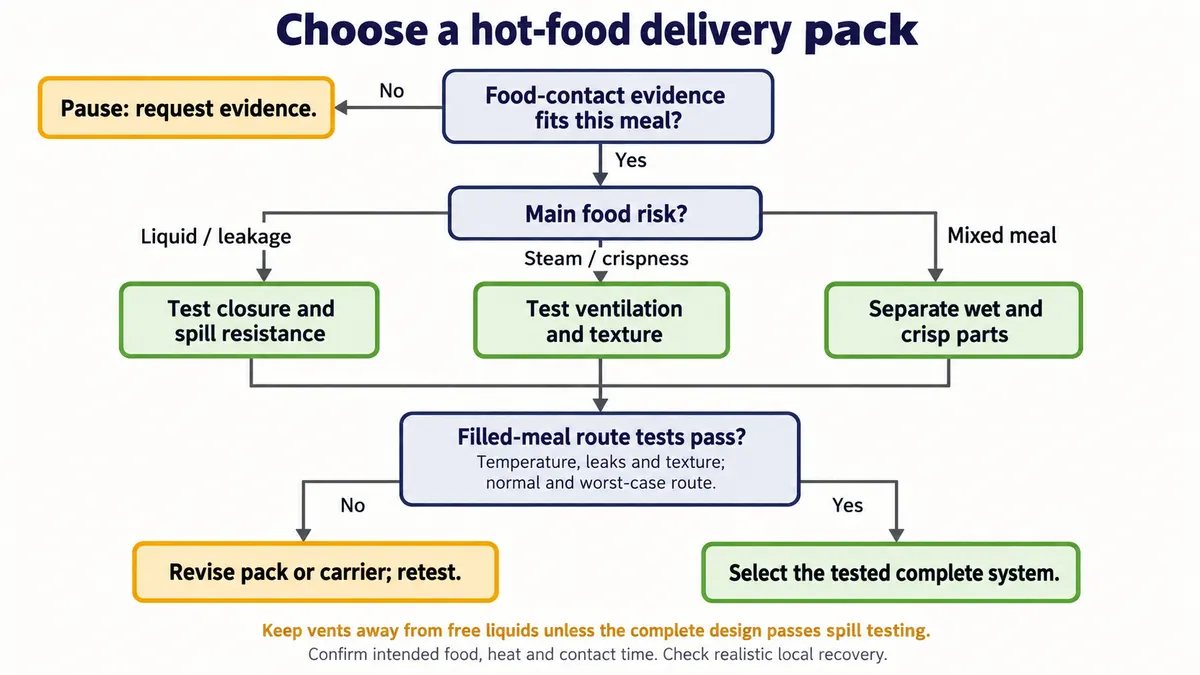
Venting Protects Crispness But Can Release Heat
Fried chicken, chips and goreng items create a different buying decision from curry or soup. A tightly sealed pack may retain heat but trap steam, allowing moisture to soften the coating.
Vents can release moisture, but they may also reduce heat retention or allow sauce to escape when badly positioned. A raised floor can help keep food away from condensed moisture collected at the bottom.
In one delivery-carton design trial, a raised floor and vents were assessed during 20 minutes in an insulated bag. The design used controlled airflow to balance heat retention and moisture removal. This is a useful design example, not proof that every vented fibre container will perform the same way.
Compare vented and unvented samples using the actual fried item, travel time and delivery bag. Prioritise containment for wet meals and controlled moisture release for foods where crispness matters.
Food-contact Evidence Must Cover The Intended Use
Food contact safe containers for hot meals should be treated as a documented, use-specific requirement. Colour, texture and a “natural” appearance cannot establish food-contact suitability.
Migration assessment should reflect the intended food type, maximum temperature, contact duration and relevant food simulants or representative conditions. Documentation for dry bakery use may not cover oily or acidic food held hot for an extended period.
Malaysian food-packaging provisions prohibit packaging, utensils or containers that release, or may release, poisonous, damaging or deteriorative substances into food or assist food deterioration. Food-transport conditions must also protect food from harmful microbial growth and deterioration.
Procurement teams should keep three checks separate:
- food-contact suitability of the finished pack;
- physical performance during holding and delivery; and
- operational temperature control for the meal.
Ask whether the declaration identifies the exact SKU, food types, temperatures and contact periods covered. Confirm that it includes the lid, barrier, coating and printing as supplied, and that it is current, attributable and issued by a competent party.
All Malaysian legal, food-contact and safety wording should receive human review before publication or procurement approval. The reviewer should record the provisions and effective dates checked.
PFAS-free And Compostable Are Separate Claims
PFAS-free food containers are not automatically resistant to oil, water or heat. PFAS were historically used as grease-proofing agents in paper food packaging because they can provide grease, oil and water resistance.
In the United States, those grease-proofing uses were phased out of the market, and the related authorisations ceased to be effective in January 2025. This is regulatory context from another market, not Malaysian law.
Alternative barriers still require performance and food-contact verification. Research into lignocellulosic coatings continues partly because replacing PFAS while retaining useful oil and grease resistance is a technical challenge.
Compostable fibre food containers also require product-level evidence. Fibre content alone does not establish that the finished item is compostable because coatings, additives, inks, adhesives and labels can affect the result.
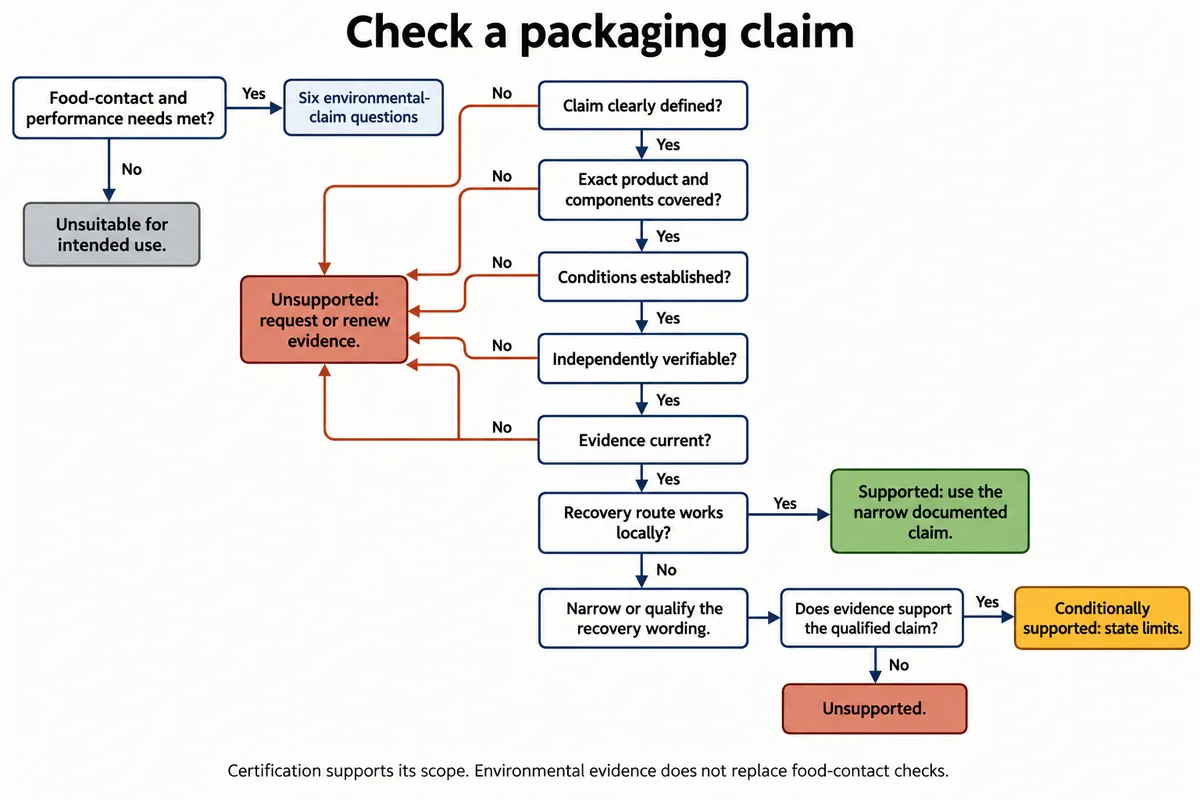
Certification programmes may evaluate finished products against stated compostability standards and fluorine limits. Such certification is not automatically a Malaysian legal requirement, and it does not guarantee that an appropriate collection or treatment route exists in the buyer’s service area.
Verify the claimed standard, certificate holder, exact SKU, validity date and intended composting conditions. Then check the actual recovery route separately before making an environmental claim.
A Minimum Viable Kitchen-and-delivery Trial
Use the following screen when comparing moulded fibre takeaway containers. It is a low-cost operational check, not a replacement for supplier documentation, laboratory testing or regulatory assessment.
Test the most demanding categories the business genuinely sells: dry bakery food, oily fried food, a moist rice or mixed meal, and curry, gravy or soup only when the pack is intended for free liquids.
- Record the exact base-and-lid SKU, sample source and lot where available.
- Standardise the maximum normal portion by weight or serving method.
- Measure the food temperature immediately before filling.
- Close the pack exactly as staff would during service.
- Hold it for the longest credible dispatch and delivery window.
- Stack it at the maximum normal height in the actual bag or catering crate.
- Reproduce normal movement, short tilts and routine handling.
- Inspect at set intervals for staining, seepage, rim distortion, closure opening, base sag, delamination, odour and food-quality changes.
- Repeat the trial enough times to expose inconsistent results.
A practical pass requires no liquid escape, no loss of safe handling strength and no closure opening. Food temperature and quality must remain acceptable under the business’s separate operating controls, with no unexplained odour, taste transfer or visible material breakdown.
Do not approve a pack from one successful sample.
Procurement Scorecard For Shortlisted Products
| Requirement | Supplier evidence requested | In-house check | Pass condition | Unresolved risk |
|---|---|---|---|---|
| Maximum use temperature | Exact SKU limit and test conditions | Fill at the highest normal temperature | No unsupported claim or structural failure | Limit may not cover long exposure |
| Hot-water resistance | Temperature, duration and test method | Test the wettest intended meal | No penetration or unacceptable softening | Condensation may differ in delivery |
| Oil and grease resistance | Oil type, temperature and holdout time | Use the oiliest menu item | No unacceptable staining or weakening | Mixed sauces may behave differently |
| Free-liquid suitability | Whole-pack liquid test, including lid | Hold and move the intended soup or curry | No seepage through base, rim or closure | Pack may require level transport |
| Verified contact time | Maximum stated duration | Test the longest credible journey plus margin | Evidence and trial cover the service window | Customer delay may extend contact |
| Portion load and base rigidity | Load or application guidance | Fill with the maximum normal portion | Base remains safely supportable | Heat may reduce stiffness over time |
| Closure and leak performance | Closure design and complete-pack test | Tilt and move the closed pack | Lid remains engaged without liquid escape | Staff closure consistency may vary |
| Stackability during transport | Recommended stack height and load | Stack in the actual delivery bag | No collapse, sliding or lid release | Road movement and mixed pack sizes |
| Venting and food-quality effect | Vent design and intended food use | Compare actual food in vented and closed packs | Acceptable heat, moisture and containment | One design may not suit wet and fried foods |
| Food-contact documentation | Current declaration for the finished SKU | Match SKU, lid, coating and intended use | Document covers food type, time and temperature | Incomplete scope or outdated evidence |
| PFAS-related claim scope | Claim definition, test basis and exact SKU | Check wording against supplied evidence | Claim is specific and independently reviewable | Claim does not prove barrier performance |
| Compostability claim and recovery conditions | Standard, certificate, SKU and validity date | Check local collection and treatment route | Product evidence and recovery conditions align | Certified item may still lack a local route |
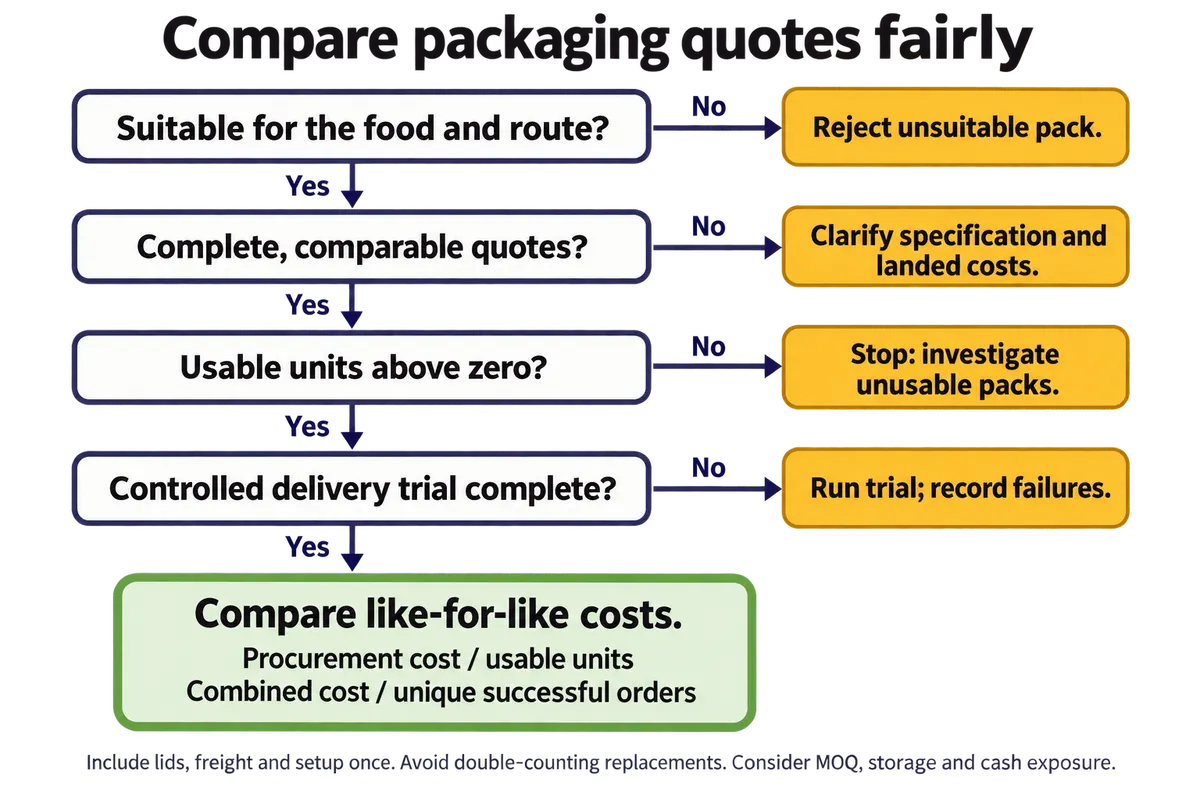
| Unit cost, case quantity, MOQ and supply consistency | Written quotation, lead time and change policy | Calculate cost per served meal and storage need | Commercial terms fit demand and operations | Formulation or supply changes may affect results |
Make The Decision From Evidence And Service Trials
Classify each shortlisted product clearly:
- Suitable: documented conditions cover the intended use and the operational trial passes consistently.
- Conditionally suitable: the pack works only for stated foods, temperatures, durations or delivery formats.
- Not yet verified: marketing claims exist, but documentation or realistic trials remain incomplete.
- Unsuitable: leakage, structural loss, closure failure or documentation gaps create unacceptable risk.
Choose moulded fibre containers for hot food only where product-level evidence and real-service trials cover the menu and journey. The strongest decision is usually conditional and SKU-specific, not a blanket approval of all moulded fibre food containers.
Apply the scorecard to two or three shortlisted SKUs and request missing specifications before placing a volume order. For fibre-source context, review the Bagasse Food Packaging guide. Businesses that need a neutral structure for comparing samples can also use the Contact page as an optional next step.
Frequently Asked Questions
Can Every Moulded Fibre Container Hold Soup Or Curry?
No. Free liquids expose the base, rim and closure to sustained pressure, while curry may challenge both water and grease barriers. Use only an exact SKU with suitable documentation and a successful hot-liquid trial.
Is PFAS-free Packaging Automatically Oil Resistant?
No. Removing one class of grease-proofing chemistry does not prove that the replacement barrier provides adequate oil resistance. Verify performance at the intended temperature and contact time.
How Long Should A Hot-meal Container Be Tested Before Purchase?
Test for the longest credible period from filling to customer opening, plus a modest operational margin. Include dispatch delay, rider collection, travel and likely customer delay.
Does Compostable Mean The Container Will Be Composted In Malaysia?
No. Product-level compostability evidence and access to a suitable collection and treatment route are separate matters. Check both before making a disposal or environmental claim.
Should Fried-food Containers Be Vented?
Often, controlled venting can help release moisture and protect crispness, but it may reduce heat retention. Compare vented and unvented packs with the actual food, delivery time and bag.
References
- Per- and Polyfluoroalkyl Substances in Food Packaging Alternatives Assessment
- Advances in Research of Molded Pulp for Food Packaging
- Solenis Contour Oil & Grease Resistant Technology
- US FDA — Authorized Uses of PFAS in Food Contact Applications
- USDA Agricultural Research Service — Developing Novel Food Packaging Applications Using Lignocellulosic Material
- Ministry of Health Malaysia — Food Packaging Provisions under the Food Regulations 1985