FoodPackLab Editorial Team
Industrial Vs Home Compostable Packaging In Malaysia: A Buyer’s Checklist
For Malaysian F&B owners and packaging procurement teams, the answer is simple: industrial vs home compostable packaging should be chosen according to the collection and composting route that will actually receive the used pack. The strongest-looking environmental claim is irrelevant if the packaging ends up in mixed waste or reaches a facility that will not accept it.
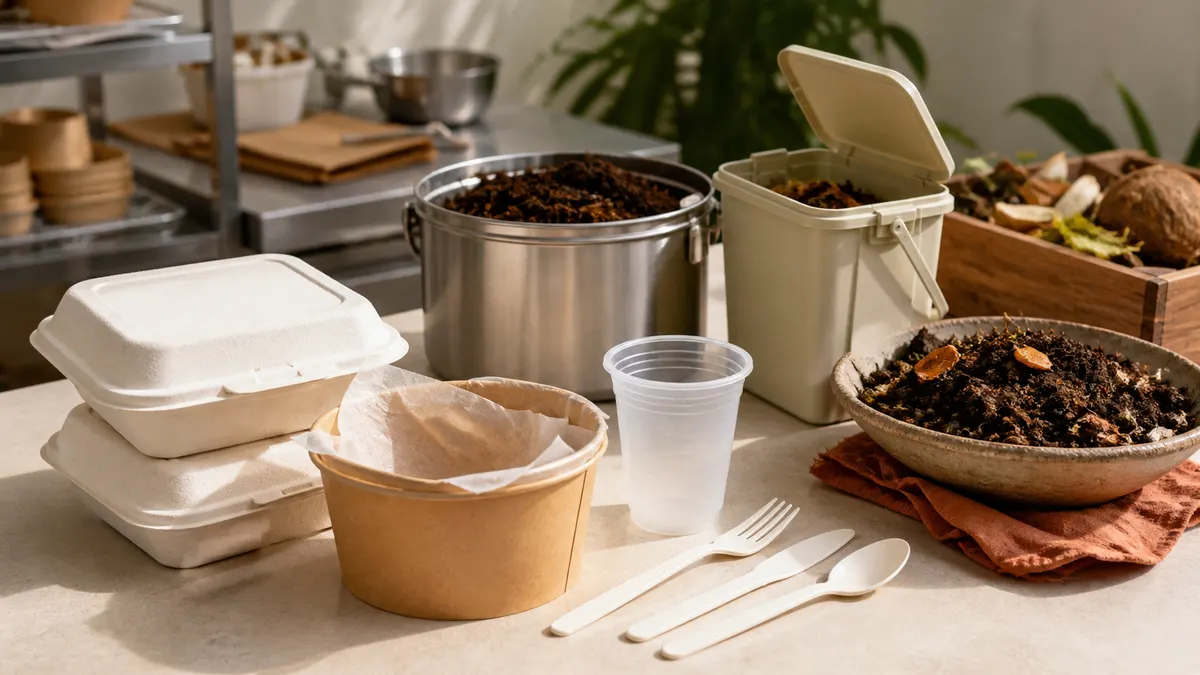
For Malaysian F&B owners and packaging procurement teams, the answer is simple: industrial vs home compostable packaging should be chosen according to the collection and composting route that will actually receive the used pack. The strongest-looking environmental claim is irrelevant if the packaging ends up in mixed waste or reaches a facility that will not accept it.
Key takeaway: choose industrially compostable packaging only when a named collector or treatment operator confirms acceptance of the finished item. Consider home-compostable packaging only when users can realistically compost it at home and the finished product has evidence for that specific category.
If neither route exists, a compostable label does not create a useful end-of-life outcome. It may describe performance under specified test conditions, but it does not provide collection, sorting or treatment.
Compostability is also separate from food-contact safety, leak resistance, heat tolerance and day-to-day performance. A pack can have credible compostability evidence and still be unsuitable for hot curry, soup, oily food or takeaway delivery.
At A Glance: What Malaysian F&B Buyers Must Check
- Industrial compostable: choose it only when a named collector and commercial treatment operator accept the exact finished pack.
- Home-compostable: choose it only when the finished pack has separate home-compost evidence and users can realistically maintain a suitable compost system.
- Finished-product scope: verify the container, lid, coating, label, ink, adhesive and maximum thickness or grammage.
- Malaysian requirements: check the applicable product category, current local rules and separate food-contact evidence.
- Operational proof: run a controlled trial before expanding across outlets.
Start With The Recovery Route, Not The Packaging Catalogue
The most useful procurement question is not “Which pack is greener?” It is “Where will this exact pack go after the customer finishes using it?”
Map the answer before comparing materials:
- Identify where the pack will be discarded.
- Identify who will separate and collect it.
- Name the operator that will treat it.
- Confirm that the operator accepts the finished pack, including its lid, label and other attached parts.
- Define the fallback route when sorting or collection fails.
A compostability certificate describes tested conditions. It does not build the waste route needed to reach them.
This distinction matters in Malaysia because the same package can have different outcomes at a catered corporate site, a café, a cloud kitchen or a food-truck event. Control over sorting and collection often matters more than the material claim printed on the pack.
Industrial And Home Composting Are Different Operating Environments
Industrial Composting Uses Managed Conditions
Industrial composting facilities manage temperature, moisture, aeration, microbial activity and processing time. Industrial-compostability testing is generally designed around controlled conditions at approximately 55–60°C.
Those conditions can support faster biodegradation and physical disintegration than an ordinary household heap. Packaging certified only for industrial composting should not be placed in a garden or home compost system on the assumption that the result will be the same.
Home Composting Is Cooler And Less Predictable
A household compost system normally operates at lower and less constant temperatures. Its performance can change with heap size, rainfall, moisture, turning frequency, the balance of green and brown material, and the user’s maintenance.
Home-compostable does not mean that an item disappears quickly in any garden, soil, drain, roadside or landfill. It describes performance under a defined home-compost test, not permission to litter or dispose of the pack anywhere.
| Buyer question | Industrially compostable | Home-compostable |
|---|---|---|
| Intended setting | Managed commercial facility | Properly maintained household compost system |
| Typical temperature | Controlled, approximately 55–60°C | Lower and more variable |
| Collection needed | Usually yes | Not where the user composts it correctly at home |
| Testing duration | Generally shorter | Generally longer |
| Does industrial certification prove home compostability? | No | Separate evidence is required |
| Is acceptance automatic? | No; ask the collector and operator | No; actual household conditions still matter |
Why Certification Categories Are Not Interchangeable
An industrial-compostability certificate does not establish home compostability. Commercial-only and commercial-and-home certification are separate categories because the temperature, time and biological conditions are different.
The testing timeframes show how substantial that difference can be. Disintegration testing takes at least three months for commercial composting and six months for home composting. Biodegradation testing takes at least six months commercially and twelve months at home.
These are certification-testing periods. They are not a promise that every pack will disappear within the same period in a restaurant’s waste system or a customer’s compost heap.
Searches for home compostable packaging Malaysia may produce many products described as compostable, biodegradable or plant-based. Those words alone do not establish the certification category, applicable standard or scope of the finished product.
Ask the supplier to state whether the claim is industrial, home, or both. If the answer remains vague, treat the evidence as incomplete.
What Recognised Test Evidence Should Demonstrate
Four Assessment Areas For EN 13432 Compostable Packaging
EN 13432 is a recognised reference for assessing the industrial compostability of packaging. Its relevance to a Malaysian purchase still depends on applicable local requirements and whether the intended receiving facility accepts the product.
The assessment covers four different areas:
- Biodegradation: microorganisms convert the material under specified test conditions.
- Disintegration: the item physically breaks down so unacceptable fragments do not remain.
- Ecotoxicity: the resulting compost does not harm plant growth under the test.
- Heavy metals: restricted content remains within specified limits.
The relevant biodegradation assessment requires at least 90% biodegradation within six months. That is a useful proof point, but it does not demonstrate breakdown in litter, ordinary soil, seawater, a drain, landfill or a home compost heap.
A Certificate Has Boundaries
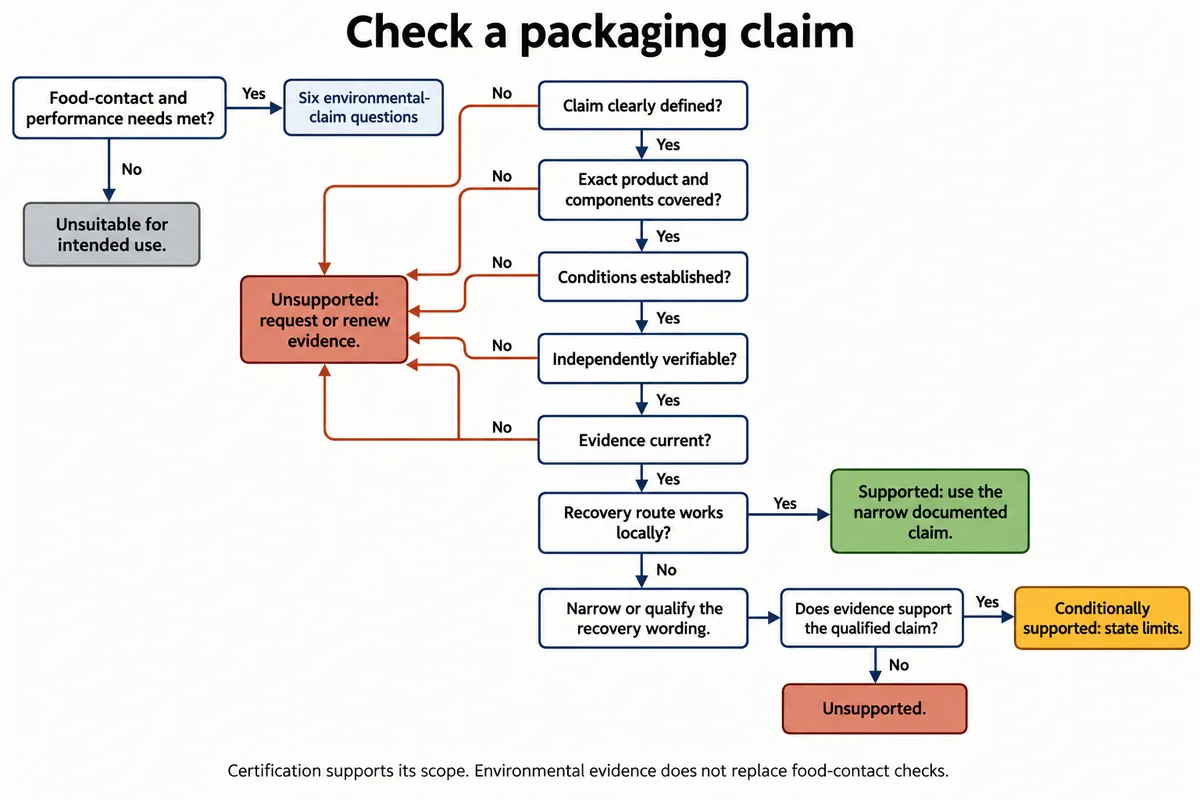
A catalogue logo is not enough. Request the certificate or independently verifiable product listing and check:
- The named standard and certification programme.
- The certificate holder and certificate number.
- The current validity status.
- The certified product name and construction.
- Whether the category is industrial, home, or both.
- Any limits on thickness, grammage, colour, coatings or additives.
Certification rules and validity can change. Record the date on which the certificate and programme rules were checked rather than keeping an undated screenshot in the procurement file.
Verify The Finished Pack, Not Only Its Raw Material
Finished product compostability certification matters because disintegration depends on the material and the pack’s final form. A certificate for a resin, coating, sheet or film does not automatically cover every cup, lid, liner, pouch, tray or laminated food box made from it.
Thickness and grammage can determine the maximum form covered by certification. A thicker pack may take longer to disintegrate and can fall outside the tested scope even when its base material is unchanged.
| Evidence supplied | Buyer interpretation |
|---|---|
| A resin supplier’s certificate with no link to the purchased item | Weak evidence for the finished pack |
| A certificate or approved-product listing naming the finished item, construction and maximum thickness or grammage | Stronger product-level evidence |
Review every component: the main container, lid, transparent window, barrier coating, liner, adhesive, ink, label and attached cutlery. Each component can have a different material, supplier and certification status.
For example, a moulded bowl may be covered by a finished-product certificate while its separately sourced lid is not. Disposing of the assembled pack as one item would then introduce an unverified component into the composting route.
Changes also matter after approval. A new gauge, coating, colourant or material supplier may move the purchased item outside the tested construction. Procurement controls should require the supplier to declare relevant changes before delivery.
Collection And Facility Acceptance Determine Whether The Claim Is Useful
Map The Complete Route
The required chain is customer or outlet sorting, separate collection, transport, an accepting treatment operator and a compatible composting process. Missing any link can change the end-of-life result.
Compostable food packaging disposal should follow an organic-waste route only when the service provider explicitly accepts the item. Compostable packaging should not be placed in an ordinary plastics-recycling stream, where it can be treated as contamination.
Landfill is not a substitute for composting. It does not reproduce the controlled temperature, moisture, aeration and processing conditions used for certification.
Certification Does Not Force An Operator To Accept The Pack
Compostable packaging collection and facility acceptance are separate checks. An operator may reject a certified pack because its process uses a shorter retention time, cannot handle the item’s form, or cannot reliably distinguish it from conventional plastic.
Lookalike conventional plastics create a practical contamination risk. Some operators therefore exclude compostable packaging even when the packaging has credible technical evidence.
Obtain written confirmation covering:
- The specific product or packaging category accepted.
- The certification category recognised by the operator.
- The policy for food residue.
- Whether lids, liners, labels and mixed components are accepted.
- Required bins, bags, signs and sorting procedures.
- The geographic area covered by collection.
- What happens when a load is rejected.
Written acceptance is stronger than a supplier’s general statement that the pack is “suitable for commercial composting”. The treatment operator controls the receiving gate.
Apply The Collection Question To Malaysian F&B Operations
Industrial compostable packaging Malaysia is primarily an infrastructure and service-route question. Material specifications matter, but they do not establish that separate collection and compatible treatment are available for a particular outlet.
Organic treatment can involve vermicomposting, windrow composting, aerated static piles, in-vessel composting or anaerobic digestion. The existence of one of these processes does not prove that its operator accepts compostable packaging.
Temperature, retention time, preprocessing and contamination controls vary. Buyers need confirmation from the intended operator rather than a broad assumption about “organic waste facilities”.
Control Changes By Business Model
- Closed-site catering: a workplace, campus or private event may offer controlled bins, trained staff and a contracted collection route.
- Takeaway café: the business may lose control of a cup and lid as soon as the customer leaves.
- Cloud kitchen: technically compostable delivery packaging may enter household mixed waste if no separate route is available.
- Food-truck event: a dedicated organics route may work only when the organiser, collector and processor coordinate accepted items and bin controls.
Controlled venues are often more workable starting points than dispersed takeaway sales. They make it easier to train users, inspect contamination and trace rejected loads.
Do not assume that acceptance or collection coverage is available nationwide. Both are time-sensitive and should be confirmed for the actual operating locations before a purchase commitment.
Check Malaysian Standards And Food-contact Obligations Separately
Match The Evidence To The Malaysian Product Category
Compostable packaging certification Malaysia should be treated as a document-checking exercise, not a label assumption. Malaysia lists SIRIM ECO 001:2018 for biodegradable and compostable plastic and bioplastic products, while SIRIM ECO 009:2019 covers biodegradable and compostable biomass products.
Under the SIRIM compostable packaging standards, buyers should first distinguish a plastic or bioplastic pack from a biomass-based fibre item. The relevant evidence may differ by category and intended market.
A 2022 Putrajaya enforcement report stated that permitted biodegradable food-packaging products there had to be biodegradable and compostable and recognised under SIRIM ECO 001:2018 or SIRIM ECO 009:2019. This local example should not be treated as proof that one identical rule applies nationwide.
Before publishing a regulatory conclusion or issuing a purchase order, check the current position with the relevant Malaysian authority and record the effective or access date. Venue rules, tenders and local requirements may also impose conditions beyond a supplier’s general claim.
Compostability Does Not Establish Food-contact Safety
Compostable packaging food contact safety Malaysia is a separate procurement gate. Regulation 27 of Malaysia’s Food Regulations 1985 prohibits packaging, utensils and containers that release or may release poisonous, harmful or deteriorative substances into food.
A compostability test does not replace food-contact evidence for the intended food, temperature and contact duration. Ask for evidence applicable to the whole finished pack, including coatings, inks and adhesives.
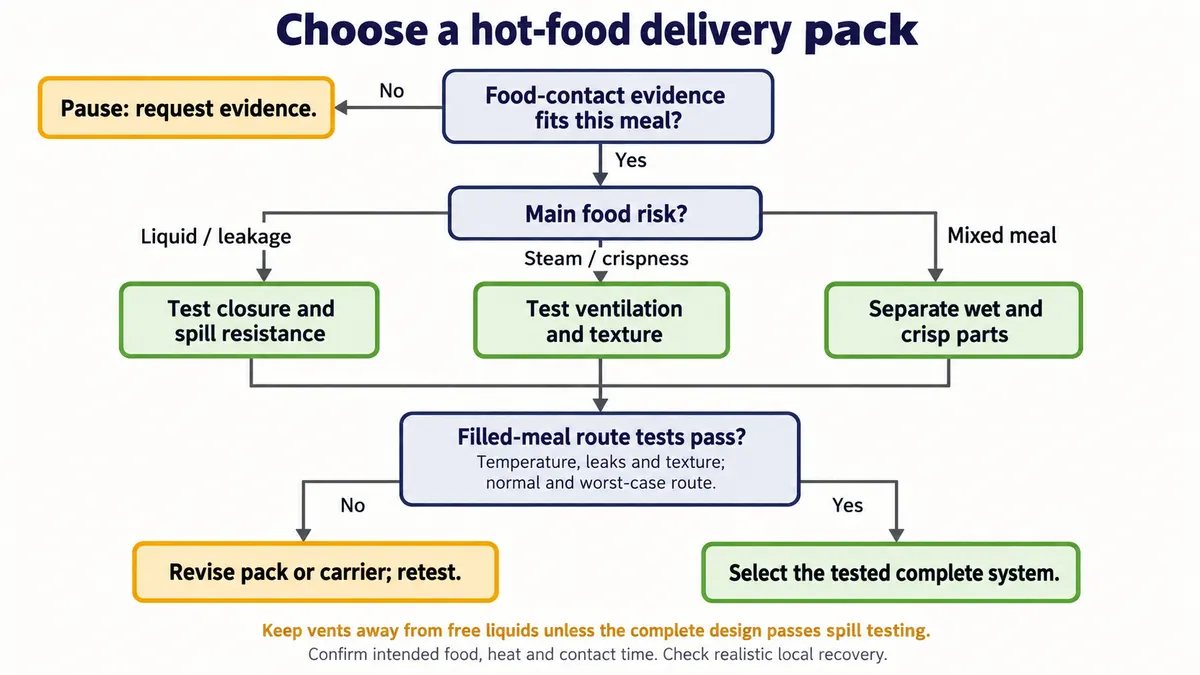
Check the real use case. Hot curry, soup, oily fried food, nasi lemak, bakery items and takeaway drinks can expose packaging to different combinations of heat, oil, moisture, acidity and holding time.
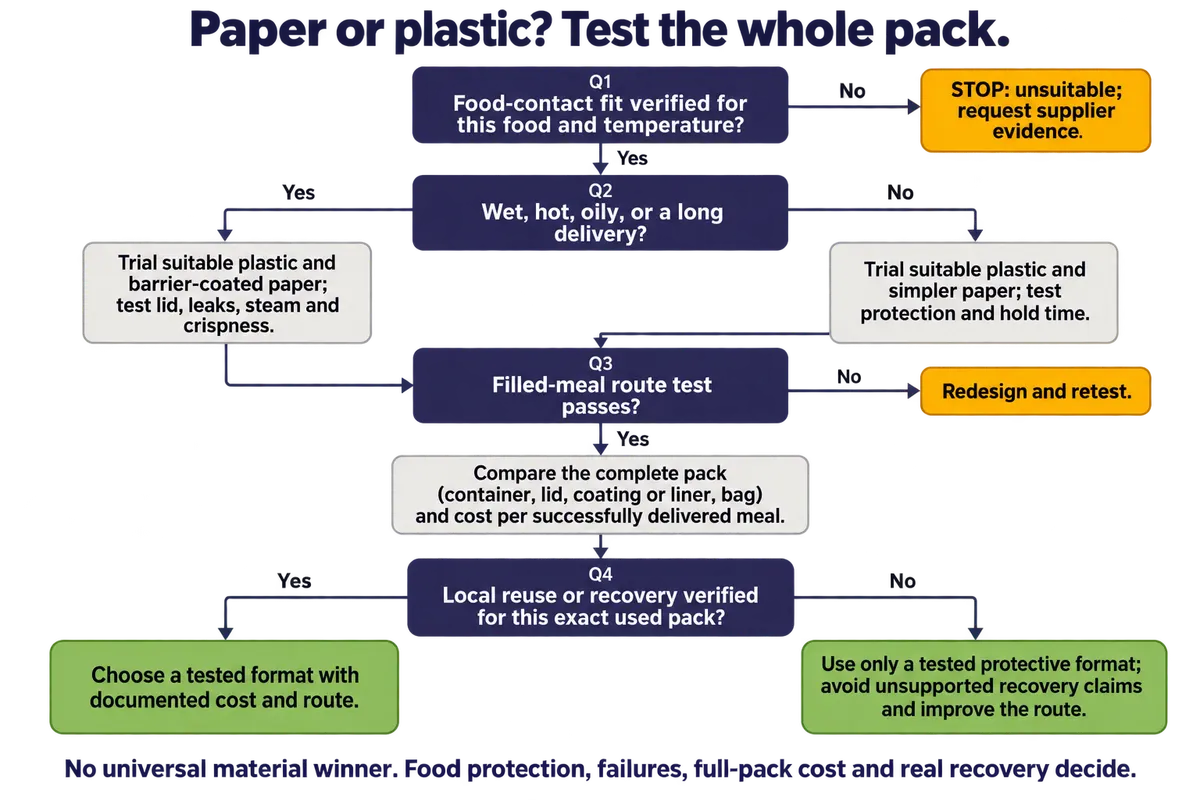
Food-contact documentation also does not prove operational performance. Run a limited trial for leaking, softening, sealing, stacking, transport and realistic delivery hold times.
Buyer Checklist Before Issuing A Purchase Order
Recovery-route Questions
- Where will the packaging be discarded after use?
- Who will separate and collect it?
- What named facility will treat it?
- Has that operator accepted the exact finished product in writing?
- Is the route available at every outlet or only at selected sites?
- What is the fallback route when sorting or collection fails?
Certificate Questions
- Is the claim industrial, home, or both?
- What standard and certification programme support it?
- Is the certificate current and independently verifiable?
- Does it name the finished package rather than only a raw resin, sheet or film?
- Does the purchased thickness or grammage fall within the certified maximum?
- Are the lid, liner, label, coating, adhesive and ink covered?
Malaysian Compliance And Use Questions
- Is SIRIM ECO 001:2018 or SIRIM ECO 009:2019 relevant to the product category and intended market?
- Are there current requirements from the relevant local authority, venue, customer or tender?
- Is there separate food-contact evidence for the intended food, temperature and holding time?
- Has performance been checked for heat, oil, liquid, sealing, stacking, transport and delivery hold time?
- Are cost, minimum order quantity, storage conditions and supply continuity acceptable?
| Evidence available | Buying interpretation |
|---|---|
| Supplier says “biodegradable” with no named evidence | Insufficient |
| Industrial certificate for raw resin only | Insufficient for the finished pack |
| Finished-pack industrial certificate but no accepting collection route | Technically relevant evidence, but a weak practical end-of-life case |
| Finished-pack home certificate but customers are unlikely to compost correctly | The claim may be valid, but the operational outcome remains uncertain |
| Finished-pack certificate, separate food-contact evidence and written operator acceptance | A stronger basis for a controlled trial |
Run A Controlled Trial Before Scaling
A technically credible pack can still fail because customers use the wrong bin, staff combine lids and containers incorrectly, collection is inconsistent or the operator rejects contaminated loads.
Start with one controlled outlet, event or catering site. Record the selected product, certificate scope, component construction, bin instructions, collection provider, accepting facility and fallback disposal route.
During the trial, measure:
- The share of packs placed in the correct bin.
- The type and frequency of contamination.
- Missed or rejected collections.
- Operator acceptance of actual loads.
- Leaks, deformation and service failures.
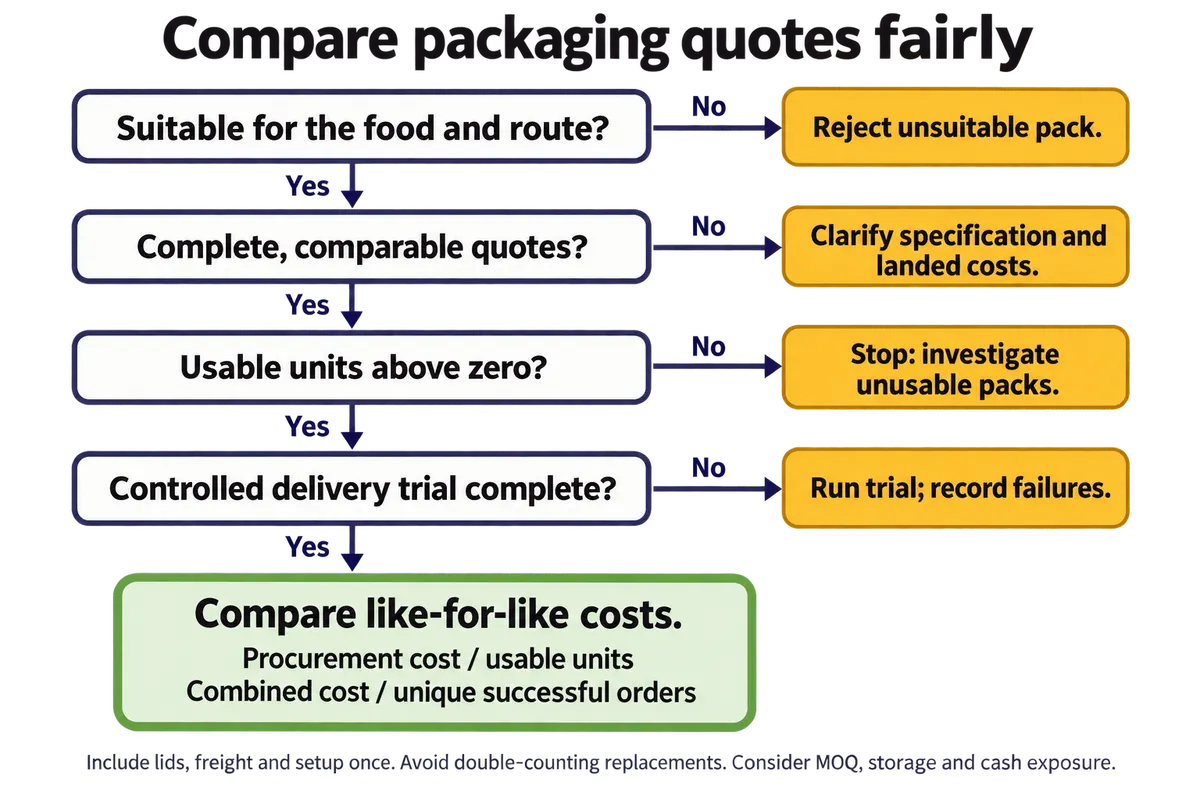
- Cost per usable pack and cost per successfully collected pack.
The last measure can reveal a hidden difference. A higher-priced pack with a functioning route may have a stronger practical case than a cheaper compostable pack that consistently enters mixed waste.
Use FoodPackLab’s eco food-packaging guides to explore related buying questions, compare packaging materials for different food uses, or request a packaging evidence checklist for supplier comparisons.
Common Buyer Questions
Can An Industrially Compostable Pack Go Into Home Compost?
Not on the strength of an industrial certificate alone. Home composting requires separate evidence because it uses cooler, less consistent conditions and longer testing periods.
Does “plant-based” Mean Compostable?
No. Feedstock and end-of-life performance are different questions. Ask for the named certification category, standard and finished-product scope.
Can Compostable Packaging Go Into Plastics Recycling?
It should not enter an ordinary plastics-recycling stream. It should enter an organic-waste route only when the collector and treatment operator explicitly accept the finished item.
Does Certification Guarantee Acceptance By A Malaysian Facility?
No. Certification provides evidence under defined test conditions, while each operator controls what enters its process. Obtain written acceptance for the specific pack and all attached components.
Is Home-compostable Always The Safer Choice When No Industrial Route Exists?
No. It is useful only when the finished pack has suitable home-compost evidence and users are realistically able and willing to maintain a compost system. Otherwise, the claimed end-of-life route may remain theoretical.
The Correct Choice Starts With The Receiving Environment
The correct industrial vs home compostable packaging decision begins with the real receiving environment, not the label on a supplier quotation.
Use three procurement gates:
- The finished product has current evidence for the claimed composting category.
- A realistic collection and treatment route accepts that exact product.
- Separate Malaysian food-contact and applicable compliance evidence is available.
If one gate is missing, record the gap instead of assuming the other two compensate for it. Compostability, collection and food-contact suitability answer different questions.
Use the checklist to compare supplier submissions, then obtain written confirmation from the relevant Malaysian authority, certification body, food-safety reviewer and waste operator where required. Begin with a controlled trial and review sorting quality and operator acceptance before expanding to more outlets.
References
- TÜV AUSTRIA — OK compost HOME
- Biodegradable Products Institute — Compostability Certification
- Biodegradable Products Institute — Get Your Compostable Product Certified
- European Commission Knowledge for Policy — Biodegradability
- European Commission — EU Policy Framework on Biobased, Biodegradable and Compostable Plastics