FoodPackLab Editorial Team
How To Choose Food Packaging In Malaysia: A Product Requirements Checklist
If you are deciding how to choose food packaging, start by recording what the food contains, how hot or cold it will be, how long it stays in contact with the pack, how it will travel and where the used pack will actually go. This method is for Malaysian restaurant operators, cafes, cloud kitchens, bakeries, caterers, food trucks and procurement teams that need packaging to perform under real service conditions.
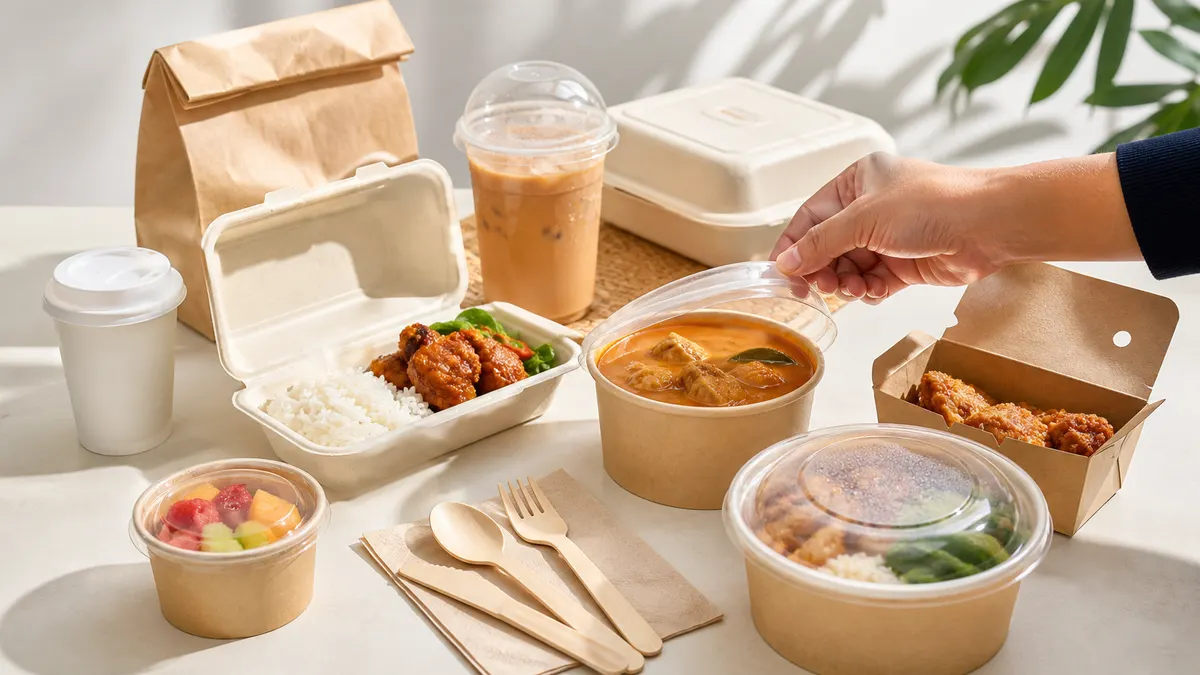
If you are deciding how to choose food packaging, start by recording what the food contains, how hot or cold it will be, how long it stays in contact with the pack, how it will travel and where the used pack will actually go. This method is for Malaysian restaurant operators, cafes, cloud kitchens, bakeries, caterers, food trucks and procurement teams that need packaging to perform under real service conditions.
This guide explains how to choose food packaging in Malaysia by checking food-contact evidence, material compatibility, temperature limits, leak resistance, transport performance, operating cost and the real disposal route.
The key takeaway is simple: work backwards from the food and its full journey. Define the most severe use condition, remove incompatible options, test the complete packaging system and compare costs only among packs that pass.
Packaging should be selected from the product backwards, not from the catalogue forwards.
Start With The Food And Its Full Journey
A material name is not a specification. Two packs made from broadly similar materials can have different coatings, wall thicknesses, seams, lids and documented use limits.
A pack that works for a dry pastry may fail with hot curry. A container that survives ten minutes on a counter may soften, leak or lose its lid during a one-hour delivery.
Use this sequence when deciding how to choose food packaging:
- Define the food and normal portion.
- Map filling, holding, delivery, storage and reheating conditions.
- Remove packs that lack relevant documentation or are incompatible with those conditions.
- Test the container, lid and complete transport system with the real product.
- Compare total cost among the options that pass.
- Check the actual collection, reuse, recycling, composting or residual-waste route.
This order prevents a low unit price or broad environmental claim from distracting the buyer from basic suitability.
Build A One-page Product Requirement Sheet
The main food packaging selection criteria should fit on one buyer brief. This gives a supplier defined conditions to answer against instead of inviting a broad statement that a product is “food-safe”.
Information To Record
- Menu item and recipe category
- Portion weight or volume
- Solid, liquid or mixed contents
- Oil or free-fat level
- Moisture, condensation and steam level
- Acidity where relevant
- Normal and maximum fill temperature
- Expected counter, holding and delivery time
- Ambient, chilled or frozen storage
- Thawing, reheating or cooking method
- Stacking, vibration, tipping and rider-bag risks
- Tamper-evidence requirement
- Expected daily and monthly quantity
- Collection, disposal or return route
Copyable Packaging Requirement Sheet
| Requirement | Your specification | Maximum or worst credible condition | Evidence or test needed |
|---|---|---|---|
| Menu item and portion | |||
| Oil, moisture and acidity | |||
| Fill and hold temperature | |||
| Contact and delivery time | |||
| Storage and reheating | |||
| Transport and stacking | |||
| Monthly quantity and MOQ | |||
| Disposal or return route |
Check Food-contact Evidence Before Performance Or Price
Regulation 27 of Malaysia’s Food Regulations 1985 prohibits packaging, utensils or containers that release, or may release, poisonous, damaging or tainting substances into food or assist its deterioration.
Malaysia’s voluntary Food Grade Certification covers materials used during food preparation, processing, packaging, storage, delivery and display. “Food grade” means safe for food contact, but a voluntary certification should not be treated as universal proof for every recipe, temperature or contact period.
The wider preparation, handling, storage, packaging and transportation process is also subject to food hygiene controls. Packaging therefore needs to fit the operating process, not merely the food at the moment it is packed.
The Practical Question Behind Food Grade Packaging Malaysia Searches
Ask: “What evidence applies to this exact container, lid, coating and intended use?”
A certificate for a material family may not answer whether a particular printed, coated or assembled pack is suitable for hot, fatty or acidic food over the intended contact time.
Documentation Checklist
- Exact product name, code and manufacturer
- Food-contact declaration or supporting test documentation
- Food types covered, including fatty or acidic foods where applicable
- Maximum temperature and contact time
- Hot-fill, chilled, frozen, microwave and reheating limitations
- Scope covering the lid, coating, ink and adhesive where relevant
- Certification issuer, covered product, validity date and limitations where certification is claimed
Keep the documents with the approved product code. If a supplier changes the container, lid, coating or manufacturer, review the evidence and trial results again.
Match The Pack To Oil, Moisture And Acidity
Food packaging material compatibility is the relationship between the food’s chemistry, the complete package construction and the actual contact conditions. It cannot be established from appearance or material terminology alone.
Ask Three Screening Questions
- Oil: Can free oil or fat weaken, stain or pass through the material, coating or seam?
- Moisture: Will liquid, condensation or steam soften the pack, reduce stiffness or weaken a joint?
- Acidity: Does the documentation cover direct contact with the acidic food for the intended time and temperature?
Food type, direct contact, temperature, time, humidity, heating, reuse and recycled content can affect migration or physical performance. This is why food packaging for oily foods requires evidence and a filled trial under the intended service conditions.
Practical Menu Examples
- Oily nasi lemak: Check grease resistance at serving temperature and again after the full delivery period.
- Curry: Check oil, acidity, heat, staining, seam strength and lid fit together.
- Soup: Check liquid containment, seal integrity, steam pressure and safe opening.
- Fried food: Balance grease resistance with ventilation because trapped steam can quickly soften the food.
- Moist bakery products: Check moisture transfer, grease contact and display time instead of treating every bakery item as dry food.
Compatibility Screening Matrix
| Food condition | Evidence to request | Common failure mode | Relevant trial condition |
|---|---|---|---|
| Dry food | Food-contact scope and storage limits | Crushing, poor closure or moisture entering | Normal portion, stacking and full storage period |
| Moist food | Moist-food contact, time and temperature scope | Softening, seam weakness or condensation | Filled hold at expected humidity and duration |
| Oily food | Fatty-food scope and coating details | Staining, seepage or loss of strength | Maximum oil contact, temperature and hold time |
| Acidic food | Acidic-food scope for the complete pack | Interaction, tainting or material deterioration | Actual recipe at maximum contact time and temperature |
| Liquid food | Liquid-contact scope plus lid and seal specification | Rim leakage, lid lift or seam failure | Maximum fill, timed hold, tilt and transport |
Define The Complete Time-and-temperature Chain
Food packaging temperature requirements are a chain, not one serving-temperature number. Record every planned stage:
- Filling
- Short-term counter holding
- Delivery or catering transport
- Refrigeration or freezing
- Thawing where applicable
- Reheating or cooking
The documented rating should cover the most severe intended combination of temperature and contact time. A brief exposure to high heat is not the same as a lower temperature maintained for several hours.
Do Not Merge Different Temperature Claims
| Claim | What it may establish | What it does not automatically establish |
|---|---|---|
| Hot-fill suitable | Suitability for a defined filling temperature and duration | Long hot holding, delivery or reheating |
| Suitable for holding hot food | Suitability under specified holding conditions | Microwave reheating or cooking |
| Freezer suitable | Suitability for specified frozen storage | Thawing or heating in the same pack |
| Suitable for microwave reheating | Reheating within stated limits | Cooking, grilling or unrestricted microwave use |
| Suitable for cooking | A defined cooking use where documented | Every appliance, temperature or recipe |
Apply Microwave Instructions Narrowly
Microwave safe food packaging should be used only according to the packaging and appliance manufacturers’ instructions. Some plastic containers can deform or melt because of heat transferred from the food, while metal or aluminium can reflect microwaves, cause uneven heating and potentially damage the appliance.
Record the maximum food temperature at filling and the intended reheating instruction. An empty-pack heat demonstration does not reproduce the heat generated by a real portion.
Test The Actual Portion, Fill Pattern And Shape
A small portion of rice, a deep curry portion and a nearly full soup container do not heat or cool in the same way. Food composition, mass, heating duration, fill depth, distribution and container shape can all affect the temperature experienced by the pack.
Validate reheating with the intended menu item and normal portion. Do not substitute an empty container or water-only trial unless a documented test method specifically requires it.
Simple Heating Trial Record
| Product and batch | |
|---|---|
| Container and lid codes | |
| Portion mass or volume | |
| Starting food temperature | |
| Equipment and settings | |
| Heating time | |
| Final food temperature | |
| Deformation, leakage or odour | |
| Lid and handling observations |
Cooling needs its own process. When rapid refrigeration is required, a large quantity of soup, curry or catering food may need to be divided into suitable wide, shallow containers rather than left in one deep pack.
Set Hold Time For The Complete System
Hold time starts when the food is filled or packed. It ends at consumption, refrigeration or reheating—not when the rider reaches the destination.
Separate three decisions:
- Package compatibility: Will the pack remain suitable throughout contact?
- Food quality: Will crispness, texture, condensation and separation remain acceptable?
- Temperature control: Does the complete process meet the business’s approved food-safety procedure?
As a conservative international benchmark, food held beyond two hours should remain above 60°C when hot or at or below 4°C when cold. This benchmark is not a substitute for current Malaysian requirements, qualified food-safety advice or a business-specific control plan.
Do not assume that an insulated bag maintains the required temperature. Measure the complete system, including food quantity, inner packaging, carrier, loading pattern, ambient exposure and delivery duration.
Run A Timed Hold Trial
- Measure at packing.
- Measure again at dispatch.
- Measure at the expected delivery time.
- Repeat at the worst credible delay.
- Record temperature, leakage, condensation, pack strength and food quality at every point.
Design For Leakage, Stacking And Takeaway Transport
Leak proof food packaging is a system-level requirement. It depends on the container, rim, lid or seal, fill level, closing procedure and handling conditions.
A catalogue description or dry, empty test is insufficient. Steam, oil on the rim, overfilling and side-loading can produce a different result.
Transport Risks To Reproduce
- Tipping and side-loading
- Rider-bag vibration
- Stacking compression
- Hot steam and internal pressure
- Condensation around the rim
- Overfilling
- Mixed hot and cold items
- Customer opening and carrying
Small Runnable Transport Test
- Fill the container with the real product at the normal maximum portion and temperature.
- Close it using the normal staff procedure.
- Inspect rim cleanliness, seal position and lid engagement.
- Hold it for the maximum planned contact time.
- Tilt and transport it in the actual secondary bag or carrier.
- Stack it at the expected delivery load.
- Record leakage, deformation, lid movement and food-quality changes.
This is the smallest useful test: it fails visibly when the container-and-lid system does not meet the defined job.
Check Incoming Packaging
Inspect deliveries for cleanliness, damage, dimensional variation and consistent lid fit. Dirty or damaged packaging can introduce microorganisms, fragments or chemicals, while a distorted rim can undermine an otherwise suitable closure.
Compare Operating Cost Only After Unsuitable Packs Are Removed
A useful food packaging cost comparison goes beyond the container’s unit price. The cheapest pack on an invoice can become expensive if it needs double-bagging, slows staff or causes remakes.
Include These Cost Fields
- Container, lid, seal and label
- Minimum order quantity
- Freight and storage space
- Packing time and equipment
- Double-packing and secondary bags
- Leakage, remake, refund and complaint rates
- Portion-control effect
- Waste collection charges
- Reusable return, washing, inspection and replacement
MVP Decision Level
Compare landed cost per completed order among options that have passed the mandatory documentation and operating tests.
Final-product Decision Level
Run a controlled service trial. Compare total cost per successful service, including staff time, failures, extra packing and complaints.
For a reusable system, use this formula:
Total reusable programme cost ÷ completed reuse cycles = effective cost per use
Reusable service ware may consume fewer resources and cost less over its operating life when collection, washing, inspection, return and loss control work in practice. A container purchase without those processes is not a functioning reuse programme.
Match Environmental Claims To The Real Disposal Route
The useful question for sustainable food packaging Malaysia is: “What collection and processing route is available for this exact used item in the customer’s location?”
Material terminology and certification do not create collection infrastructure. A technically recyclable or commercially compostable item may still enter residual waste when no programme accepts it.
Evaluate Routes In This Order
- Reuse: Use it where a workable return, washing, inspection and redistribution system exists.
- Recycling: Confirm that the local programme accepts the exact item and that food contamination can be controlled.
- Commercial composting: Confirm that the exact product is accepted and that collection or hauling is available.
- Residual waste: Record the current route honestly where no verified recovery pathway operates.
Food remains and small item size can reduce recycling performance. Where a programme accepts the item, it generally needs to enter collection without food or beverage remains and according to local preparation rules.
Recycling is an operating system involving separation, collection, preparation and delivery to an appropriate centre or collection point. Composting likewise needs a real reprocessing route.
Record the location, programme, accepted item description and verification date. Recheck acceptance because local infrastructure and programme rules can change.
Use Pass Gates Before A Weighted Score
The final answer to how to choose food packaging is not to give every option a score immediately. First apply mandatory pass-or-fail gates. Scoring an unsuitable pack highly because it is cheap hides the most important failure.
Mandatory Pass Gates
- The exact pack has adequate food-contact documentation.
- The food chemistry is within the documented scope.
- Verified time and temperature limits cover actual use.
- The real portion and reheating method pass the trial where applicable.
- The lid or seal passes the filled transport test.
- The complete hot or cold holding system meets the business’s approved procedure.
Score Only The Options That Pass
| Criterion | Suggested weighting | What to measure |
|---|---|---|
| Food-quality performance | 25% | Texture, moisture, staining, odour and presentation at the end of hold time |
| Transport reliability | 25% | Leakage, lid movement, stacking and deformation |
| Total operating cost | 20% | Landed cost, labour, failures and secondary packing |
| Staff and customer usability | 15% | Filling, closing, carrying and safe opening |
| Verified disposal or reuse pathway | 15% | Actual collection, acceptance and processing route |
Adjust the weighting to the operation. A delivery kitchen may give transport reliability more weight, while an event caterer may prioritise holding, stacking and return logistics.
Versioned Approval Record
| Requirement | Pass/fail threshold | Supplier evidence | Trial result | Owner | Approval date |
|---|---|---|---|---|---|
| Food-contact scope | |||||
| Oil, moisture and acidity | |||||
| Time and temperature | |||||
| Filled transport test | |||||
| Holding procedure | |||||
| End-of-use route |
Assign a version to every approved container-and-lid combination. Changing either component can change fit, heat response and transport performance.
Four Examples Of The Method In Practice
Oily Rice Meal For Delivery
Requirements: Hot filling, oil contact, a 45–60 minute delivery target, stacking and condensation risk.
Tests: Grease resistance, base strength, lid retention, ventilation effect and a rider-bag trial with the normal portion.
Decision: Reject an option if it stains through, softens, opens or traps enough steam to make the meal unacceptable within the defined hold time.
Curry Or Soup Takeaway
Requirements: Hot liquid, possible oil and acidity, side-loading and safe customer opening.
Tests: Seal integrity at the maximum fill line, a timed tilt test, steam behaviour, rim cleanliness and handling temperature.
Decision: Keep only packs with documentation matching the food and use conditions. Compare cost after they pass the filled transport trial.
Bakery And Cafe Service
Requirements: Separate dry, moist, greasy, chilled and hot products instead of relying on one broad bakery specification.
Tests: Moisture transfer, grease staining, condensation, display duration and customer carrying.
Decision: Standardise packaging only where product requirements genuinely overlap.
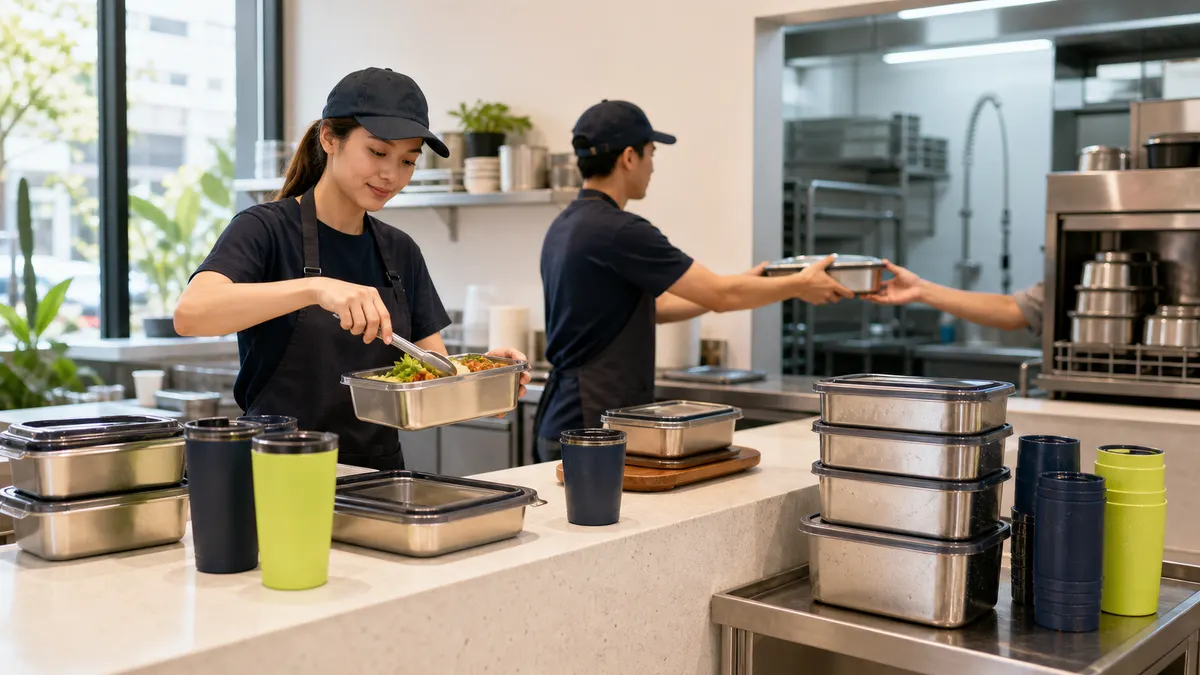
Catering With Reusable Containers
Requirements: Collection, washing, drying, inspection, storage, return rate and replacement stock.
Tests: Run the complete operating cycle and calculate cost per completed reuse.
Decision: Treat reuse as a service system, not merely a container purchase.
Printable Packaging Selection Checklist
- ☐ Define the exact menu item and maximum portion.
- ☐ Record oil, moisture, acidity and liquid content.
- ☐ Record maximum fill temperature and contact time.
- ☐ Map ambient, chilled, frozen and reheating stages.
- ☐ Identify tipping, vibration, stacking and steam risks.
- ☐ Obtain documentation for the exact container and lid.
- ☐ Confirm relevant food types, time and temperature limits.
- ☐ Run a filled hold, tilt, stack and transport test.
- ☐ Measure the complete hot or cold holding system.
- ☐ Compare landed and operating cost among passing options.
- ☐ Verify the actual reuse, recycling, composting or waste route.
- ☐ Record the approval owner, date and pack version.
Frequently Asked Questions
Can One Food Container Work For Every Menu Item?
Sometimes a container can serve several items, but only where the requirements overlap. Differences in oil, moisture, acidity, temperature, portion depth and hold time may require different specifications.
Is A Food-grade Claim Enough For Hot Curry Or Oily Food?
No broad claim should replace exact product evidence. Check whether the documentation covers the complete pack, relevant food type, maximum temperature and intended contact time.
Does Microwave-safe Mean Suitable For Cooking?
No. Reheating and cooking can involve different temperatures, durations and food behaviour. Follow the documented pack limits and appliance instructions for the exact intended use.
How Should A Cloud Kitchen Test A New Takeaway Container?
Fill it with the real maximum portion at normal packing temperature. Hold it for the planned duration, then tilt, stack and transport it using the normal lid-closing procedure, bag and delivery load.
Is Compostable Packaging The Right Choice If Customers Use Normal Rubbish Bins?
Certification alone does not establish collection or processing. If the exact item has no accessible and verified composting route, the likely disposal outcome should be stated honestly.
Make The Next Order A Controlled Decision
A defensible packaging decision begins with the food and operating process. It removes incompatible packs through documentation and filled trials, then compares cost and disposal routes only among options that meet the requirements.
Use the requirement sheet for one high-volume menu item, request evidence for the exact pack and run a filled transport trial before placing a larger order.
For more material-specific context, review the guide to evaluating bagasse food packaging. You can also browse the packaging buyer guides or use the contact page to suggest a purchasing question for future coverage.
References
- Ministry of Health Malaysia — Microplastics and Food-Packaging Provisions
- Ministry of Health Malaysia — Food Grade Certification
- Ministry of Health Malaysia — Food Safety and Quality Programme
- US FDA — Food Types and Conditions of Use for Food Contact Substances
- Food Standards Australia New Zealand — Food Packaging
- US FDA — Chemistry Recommendations for Food Contact Substances